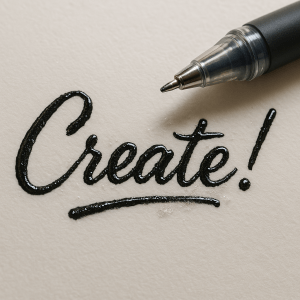
As I write this, I can watch the gel ink dry into the paper behind each new word. Dried into the fibers, permanent. Immortal. Eternal—for as long as the paper exists.
Place this paper in a vault, and the words will live forever. But they will not live. They remain preserved, filed, and recorded. Yet unread, they exist only as part of the vault’s mass. Their weight merely added to the total.
To the living world, the paper does not exist.
The same can be said of us.
We are the ink. As it dries, we move on—the march of time relentless, unpausing, uncaring. Once the ink dries, it is finished. That is our past. Our memories.
And we are also the vault. Every memory exists within us, along with anyone else who experienced it while the ink was still wet. Once we are gone—once those who share our memories are gone—so too is the memory. So too is the ink, the paper, the vault.
And that is life. Our life. Everyone’s life.
There will come a time when even the thought of you is lost. A day when the last person who remembers you will recall your name or your story for the final time. Then you are gone—lost to eternal oblivion.
Clifton Fadiman once said:
“A cheese may disappoint. It may be dull, it may be naive, it may be oversophisticated. Yet it remains cheese, milk’s leap toward immortality.”
Creativity—our art—is our cheese. Write a book, and it may be read forever. Paint, and your strokes may hang long after your heartbeat fades. The internet has become our new Library of Alexandria. Our vault.
In Cosmos, episode eleven, Carl Sagan said—and I’ll never forget it:
“What an astonishing thing a book is. It’s a flat object made from a tree with flexible parts on which are imprinted lots of funny dark squiggles. But one glance at it and you’re inside the mind of another person, maybe somebody dead for thousands of years… Books break the shackles of time. A book is proof that humans are capable of working magic.”
Another favorite of mine, Oscar Wilde, wrote:
“All art is immortal. For emotion for the sake of emotion is the aim of art, and emotion for the sake of action is the aim of life.”
So create. Plant a tree. Paint a picture. Write a story—your story.
Oblivion awaits. But leave something behind that will outlive you—and outlive the memory of those who knew you.
Will you be remembered for it? Maybe. Maybe not. But your creation might.
I wonder if anyone will ever read this. I wonder if anyone will remember it, if they did.
Brian kicked the bass drum. His foot led the pace of the song. The sound transmitted itself through my chest, challenging my heart for dominance. I watched Bob as he fingered a chord, ready to join the song. With the pick in his right hand, he raised it and strummed the strings. At the same time, I did the same. Instantly, I was in a band. Bobby launched into the vocals, enthusiasm pouring through the microphone and amplifier into the room. I stood nearest to my friend, Steve, the bassist.
Steve had introduced me to the band, inviting me to join him on a “Friends and Family” night when acquaintances could join the band onstage. That first night was the thrill of a lifetime. And instantly, I had the bug to do more.
I was nervous before joining them onstage that first night. When I’m anxious, I talk nonstop, trying to defuse the tension with humor. I offered to pay off the bartender to call out “last call” to avoid playing and potentially making a fool of myself. I playfully curse my sister-in-law, Steve’s girlfriend, for making me do this in the first place. Steve told me the three songs I would accompany the band with. I had practiced them incessantly for a week. Then, a few hours before the event, he texted me the songs again. Except they were different! I practiced the new batch until I had to leave. When I arrived at the bar, Steve told me the three songs I would be accompanying the band with. Two were different! I panicked. I had played them before but was not as comfortable with them as I was with the others.
And then something amazing happened. I joined the guys on stage, plugged in my guitar, the song began, and muscle memory took over. I did know the songs well enough to enjoy myself thoroughly. The other member of the band, Joel, is flat-out incredible. He plays the guitar (incredibly well), the violin, bass, and harmonica. There are cover songs the band plays where the original has no violin, and yet Joel can launch into a solo that catches your breath. He did that on one of the songs I was playing. Comfortable enough with the rhythm section I was playing, I found myself mesmerized by Joel’s violin. I thought to myself that I had the best seat in the house. When the song ended, I found myself applauding along with the audience.
The band practices every Monday night. I have not joined them as I am not a member. I can only imagine how fluid the band members become as they feed off of each other while playing, comfortable with their arrangement of any given song and working out any flaws. How powerful and collegial it must be.
In contrast, I have only played with Pink Floyd, The Beatles, The Rolling Stones, P!nk, Green Day, My Chemical Romance, Eric Clapton, and other bands. Well, not really. I play along with songs by these bands, learning chords, strumming patterns, and pretending I can solo.
I learned to play the guitar in college. I’m left-handed, and so was my roommate, Eric. He played and had a couple of guitars. He taught me a few chords, and I fiddled with them, eager to learn. Bill, across the hall, was a major Ozzy fan. More than once, upon returning from class, I would hear Randy Rhodes midway through a classically inspired solo in an Ozzy song, Bill attempting to follow along. Eric was excellent. I was not. I’m still not. I’ve learned many more chords and can play along with hundreds of songs. And that’s fine with me. Playing the guitar is relaxing. I can play along and forget the stresses of life for a while.
As someone who likes to write, the creativity bug bit me hard before playing with the band. Other than learning the circle of fifths, I churned out eight songs in a week without the benefit of any songwriting rules. Some were new, while others were old poems I put to music. I’m sure they are awful. I’ve played them many times in my office, trying to sing along. Learning to play and sing at the same time is a skill. I’m getting there. I have an audience of one, me, who is critical enough. I doubt anyone outside of my house will ever hear these songs.
Playing with the band has been a thrill. All of the guys are very kind and have welcomed me. They are Crazy Pete’s Band. And like Pink Floyd, none of them are named Pete. There’s a story about the name. Something about a character in their town everyone knew. They play every third Wednesday at the Common Pub in Bristol, Rhode Island. They’re great guys, the music is fun, and it’s a good time and even better when you play with them!
“Necessita induce, e non diletto.” (“It is a necessity and not pleasure that compels us.”) – Dante Alighieri, The Divine Comedy, Inferno)
There may be droughts, but ultimately, the artist must create. Left alone, thoughts smolder, and a flame sparks.
The writer must give voice to thought, the artist must give voice to vision, and the singer must give voice to sound. The musician must give voice to the melody. The medium is different; however, the result, sometimes free-flowing, other times tortured, soars.
My daughter showed me a quote sometimes attributed to Ernest Hemingway (though it probably originated with Red Smith, Paul Gallico, or another earlier scribe) that reads, “Writing is easy. You simply sit down at the typewriter, open your veins, and bleed.”
What I write here is the result of the wrestling match inside my head bled onto the page (screen). Writing is, for me, cathartic. I write for me. Just me. I write to exorcise the demons occupying too much real estate inside my little brain. When I am bothered, angry, upset, happy, confused, enamored, penitent, wistful, nostalgic, depressed, disgusted, or (name the emotion), I can often only truly understand how I feel by wrestling with my thoughts on the page.
I am not alone.
“The impulse to write things down is a peculiarly compulsive one, inexplicable to those who do not share it, useful only accidentally, only secondarily, in a way that any compulsion tries to justify itself. I suppose that it begins or does not begin in the cradle.” – Joan Didion, Slouching Towards Bethlehem.
All creative people have this compulsion to understand. The lyricist and musician (sometimes the same person) are restricted far more than me by structure and rhyme, whereas I am only limited by coherence and cadence. So too, the painter, who must become an architect to effectively develop the vision they are compelled to reproduce on canvas.
I am fascinated by the creative process and the different paths inspiration takes through inspired people. These people are heroes to me. Not in the Marvel universe way or celebrity way, but in how they are compelled to produce, driven to evict the vision seen only in their mind and share it with others. I am fascinated when I listen to a piece of classical music and find a story developing inside my head played out by the various instruments. I wonder if that was the composer’s intent or if I’m just nuts.
I write because there is an overwhelming need to sit and purge what is ruminating deep inside. I don’t know what the end result will look like or even where I come down on various topics until I sit, research, and write it down. It is cathartic and oftentimes the healthier vent for sadness, disappointment, or anger.
I have witnessed this process within my own house in different ways. My daughter studied art in college. I watched, sometimes with tears in my eyes and a lump in my throat, as she painted Dorian Gray repeatedly. She reflected the pain she experienced watching her mother die of cancer over many years onto the canvas. Her body image issues spilled onto the canvas. She was compelled to exorcise these thoughts through her art. It pained me and fascinated me to watch. Like me, my son writes. His work is a mélange of Douglas Adams, Rod Serling, Christopher Marlowe, and Ian McEwan. He cloaks analogies in irreverent prose and biting satire. He, too, is compelled to exorcise these thoughts through his art.
“Don’t tell me the moon is shining; show me the glint of light on broken glass.” – Anton Chekhov
Another in our family also has this drive, this compulsion, my niece, Jackie Marchal. I call her my niece because, as my late wife was the only child of two only children, we joked that her family tree was more akin to a creeping vine. Anyway, my late wife’s cousin’s children, ergo my niece! She is a singer, lyricist, and musician. Recently graduating from Columbia after having been raised in NYC, I have witnessed her art mature with each successive song. I admit to not having seen any of her live performances in the city and have only recently focused on her burgeoning portfolio of music.
This past weekend, I worked on finishing a desk and putting on her music while I sanded, stained, and polyurethaned. The first thing that struck me was the effortless fluidity of her voice. Her voice floats. I have no better word for it. Despite not having an empty bourbon glass in my hand, I could almost see her voice floating throughout the garage as the rain beat down outside. I shuffled through many of her songs and then, and only then, listened to the words by playing them a second time. All artists pull from their personal lives. As I listened to the lyrics of each song, I wondered how much of what I was hearing was experienced and how much was storytelling. That may come from knowing the family. I generally don’t consider that when listening to other artists. The pain and the heartache in several of her songs compelled me to sit and write this because I once again saw (heard) the creative process demanding a voice. She is compelled to exorcise these thoughts through her art.
“Such sweet compulsion doth in music lie.” – John Milton, The Complete Poetry
They say stereotypes are often rooted in reality, a caricaturist’s reduction of whole and unique people. The tortured artist is one such trope. And while I often struggle with thoughts and sometimes need to organize them on paper to understand how I truly feel (and sometimes it is a tortuous journey), it is an exercise I cannot do without—no more than my daughter, son, or niece. The artist must create.
For more information on Samantha Thivierge, see her Instagram.
As I write this, I can watch the gel ink dry behind each subsequent word. Dried into the paper, permanently a part of the wood fiber. Immortal, eternal as long as the paper exists. Put the paper in a vault, and the words live forever. There they will remain preserved, filed, recorded, and likely unread.
The same can be said of humans. As the ink dries, we move on. The relentless marching on of time. Relentless. Never ending, never pausing, never caring. Once the ink dries, it is done. It is the past. It is our past. Our memories. We are the vault. And our vault, memories, and existence exist only as long as anyone who experienced something with us or heard a story about us exists. Once we are gone and those who recall us are gone, so are our memories, the ink, the paper, and the vault. That’s life. Our life. Everyone’s life.
There will come a day when the very thought of us as individuals will be lost. There will be a day when the last person who remembers you or recalls a story about you recalls it for the last time. You will be lost to eternal oblivion. Sure, there are individuals whose memory transcends time. Shakespeare, Caesar, Keith Richards, but for most of us, we will be lost to time, just a number in the ever-expanding pile of humans that once existed.
Is there a way to combat this eternal oblivion? Or is this simply an exercise of someone who just celebrated a birthday and is reminded that the road before him is shorter than the view in the rearview mirror? And, let me add that the road before him is neither clear nor guaranteed.
Clifton Fadiman said, “A cheese may disappoint. It may be dull, it may be naïve, it may be over-sophisticated. Yet it remains cheese, milk’s leap toward immortality.” Creativity (the arts) is our antidote, our cheese. Write a book, and it remains available forever. The internet is the newer, better Library of Alexandria. Paint something, sculpt something, and it exists long after you perish.
In episode eleven of Cosmos, Carl Sagan said something I’ll never forget, “What an astonishing thing a book is. It’s a flat object made from a tree with flexible parts on which are imprinted lots of funny dark squiggles. But one glance at it and you’re inside the mind of another person, maybe somebody dead for thousands of years. Across the millennia, an author is speaking clearly and silently inside your head, directly to you. Writing is perhaps the greatest of human inventions, binding together people who never knew each other, citizens of distant epochs. Books break the shackles of time. A book is proof that humans are capable of working magic.”
Another favorite of mine, again, capable of stringing together words far better than I’ll ever dream of, Oscar Wilde said, “All art is immortal. For emotion for the sake of emotion is the aim of art, and emotion for the sake of action is the aim of life.”
So, create! Rabindranath Tagore said, “The one who plants trees, knowing that he will never sit in their shade, has at least started to understand the meaning of life.” So, plant a tree! Paint a picture! Write a story! Write your story! Eternal oblivion awaits us. Leave something behind that outlives you, outlives the memory of the last person to recall you. Will you be remembered for it? Maybe. Maybe not. However, your creation will endure.
As the ink dries on that last word, I wonder if anyone will ever read this. I wonder if anyone will ever remember it if they did read it. Create, people! Our ink is drying!




 Thoughts at Large