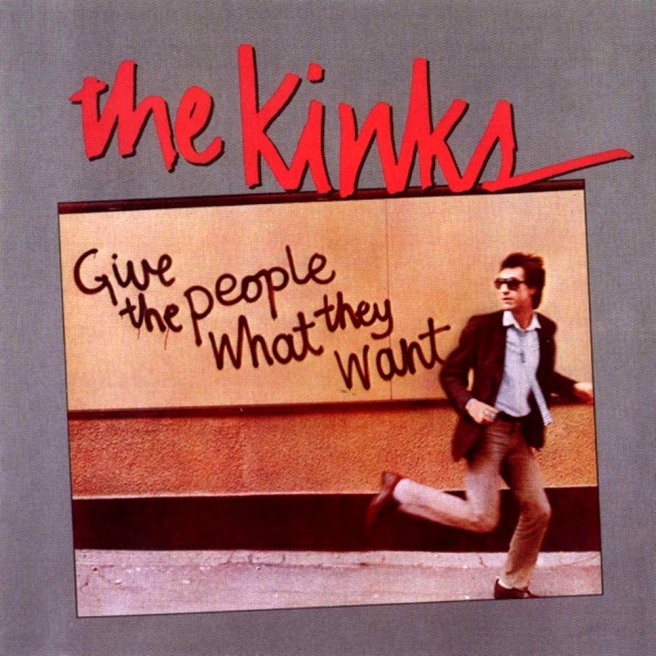
Give The People What They Want

Give The People What They Want

I am many things.

Male

White

Short

Overweight

Middle aged

Married

College educated

New England raised

Living in Texas

A son

A husband

A father

An uncle

A nephew

A friend

An enemy

Blue-eyed

Left handed

Employed full-time

Middle class

Homeowner

Car owner

Non-smoker

Independent

I am all of these things and these are measurable demographics used by all manner of people and organizations in order to sell me things and, in politics, theoretically, represent me.

Having been raised in Rhode Island, I grew up thinking the majority of the country was just like me, white, Catholic, middle class. There were blacks and Jews in school with me, and while they were the minority, I did not treat them any differently, nor did they see me (I hope) as an oppressor. They were my friends and part of my world.

As I grew, I began to see the political landscape of Rhode Island as the basis for the fabric of America. At the same time, I joined the workforce and began to understand Churchill’s remark:

“Show me a young Conservative and I’ll show you someone with no heart. Show me an old Liberal and I’ll show you someone with no brains.”

Rhode Island politics is dominated by trade unions. Democrats control the legislature and the state constitution essentially renders the Governor moot. As I began to bring home part-time, high school student paychecks with deductions to anagrams I did not understand, I began to think like a conservative (Republican). I worked for this money; don’t give it to somebody else. Business drives the economy. Without jobs there are no unions. Ayn Rand would have been very proud. But in retrospect, I think this reaction was more a rebellion against the Rhode Island Democrat mindset and less a political ethos. Taxes were too high, handouts too easy and I did not feel my hard work was being protected in the state house. I was a Conservative with no heart.

As with everybody, as we get older, the world gets smaller. College, just next door in neighboring Connecticut, opened my eyes to other religions. No longer was Catholicism the dominant religion. No longer did liberal tendencies dictate legislation. So, too, were these the days of Ronald Reagan’s trickle-down economy. As a burgeoning economics major, this philosophy made sense and met with my understanding and expectation of things. However, as a college student trying to get loans and seeing my parents struggle to shoulder the weightiest financial burden for two college aged children with a third coming up through the ranks, coupled with the seemingly never ending string of corruption issues emanating from the Reagan administration, my conservative leanings were shaken. Was this a reaction to the financial situation I found myself in? Was it a reaction to the broadening of my understanding of the country and the world? Or was it simply another shift against the grain?

Careers, a marriage and parenthood quickly followed. Once again, I found myself trying to provide for my family and build a career in an economy growing under Clinton’s watch through economic structures established by his Republican predecessors. And once again, living in the Rhode Island Union, I saw the expansion of social programs as a long term detriment to the local economy, but those were heady times and we were all (relatively) happy living on the dotcom bubble. When that burst, and September 11, 2001 hit, Rhode Island was slow to respond to the economic crisis that ensued. Like the rest of the country, I was angry and wanted to strike back at somebody for the evil perpetrated on my neighbors (Boston, from where the flights originated and New York). Following the morally damaged presidency of Clinton, I fell into the political pit warned about by Bertrand Russell when I voted for W:

“Our great democracies still tend to think that a stupid man is more likely to be honest than a clever man.”

I had ascribed FDR’s tenet, “I’m not the smartest fellow in the world, but I can sure pick smart colleagues” to W and assumed he would do the same. Unfortunately, I think Kurt Vonnegut put it best when he said:

“The last thing I ever wanted was to be alive when the three most powerful people on the whole planet would be named Bush, Dick and Colon.”

My wife’s diagnosis with an aggressive breast cancer in 2008 forced us to reevaluate our lives. Because family and her survival weighed so much more over career and home, we picked up stakes and moved to Texas to seek treatment at the University of Texas M.D. Anderson Cancer Center in Houston.

At first, this change of environment seemed to meet my expectations and stereotypes. Southerners were friendly and slower. Northerners were rude and always in a hurry. I ignored the conservative predispositions of Texas even though Texas-bred W took us to war in Iraq over bogus intelligence and OBL and the Taliban hid in the lawless Hindu Kush on the Afghanistan/Pakistan border. And even though Rick Perry, W’s intellectual equal, continued to gut the education system and pilfer jobs from other states, it didn’t matter to me as long as my wife was receiving the best medical treatment. My once expanded understanding of the world didn’t matter to me when my family was suffering.

Then, on December 14th of 2012, while working on my laptop at the hospital while my wife was undergoing restaging tests, news broke of a shooting at an elementary school in Connecticut. I read with horror as first the casualty total rose and then it was reported that children were among the victims. That day, coupled with the local reaction in the following weeks caused a seismic shift in my perception and attitude. No longer was Texas the friendly, slow state with questionable education standards and a job-pilfering, slow-witted governor, now it showed itself to be a gun loving, religious zealot, paranoid, racist, American anachronism. Unfortunately, as time elapsed, I came to understand that this political/religious background was neither limited to Texas, nor the south. “Red” states throughout the country began to show their prejudices, paranoia, fear and hatred. The “Gun Control” debate had ripped the genteel mask of civility off of otherwise, (seemingly) generous people. I saw the people who attended the NRA’s Annual Paranoia Jamboree here in Houston. I argued with them. I argued with the dimwitted grandfather who brought his grandson to a gun control rally in Austin to argue for more gun rights. I was scheduled to debate a state senator, who had introduced a firearm protection act, on television, until he chickened out. I had become a liberal without a brain.

And then it hit me. The Kinks were right!

Why, I asked myself, was I always going against the grain? Why were my political positions always running counter to the culture in which I lived? How could I be represented by people so contrary to my positions? Lightbulb! Ted Cruz was elected by people who were pleased by what he claimed to represent. Louie Gohmert was elected by people who believe what he believes. Steve Stockman was elected by people as deranged as him. And so it is. Give the people what they want.

And so, the reason congress is in a perpetual state of paralysis is because America is in a perpetual state of paralysis. We seek to impose our ideal democratic notion on the rest of the world while ignoring fractures at home. Russian president Vladimir Putin wrote, warning America not to consider ourselves exceptional. George Bernard Shaw wrote,

“Patriotism is, fundamentally, a conviction that a particular country is the best in the world because you were born in it….”

The fact I find most interesting is that Congress has a 19% approval rating, according to Gallup. If we elect representatives who represent our interests and convictions, why is our approval of the job they do so low? At heart, are we not happy with our own convictions? The devil is in the details and it is this process that divorces concept (patriotism and democracy) from reality (legislation and personal responsibility). We cannot give the people what they want because they are not prepared to work for that which they think they deserve.


Syriasly?

chemweapon

Protocol for the Prohibition of the Use in War of Asphyxiating, Poisonous or other Gases, and of Bacteriological Methods of Warfare.  Signed at Geneva, June 17, 1925.

French and English official texts communicated by the President of the Council, Minister for Foreign Affairs of the French Republic.  The registration of this Protocol took place September 7, 1929.

THE UNDERSIGNED PLENIPOTENTIARIES, in the name of their respective Governments :

Whereas the use in war of asphyxiating, poisonous or other gases, and of all analogous liquids, materials or devices, has been justly condemned by the general opinion of the civilised world; and

Whereas the prohibition of such use has been declared in Treaties to which the majority of Powers of the world are Parties; and

To the end that this prohibition shall be universally accepted as a part of International Law, binding alike the conscience and the practice of nations;

DECLARE:

That the High Contracting Parties, so far as they are not already Parties to Treaties prohibiting such use, accept this prohibition, agree to extend this prohibition to the use of bacteriological methods of warfare and agree to be bound as between themselves according to the terms of this declaration.

The High Contracting Parties will exert every effort to induce other States to accede to the present Protocol. Such accession will be notified to the Government of the French Republic, and by the latter to all signatory and acceding Powers, and will take effect on the date of the notification by the Government of the French Republic.

The present Protocol, of which the French and English texts are both authentic, shall be ratified as soon as possible. It shall bear today’s date.

The ratification of the present Protocol shall be addressed to the Government of the French Republic, which will at once notify the deposit of such ratification to each of the signatory and acceding Powers.

The instruments of ratification of and accession to the present Protocol will remain deposited in the archives of the Government of the French Republic.

The present Protocol will come into force for each signatory Power as from the date of deposit of its ratification, and, from that moment, each Power will be bound as regards other Powers which have already deposited their ratifications.

Signed by 138 countries. Signed by United States 6/17/1925. Signed by Syria 12/17/1968

Organisation for the Prohibition of Chemical Weapons

Chemical Weapons Convention

Articles

Article I. General Obligations

1. Each State Party to this Convention undertakes never under any circumstances:

(a) To develop, produce, otherwise acquire, stockpile or retain chemical weapons, or transfer, directly or indirectly, chemical weapons to anyone;

(b) To use chemical weapons;

(c) To engage in any military preparations to use chemical weapons;

(d) To assist, encourage or induce, in any way, anyone to engage in any activity prohibited to a State Party under this Convention.

2. Each State Party undertakes to destroy chemical weapons it owns or possesses, or that are located in any place under its jurisdiction or control, in accordance with the provisions of this Convention.

3. Each State Party undertakes to destroy all chemical weapons it abandoned on the territory of another State Party, in accordance with the provisions of this Convention.

4. Each State Party undertakes to destroy any chemical weapons production facilities it owns or possesses, or that are located in any place under its jurisdiction or control, in accordance with the provisions of this Convention.

5. Each State Party undertakes not to use riot control agents as a method of warfare.

Signed by 189 countries. Signed by United States 1/13/1993 Syria has not signed.

As a critic of the sea of steel the United States finds itself drowning in, namely the 310,000,000 firearms flooding society, I find the current debate regarding the potential use of military force in Syria to be humorous if it weren’t, like the gun debate, so deadly serious.

One of the arguments I hear all too often by the gun-hugging, “patriot” crowd (other than the banal argument that toting an arsenal around to get a skinny latte at Starbucks is a “God given right”), is the equally numb “criminals don’t follow the law” line. Because “they” don’t, these “patriots” argue, there is no sense in having common sense gun legislation such as universal background checks. This simplistic argument, if taken to its logical conclusion would suggest that we abolish all laws because, by definition, criminals don’t follow the law. Indeed, the Tea Party would suggest that we abolish the IRS, the Department of Education and the… uh, um, what’s the third one there? Let’s see… Oops. Of course, it is always every other department, other than the one which constitutes 20% of the federal budget, defense. When you spend $718 billion a year on defense, it becomes reasonable to want to play with the toys that Santa War brought you.

Which brings me to Syria and the mirror-image response many Americans have to Syria versus the gun debate. The United States and its citizens have assumed the mantle of “the world’s policeman” bestowed upon itself through the confluence of being the “victor” of the Cold War and the permanent paralysis of the UN to act. Unfortunately, one cannot be the policeman of the world with its altruistic, justice-seeking mandate and be a world power with “national interests” flavoring every decision. “Rescuing” Kuwait from Saddam’s clutches followed by two Gulf wars to “free” Iraq and another war  to “stabilize” Afghanistan have done little to convince the rest of the world that we are not just another mammoth imperial entity trying to dictate our ethos (and capitalism couched as democracy) on a misguided world. Our blind eye to the people suffering in Sudan, Congo, Somalia, Kashmir, Darfur notwithstanding, we are on the side of right; God is on our side. And therein lays the problem.

President Obama said in Stockholm today, “I didn’t set a red line — the world set a red line.” If that is the case, then the UN should handle the investigation and response. Of course, it might be faster to watch the polar ice caps melt than wait for the UN to act. If the world set the red line, then where is the international outrage and rush to punishment some Americans are salivating for? The UK listened to David Cameron’s position and said, no thanks. Where is the coalition of forces massing on the border to overthrow Assad and bring him to The Hague for crimes against humanity? I’ll wait.

The suffering of the people in Syria is horrific. The videos leaked on social media of the chemical attack show unconscionable pain. But being a country that suffered through its own civil war (has there ever been a more oxymoronic phrase in the English language?), imagine the headlines had France or Russia bombed Washington, D.C. in 1863 because Union forces were using steel ships. Why didn’t England bomb Paris in 1789 because French troops were busy shooting Gavroche? Why didn’t the United States bomb Pretoria or Cape Town when apartheid kept 85% of the population under the control of the white 15%?

Why? Because there is law; because if we ignore the law we are the criminals. Laws without punishment are impotent. The answer is not to abolish the laws, but to enforce them. If they have no teeth, change them. This is neither earth-shaking nor “God given”, but merely common sense. If Syria has chemical weapons in violation of the 1925 Geneva Protocol, the UN should send in inspectors to confiscate them under the tip of a multilateral UN-backed coalition of forces. Again, law with consequences. If the “good guy” with a gun suddenly becomes the “bad guy” with a gun, he should have his gun taken away from him under the tip of US-backed law enforcement. Laws must have consequences when violated. Unfortunately, the Congress will likely authorize “surgical strikes” (another military oxymoron) on Syria and continue to ignore the blood stained streets of America under a hail of gunfire and simple-minded patriotism. God bless the USA.

Character Candling

candling egg

From Merriam Webster:

candle (transitive verb): to examine by holding between the eye and a light; especially : to test (eggs) in this way for staleness, blood clots, fertility, and growth

Have you ever looked at a word you’ve written a thousand times as though it couldn’t possibly be spelled that way? You doubt yourself, double check it in the dictionary and carry on. I have recently had the opportunity to reassess personal relationships I’ve held sacred, but upon examination found I have done so without a compelling reason.  No longer a child, I held up these individuals to the same light of reason, logic, compassion and magnanimity  to which I would hope to be judged, not unlike candling an egg. Rather than record my observations, I sought insight from those more intelligent. Here are my thoughts via their appropriated words, alpha by author:

“Children’s talent to endure stems from their ignorance of alternatives.”     Maya Angelou

“Beware the man of a single book.”     St. Thomas Aquinas

“Never let your sense of morals prevent you from doing what is right.”     Isaac Asimov

“The basic stimulus to the intelligence is doubt, a feeling that the meaning of an experience is not self-evident.”     W.H. Auden

“I think we risk becoming the best informed society that has ever died of ignorance.”     Reuben Blades

“If you think education is expensive, try ignorance.”     Derek Bok

“There is no such uncertainty as a sure thing.”     Robert Burns

“The evil that is in the world almost always comes of ignorance, and good intentions may do as much harm as malevolence if they lack understanding.”     Albert Camus

“Never underestimate the power of stupid people in large groups.”     George Carlin

“The IQ and the life expectancy of the average American recently passed each other in opposite directions.”     George Carlin

“I prefer tongue-tied knowledge to ignorant loquacity.”     Marcus Tullius Cicero

“I am not ashamed to confess I am ignorant of what I do not know.”     Marcus Tullius Cicero

“He only employs his passion who can make no use of his reason.”     Marcus Tullius Cicero

“To live is to think.”     Marcus Tullius Cicero

“Confidence is ignorance. If you’re feeling cocky, it’s because there’s something you don’t know.”     Eoin Colfer

“Real knowledge is to know the extent of one’s ignorance.”     Confucius

“Ignorance is the night of the mind, a night without moon or star.”     Confucius

“The essence of knowledge is, having it, to apply it; not having it, to confess your ignorance.”     Confucius

“He who knows all the answers has not been asked all the questions.”     Confucius

“Where ignorance is our master, there is no possibility of real peace.”     Dalai Lama

“Ignorance more frequently begets confidence than does knowledge: it is those who know little, not those who know much, who so positively assert that this or that problem will never be solved by science.”     Charles Darwin

“And, in fine, of false sciences I thought I knew the worth sufficiently to escape being deceived by the professions of an alchemist, the predictions of an astrologer, the impostures of a magician, or by the artifices and boasting of any of those who profess to know things of which they are ignorant.”     René Descartes

“Military guys are rarely as smart as they think they are, and they’ve never gotten over the fact that civilians run the military.”     Maureen Dowd

“He who joyfully marches to music in rank and file has already earned my contempt. He has been given a large brain by mistake, since for him the spinal cord would surely suffice.”     Albert Einstein

“The measure of intelligence is the ability to change.”     Albert Einstein

“You are not entitled to your opinion. You are entitled to your informed opinion. No one is entitled to be ignorant.”     Harlan Ellison

“Fear always springs from ignorance.”     Ralph Waldo Emerson

“There are many things of which a wise man might wish to be ignorant.”     Ralph Waldo Emerson

“If we encounter a man of rare intellect, we should ask him what books he reads.”     Ralph Waldo Emerson

“Talk sense to a fool and he calls you foolish.”     Euripides

“Anger exceeding limits causes fear and excessive kindness eliminates respect.”     Euripides

“The test of a first-rate intelligence is the ability to hold two opposed ideas in the mind at the same time and still retain the ability to function.”     F. Scott Fitzgerald

“Stupidity lies in wanting to draw conclusions.”     Gustave Flaubert

“Being ignorant is not so much a shame, as being unwilling to learn.”     Benjamin Franklin

“The doorstep to the temple of wisdom is a knowledge of our own ignorance.”     Benjamin Franklin

“The only thing more expensive than education is ignorance.”     Benjamin Franklin

“We are all born ignorant, but one must work hard to remain stupid.”     Benjamin Franklin

“I wash my hands of those who imagine chattering to be knowledge, silence to be ignorance, and affection to be art.”     Kahlil Gibran

“There is nothing more frightful than ignorance in action.”     Johann Wolfgang von Goethe

“Point me out the happy man and I will point you out either extreme egotism, selfishness, evil — or else an absolute ignorance.”     Graham Greene

“If you’re gonna be stupid you gotta be tough.”     John Grisham

“The greatest enemy of knowledge is not ignorance, it is the illusion of knowledge.”     Stephen Hawking

“Man’s mind, once stretched by a new idea, never regains its original dimensions.”     Oliver Wendell Holmes Sr.

“The recipe for perpetual ignorance is: Be satisfied with your opinions and content with your knowledge.”     Elbert Hubbard

“God will not look you over for medals, degrees or diplomas but for scars.”     Elbert Hubbard

“The learned man knows that he is ignorant.”     Victor Hugo

“The tax which will be paid for the purpose of education is not more than the thousandth part of what will be paid to kings, priests and nobles who will rise up among us if we leave the people in ignorance.”     Thomas Jefferson

“Those who never retract their opinions love themselves more than they love truth.”     Joseph Joubert

“The only means of strengthening one’s intellect is to make up one’s mind about nothing — to let the mind be a thoroughfare for all thoughts.”     John Keats

“People demand freedom of speech as a compensation for the freedom of thought which they seldom use.”     Søren Kierkegaard

“Nothing in the world is more dangerous than a sincere ignorance and conscientious stupidity.”     Martin Luther King, Jr.

“A fool can easily be known by what proceeds from his or her mouth.”     Adedayo Kingjerry

“Living is easy with eyes closed.”     John Lennon

“Having children makes you no more a parent than having a piano makes you a pianist.”     Michael Levine

“I do not think much of a man who is not wiser today than he was yesterday.”     Abraham Lincoln

“A good head and good heart are always a formidable combination. But when you add to that a literate tongue or pen, then you have something very special.”     Nelson Mandela

“Military intelligence is a contradiction in terms.”     Groucho Marx

“A book lying idle on a shelf is wasted ammunition.”     Henry Miller

“We have now sunk to a depth at which restatement of the obvious is the first duty of intelligent men.”     George Orwell

“I would prefer an intelligent hell to a stupid paradise.”     Blaise Pascal

“And whenever anyone informs us that he has found a man who knows all the arts, and all things else that anybody knows, and every single thing with a higher degree of accuracy than any other man –whoever tells us this, I think that we can only imagine him to be a simple creature who is likely to have been deceived by some wizard or actor whom he met, and whom he thought all-knowing, because he himself was unable to analyze the nature of knowledge and ignorance and imitation.”     Plato

“A little learning is a dangerous thing; Drink deep, or taste not the Pierian spring; There shallow draughts intoxicate the brain, And drinking largely sobers us again.”     Alexander Pope

“There is no reply to the ignorant like keeping silence.”     Proverb

“Discussion is an exchange of knowledge; an argument an exchange of ignorance.”     Robert Quillen

“When ignorance gets started it knows no bounds.”     Will Rogers

“The fundamental cause of the trouble is that in the modern world the stupid are cocksure while the intelligent are full of doubt.”     Bertrand Russell

“A stupid man’s report of what a clever man says can never be accurate, because he unconsciously translates what he hears into something he can understand.”     Bertrand Russell

“Two things are to be remembered: that a man whose opinions and theories are worth studying may be presumed to have had some intelligence, but that no man is likely to have arrived at complete and final truth on any subject whatever. When an intelligent man expresses a view which seems to us obviously absurd, we should not attempt to prove that it is somehow true, but we should try to understand how it ever came to seem true. This exercise of historical and psychological imagination at once enlarges the scope of our thinking, and helps us to realize how foolish many of our own cherished prejudices will seem to an age which has a different temper of mind.”     Bertrand Russell

“Ignorant people see life as either existence or non-existence, but wise men see it beyond both existence and non-existence to something that transcends them both; this is an observation of the Middle Way.”     Seneca

“There is no darkness but ignorance.”     William Shakespeare

“A knavish speech sleeps in a fool’s ear.”     William Shakespeare

“The fool doth think he is wise, but the wise man knows himself to be a fool.”     William Shakespeare

“The shortest route to courage is absolute ignorance.”     Dan Simmons

“There is only one good, knowledge, and one evil, ignorance.”     Socrates

“It’s an universal law– intolerance is the first sign of an inadequate education. An ill-educated person behaves with arrogant impatience, whereas truly profound education breeds humility.”     Aleksandr Solzhenitsyn

“It is better to remain silent at the risk of being thought a fool, than to talk and remove all doubt of it.”     Maurice Switzer

“The stupid neither forgive nor forget; the naive forgive and forget; the wise forgive but do not forget.”     Thomas Stephen Szasz

“Ignorance and inconsideration are the two great causes of the ruin of mankind.”     John Tillotson

“We can know only that we know nothing. And that is the highest degree of human wisdom.”     Leo Tolstoy

“All you need in this life is ignorance and confidence, and then success is sure.”     Mark Twain

“Ignorance is a virus. Once it starts spreading, it can only be cured by reason. For the sake of humanity, we must be that cure.”     Neil deGrasse Tyson

“He must be very ignorant for he answers every question he is asked.”     Voltaire

“The more I read, the more I acquire, the more certain I am that I know nothing.”     Voltaire

“If your brains were dynamite there wouldn’t be enough to blow your hat off.”     Kurt Vonnegut

“Irony is wasted on the stupid.”     Oscar Wilde

“The public have an insatiable curiosity to know everything, except what is worth knowing.”     Oscar Wilde

“He had just about enough intelligence to open his mouth when he wanted to eat, but certainly no more.”     P.G. Wodehouse

“Ignorance is not bliss – it is oblivion.”     Philip Wylie

“Rich people have small TVs and big libraries, and poor people have small libraries and big TVs.”     Zig Ziglar

Which quote is your favorite?

Mine?

“Many wearing rapiers are afraid of goosequills.”     William Shakespeare.

Although you may recognize it as:

“The pen is mightier than the sword (or gun).”

Mutually Assured Paranoia

MAP

“My factories may make an end of war sooner than your congresses. The day when two army corps can annihilate each other in one second, all civilized nations, it is to be hoped, will recoil from war and discharge their troops.” Alfred Nobel, inventor of dynamite, 1909

“The world has achieved brilliance without conscience. Ours is a world of nuclear giants and ethical infants. We know more about war than we know about peace, more about killing than we know about living. If we continue to develop our technology without wisdom or prudence, our servant may prove to be our executioner.” Omar Bradley, U.S. Army General, 1948

John von Neumann, whose genius as a mathematician and scientist earned him a spot on the Manhattan Project, later used game theory to develop the Cold War’s Mutual Assured Destruction (MAD) doctrine. Deployed in the United States by “Whiz Kid” Robert McNamara, its theory goes something like this:

With the use of nuclear armed ICBM submarines, a unilateral nuclear strike by either the United States of the Soviet Union would be met with a second strike on the aggressor, thus ensuring the destruction of both.

In a classic case of reductio ad absurdum, this folly was perfectly demonstrated in the 1964 film, Dr. Strangelove or: How I Learned to Stop Worrying and Love the Bomb. And while the ridiculous nature of this doctrine passed for foreign policy, we did not destroy the earth. Whether this is a case of post hoc, ergo propter hoc or whether MAD should be credited for carrying us through our nuclear infancy is a matter for others to debate. Either way, we can all agree that the acronym is befitting the doctrine.

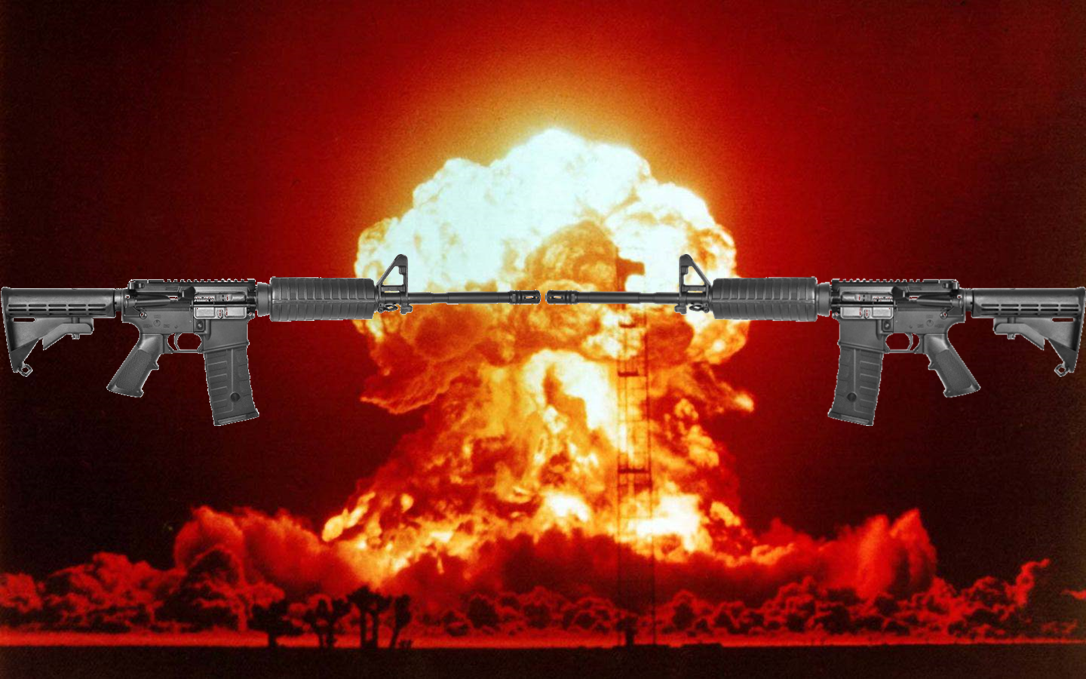
Apply this now to the NRA’s dream of a fully armed America as a means of ultimate protection. Every man, woman and child carrying an AR-15 with them at all times with a pistol in their sock, you know, just in case. Reductio ad absurdum? Or America: 2013? Unlike the quote from Gautama Buddha, who said, “Thousands of candles can be lit from a single candle, and the life of the candle will not be shortened. Happiness never decreases by being shared,” it seems to me that the ubiquitous availability of firearms would lead to casualties beyond imagination due to the deadly combination of man’s incendiary temper and the impossible retrieval of a bullet once fired. If this be so, then mankind is neither mature enough nor evolved enough to have firearms. If we were, we wouldn’t need them. Because we’re not, we shouldn’t be allowed them. Anything less casts us as troglodytes, monsters and condemned to live a life in mutually assured paranoia.

As McNamara later said, “One cannot fashion a credible deterrent out of an incredible action.”