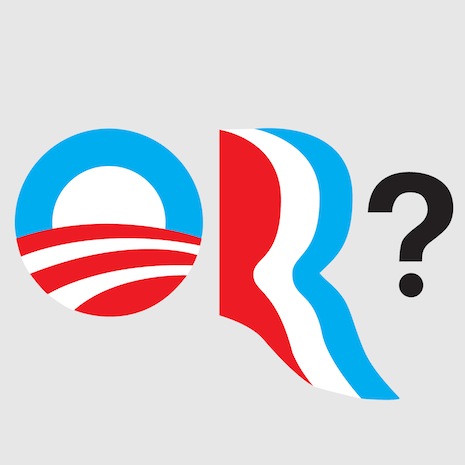
Perhaps…

Perhaps the Republican Party will reflect on this election loss and consider its implications on their future.

Perhaps the religious right will no longer be the centerpiece of the Republican Party.  America largely ignored Romney’s Mormonism as an issue.  Perhaps Republicans can learn to ignore everybody else’s religion (or lack thereof).  As America becomes increasingly secular, perhaps we can dispense with the politically correct insipidness that it is alright for anybody to believe in creationism after they have attained the age of two and played with a toy dinosaur.  Perhaps the fanaticism employed by the right in their attempts to include God in every discussion should be left to the Islamic fanatics of the Middle East.  Perhaps the frenzied somnambulist’s nightmare of sharia law infiltrating American jurisprudence can be left to the conspiracy theorists.  Surely we can agree that while American’s rejected Romney’s attempt to return the United States to the social constructs of the year 1950, are there any circumstances under which we would accept a return to the Islamic laws of the year 632?  Someone once said that one conspiracy theorist is a schizophrenic, whereas a group of them is a Republican convention.  Perhaps it is time to change that.

Perhaps the right wing will clear themselves of their paranoid miasma of a national “confiscation day,” where President Obama personally goes door-to-door collecting every gun from the self-proclaimed “sane,” 2nd amendment loving, NRA financing, gun lovers.  Perhaps we can have a rational discussion on gun control and agree that ordinary citizens probably do not need a semi-automatic assault rifle with a 100 round clip in order to defend themselves from a burglar, unless the burglar is China, in which case we have an exceedingly well armored military.

Perhaps Republicans can agree that rape is not a topic on which there can be two rational sides.

Perhaps Republicans will see women’s rights and control over their own bodies as sacrosanct and not fodder for white men to debate.

Perhaps marriage equality will extend its foothold in the less religiously rigid states and plant the seeds for a national discussion devoid of homosexuality being considered a moral abomination and “curable.”

Perhaps Republicans will see Latino’s not as a monolithic Democratic voting block consisting of “wetbacks” and illegal (I hate this term) aliens, but rather Americans.  A look at any of the maps used by the networks in last night’s election coverage shows that America, beyond Tim Russert’s Red State/Blue State analogy is really about urban versus suburban, white versus everybody else (captured as that all-encompassing and grossly misrepresentative term “ethnic”).  For example,  white suburban Virginia versus the “ethnic” northern part of the state, white suburban Ohio versus the “ethnic,” blue-collared northern part of the state, white suburban western Pennsylvania versus the “ethnic” Philadelphia region.  See a pattern?  White’s comprise huge swaths of territory, but with few inhabitants versus the “ethnic” and densely populated cities.  The Red State/Blue State paradigm is flawed.  Perhaps, it should be county based, or perhaps it is time for white Americans to stop trying to return America to the “good old days” of segregation and oppressive “white power” and embrace their place in the prismatic colors that are America’s skin tones.

Perhaps Republicans will take this opportunity to unite with Democrats and engage in meaningful arguments about the cataclysmic topics facing America, represent their constituents without abandoning the greater good and moving the needle on America’s march into an energy independent future.  Perhaps we can dispense with the banal name calling and talentless idolatry rampant in America and engender personal responsibility as a manifesto for our children.

Perhaps Donald Trump will donate his $5 million to a charity of his choice and sit down.

Perhaps, but probably not.
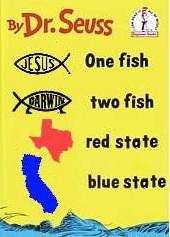
RED, white and BLUE

The presidential election is in four days and the divide in America has once again been colorized for our dim amusement.  It’s the red states versus the blue states! We should all get t-shirts for the $10 billion being spent on the race, a patriotic “shirts versus skins” game for the world to observe.  Is this a case of north versus south, east versus west, the egomaniacal one-per-centers versus the torpid proletariat, big business versus farmers, cities versus the heartland?  Classify it however you want.  Categorize it until it meets your expectations.  But the differences are there.  First, the facts:

Blue States Red States
Population 63.4% 36.4%
Land Mass 35.9% 64.1%
Population Density, people per sq. mile 659 75
Median Age 37.4 36.0
White America 67.9% 73.8%
Black America 10.6% 11.7%
Latino America 12.6% 8.3%
Asian America 5.4% 1.8%
Foreign Born Americans 11.5% 5.5%
High School Graduation Rates 87.4% 85.5%
Bachelor’s Degrees 30.6% 24.2%
Home of Top 50 Universities 40 10
Veterans 62.2% 37.8%
Military Recruits, per 1,000 eligible 18-24 2.07 2.49
Median Home Value $260,089 $141,129
Median Household Income $56,293 $46,696
Unemployment 7.8% 7.0%
Poverty Rate 12.2% 14.9%
Obesity Rate 25.5% 28.7%
Businesses 66.8% 33.2%
Women-Owned Businesses 15.7% 15.2%
New Home Construction 50.8% 49.2%
Marriage Rates, per 100,000 7.9% 7.3%
Divorce Rates, per 100,000 3.5% 4.1%
Belief in God 66% 78%
Gun Ownership 28.0% 47.1%
Deaths by Firearm, per 100,000 9.5 13.7

One could spend all day searching for correlations among these characteristics; however, a few do stand out more prominently than others.  For example, combining several characteristics, one can state that the Blue States tend to be better educated with higher high school graduation rates, more bachelor degrees and more of the top universities.  Blue States also tend to spend more on their houses (4.6 times their median income) versus Red States who spend only 3.0 times their income on a home.  True, this could be due to the fact that there is more available land in the Red States presumably making lots cheaper to build on.  However, then isn’t it strange that new home constructions are split about evenly between Blue and Red?  And while the overwhelming numbers of businesses reside in the Blue States, their unemployment rate is higher than in the Red States.  However, the poverty rate and obesity rate is higher in Red States.  There is also a strange dichotomy in the Red States.  While being comprised of the “Bible Belt,” they yet have lower marriage rates, higher divorce rates, higher gun ownership and more deaths caused by firearms.  What would God think of that combination?

Blue State Propaganda

Politically, it is also a mixed bag.  When polled, Americans consider the economy to be the overriding theme of this presidential election season.  To borrow a phrase from Bill Clinton’s White House, “It’s the economy, stupid.”  But while you would think the states with the highest unemployment would lean toward Mitt Romney and his job creating (albeit mathematically mystical) juggernaut, it is quite the opposite.  Is this a case of mass delusion or a schadenfreude miasma?  Similarly, if Barack Obama is the embodiment of a socialistic welfare state, why then would the region with the highest household income, the most businesses and a lower poverty rate bother to look at him? Were they all working late and missed his soporific first debate?

Red State Propaganda

It is in these mysteries that this election is wrapped.  God bless the RED, white and BLUE.  Now go vote.

Undecided No More

Image from The New Yorker

My son, a freshman in college, and I were on the phone last night discussing our impressions of the latest town hall debate between President Barack Obama and former governor Mitt Romney.  Given the particularly rancorous tone the debate had, a mirrored reflection of the actual campaign, I commented that I found it hard to believe that there were enough undecided voters in the country to fill the audience, let alone that many in Nassau County; but there they were.

Rabid, robotic sycophants in each party leave no room for the truly undecided voter to express their uncertainty with a candidate lest they be subjected to immediate internment in the opposing camp, suddenly responsible for each plank in a platform in which they are ill-prepared and unwilling to defend.  Are these undecided voters genuinely inquisitive, searching for positions on a myriad of issues or are they the dull, unread and oblivious?  For the sake of the future of the United States, I hope it is the former while concerned it is the later.

The polarization of politics, the fracturing of consensus and absence of debate, the removal of concession as a tool toward progress has paralyzed politics.  A shattered media, where any myopic obsession with one particular issue is rewarded with its own cable channel and a thousand militant websites, encourages the electorate to choose a candidate for their position on a single issue and while ignoring the candidate’s position on every other issue as “somebody else’s problem.” You’re concerned about the economy? The environment be damned.  You’re concerned about healthcare? Jobs be damned. And so on…

Neither candidate has successfully escaped this reality.  In a perfect world, Mitt Romney would be able to express the desire for small business (“the economic engine of the country”) to thrive and grow.  He would be able to encourage the celebration of the individual based on their genius and initiative (not their celebrity quotient), rewarded with the fruits of a capitalistic marketplace or starved by the same; where wealth is seen, not as the unconscionable greed plundered by the mindless “looters” of Ayn Rand’s Atlas Shrugged, but celebrated as the moral destination of individual gain.  In this perfect world there would be more Hank Rearden’s and Dagny Taggart’s and fewer Wesley Mouch’s and Jim Taggarts.  Unfortunately, this industrial utopia ignores the choices people make.  Atlas Shrugged spends an exhaustive number of pages explaining that the choice a mother makes to give the last piece of bread to her child is not a sacrifice and not given out of pity, but the rational choice of a rational mind.  In the real world, choices like this are made by individuals on a daily basis with no expectation of societal support in return.  Honor is held internally by these individuals, as they navigate life’s course, carved by the choices they have made and determined to persevere.  There are no children in Atlas Shrugged and no characters ravaged by illness, excepting, of course, that a conscious refusal to think for one’s self is terminal. In reality, there are those whom Fortune has betrayed, felled by disease or events beyond their control for whom that proverbial “governmental safety net” should be axiomatic.

Conversely, President Obama has not been able to effectively convey a perfect world where government involvement in the minds and pocketbooks of citizens is not for the benefit of the lazy takers and looters, but where an “audacity of hope” lifts all boats; where society’s infrastructure is measured in the tons of steel and yards of cement in our roads and bridges and not in the number of governmental agencies handing out food stamps and welfare checks to the unworthy.  He has not been able to sell his opponents on a middle class worthy of the platitudes bestowed upon it by Democrats as the hardworking backbone of America, and not the resource-sponging Pablum vilified by Republicans.  To assume that every citizen is doing their best and ignoring society’s leeches does nothing but invite deserved criticism.    No amount of rhetoric can make up for the picture of the able-bodied young man who has fathered countless children without concern for their future, waiting in line for a government check rather than searching for work, laughing in full belief that the government “owes” him.  Nor has the president escaped the portrait, painted in dazzlingly surreal colors by the “Confiscation Day” fear-mongering NRA, of  him as a soft, yellow, liberal hoplophobe, as opposed to a father and leader legitimately questioning why regular citizens need to own AR-15’s with 100 round drums.

Each side sees only the idealized version of themselves in the mirror and ignores the Dorian Gray painting in the corner while only seeing the Dorian Gray painting of their opponent.

My son suggested that the town hall format, while colloquial and folksy did little to further either candidate’s command of the undecided.  He, himself an accomplished high school debater, suggested that there be two debates scheduled for future presidential campaigns.  Each candidate selects the most partisan member of the media they can find, crafts pointed questions and directs them at their opponent, knowing that their opponent will have the same opportunity in the next round.  In fact, why not remove the commentator altogether?  This would eliminate the bias claims leveled at every commentator by partisan hacks and conspiracy theorists.  Simply have one debate where the Republican candidate asks questions directly to the Democratic candidate and a second debate where the Democratic candidate asks questions directly to the Republican candidate.  These debates should be limited to six hours in length and broadcast on every cable and radio station.  Proof of viewership (of both debates) should be required of every voter on election night, thus ensuring that an informed electorate is a prepared electorate, undecided no more.

Moon Shots

ImageIn the third season of The West Wing, at the end of the episode titled “100,000 Airplanes,” Deputy White House Communications Director Sam Seaborne deletes from his computer the following passage from a final draft of President Bartlet’s upcoming State of the Union speech:

“Over the past half-century, we’ve split the atom, we’ve spliced the gene, and we’ve roamed Tranquility Base. We’ve reached for the stars, and never have we been closer to having them in our grasp. New science, new technology is making the difference between life and death, and so we need a national commitment equal to this unparalleled moment of possibility. And so, I announce to you tonight, that I will bring the full resources of the federal government and the full reach of my office to this fundamental goal: we will cure cancer by the end of this decade.”

Politics prevented the fictional president from making this statement.  I would submit that politics has prevented every actual president from making this proclamation as well.  However, it is the private sector (coupled with federal initiatives) that rises to meet this monumental challenge.  Through the tireless efforts of countless researchers over the past few decades, major advances have occurred in the fight against cancer.  This past Sunday (September 23, 2012) Nature published an article identifying four definitive types of breast cancer following a comprehensive genetic study.  This study is part of The Cancer Genome Atlas (TCGA).  Funded as a pilot program in 2006 with a $50 million investment from both the National Cancer Institute (NCI) and National Human Genome Research Institute (NHGRI), the TCGA pilot project concluded that a compendium of DNA “errors” could be categorized for specific cancer types. The National Institutes of Health has committed $175 million from the American Recovery and Reinvestment Act (ARRA) to continue the program.

Four days earlier, on Wednesday, September 19th, the University of Texas M.D. Anderson Cancer Center launched its Moon Shots program designed to “accelerate the pace of converting scientific discoveries into clinical advances that reduce cancer deaths.”  The cost of the Moon Shots Program will be an estimated $3 billion in the first 10 years. It will be funded through M.D. Anderson institutional earnings, philanthropic donations, research grants and earnings gained from new discoveries.

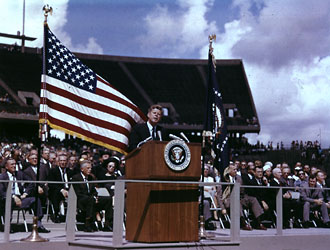
Cancer knows no boundaries, takes no prisoners and ensures its own destruction by ultimately killing its host.  War against such an enemy can likewise know no mercy.  ImagePresident Kennedy, in his famous speech at Rice University on September 12, 1962 wherein he committed the United States to reach the moon by the end of the decade said, “William Bradford, speaking in 1630 of the founding of the Plymouth Bay Colony, said that all great and honorable actions are accompanied with great difficulties, and both must be enterprised and overcome with answerable courage.”  Let neither great difficulties, nor politics dissuade us from reaching this “moon.”

How Big the American Penis

When did the morality of the United States go from entering World War II because it was the “right” thing to do to invading Iraq because we could?  We won the Cold War and promptly anointed ourselves the world’s policeman and obligatory parent.  We went from a Vietnam-era public untrusting of our government and pleading for peace to a public untrusting of our government and spoiling for a fight with it and everybody else.  We wrap ourselves in two diametrically opposed swatches of moral cloth; the second amendment and the bible.  We believe our government has become tyrannical and thus we must arm ourselves with all manner of weaponry.  We dismiss gun control with vitriolic fervor, siting the legislative ineffectiveness of established laws, while ignoring the fact that those same laws had been eviscerated by NRA-backed politicians.  “See, they don’t work,” say the gun lovers.  A cynical person might see this as a self-fulfilling prophecy purposely set up by the NRA to prove that gun laws don’t work, hiding the fact that the laws were programmed to fail as written.  Fitted with a 30-second sound bite mentality, we espouse our philosophy in fortune cookie slogans.  “Guns don’t kill people, people kill people.”  “If we outlaw guns, only outlaws will have guns.”  “Should we outlaw the spoon to prevent obesity?”  “Should we outlaw the car to prevent automobile deaths?”  No, we should use some common sense and prevent 100,000 Americans from being shot every year.  Duh.  The problem, of course, is that common sense isn’t common anymore.

We must arm ourselves with concealed weapons because the boogeyman is going to attack us in our homes, while at the same time we profess to follow the teachings of Jesus.  “Keep Christ in Christmas,” reads the bumper sticker on the left side of the bumper of the twelve foot high pickup truck under which I can drive my Camry and not get wet from the rain.  The right side of the bumper has another sticker which reads, “Gun Control means using BOTH hands.”  If only someone in the audience in Aurora had been packing…

Yes, American machismo is alive and well, even without any requisite reasoning.  The top selling vehicle in 2000 was the Ford F-150 pickup truck.  In the years that have followed (living in the post September 11 world of war, our “desire” to move away from an oil based economy  and the birth of “green” technology), the best-selling vehicle through June of this year is the Ford F-150 pickup truck.  My, what we have learned!  True, gas mileage has increased over those ten years.  The 2000 F-150 only got 15 miles per gallon.  The 2012 model got 17.   And why do they have to be jacked up so high that in driving in my lowly hybrid sedan I can’t see past the steel wall in front of me.  Having them behind me is no bargain either.  Their headlights are so high that they pass directly into my rear view mirror!  And when did we begin to believe that pickup trucks must be driven like NASCAR vehicles?

Of course, there is a path back to reason that doesn’t have to pass through “Who is John Galt” egoism.  The 2008 Supreme Court decision referenced, championed and waived like a flag by the gun loving public (D.C. v. Heller) contains language that makes sensible legislation possible.  Two words, actually.  Paragraph number two specifically states:

The Court’s opinion should not be taken to cast doubt on longstanding prohibitions on the possession of firearms by felons and the mentally ill, or laws forbidding the carrying of firearms in sensitive places such as schools and government buildings, or laws imposing conditions and qualifications on the commercial sale of arms.

sensitive places.”  Further define “sensitive places” and the problem is solved.  Add movie theatres, churches, and anyplace else that I, my wife or children might wander and I’ll be happy.

The second option is to legislate around the second amendment’s archaic premise.  The late Senator Daniel Patrick Moynihan (D- N.Y.) suggested on November 4, 1993 that while the United States had a 200 year supply of guns, we only had a four year supply of ammunition.  Turning the oft-quoted phrase noted above on its ear, he was quoted as saying before the senate, “Guns don’t kill people; bullets do.” He proposed legislation adding a tax on ammunition.  A 10,000% tax!  Translated, that means that a $24 box of 20 Black Talon cartridges would cost $1,500.  The Black Talon was a 9-millimeter hollow-tipped cartridge with a bullet advertised as expanding “to expose razor-sharp reinforced jacket petals.  Advertisements for these bullets are quoted as saying, “These cut tissues in the wake of the penetrating core,” and “penetrates soft tissue like a throwing star — very nasty; very effective; a real improvement in handgun ammo.”  Sounds like a great product!  Alas, despite his being the chairman of the Finance Committee, the bill went nowhere.  In an odd endorsement, the comedian Chris Rock, speaking years later as part of his routine, said:

You don’t need no gun control, you know what you need? We need some bullet control. Men, we need to control the bullets, that’s right. I think all bullets should cost five thousand dollars… five thousand dollars per bullet… You know why? Cause if a bullet cost five thousand dollars there would be no more innocent bystanders.

Yeah! Every time somebody get shot we’d say, ‘Damn, he must have done something … Shit, he’s got fifty thousand dollars’ worth of bullets in his ass.’

And people would think before they killed somebody if a bullet cost five thousand dollars. ‘Man I would blow your (f*@#ing) head off…if I could afford it.’ ‘I’m gonna get me another job, I’m going to start saving some money, and you’re a dead man. You’d better hope I can’t get no bullets on layaway.’

So even if you get shot by a stray bullet, you wouldn’t have to go to no doctor to get it taken out. Whoever shot you would take their bullet back, like “I believe you got my property.”

In his 1870 work My Summer in a Garden, Charles Dudley Warner wrote, “Politics makes strange bedfellows.”  Never was this truer than an agreement between Senator Moynihan and Chris Rock!

The macho American male dismisses “rational” discussion on these topics as the ranting of bleeding-heart liberals.  Tree hugging, global-warming-believing, socialists.  We won, you lost, discussion over.  Deal with it.  My gun is bigger than yours; my truck is bigger than yours. My penis is bigger than yours.  Now sit down and shut up before I hit you with either of them.

In Defense of the Camel

Alex Issigonis, a Greek automobile designer born in what is now the Turkish city of Izmir, was quoted in the July 1958 edition of VOGUE as saying, “A camel is a horse designed by committee.”  Famous for designing the Mini as a small, utilitarian, simple to use automobile, his name is lost to history.  These same adjectives, coupled with a similar design aesthetic could also be used to describe Steve Jobs.  Mr. Jobs was the laser-focused CEO of a small, silicon-valley based company called Apple.  Neither one was interested in public opinion surveys or focus groups, and as we know, neither man ever amounted to much in life.

Thankfully, our public leaders are held to a higher position.  President Clinton was forever accused of giving wet-Willie’s to people because his index finger was always wet.  But it was only wet for the purpose of seeing which way the wind was blowing.  Every president since and every senator and representative down the line from the national to the local level have taken this game book to heart.  Public opinion is the narcotic to which every politician is addicted.  We are the Gallup Nation.  For reasons that elude me, our Founding Fathers insisted on forming the government as a republic rather than a democracy.  Fortunately, that nuance (nuisance) has been lost on all subsequent generations.   Committees now lead us and our government has become the camel.  And don’t we all love camels?

In fact, the situation is a little more complicated.  While public opinion dictates the position of politicians, lobbyists and partisan “news” organizations teach the public what to think.  So, lobbyists tell us what to think, we tell the politicians what we now believe and the politicians tell us what we want to hear.  It is a very efficient system.

For some reason, we, collectively, have an unfounded appreciation for Abraham Lincoln.  First of all, with a name like Abraham, are we sure he wasn’t Jewish?  I, for one, have never seen his birth certificate.  I can’t help but wonder if a modern president were in office back in 1862 whether or not we would have had a Civil War at all!  Public opinion at the time must have been pushing one way or another.  Why did our leader not bend to their wishes?  Certainly, if we had wanted slaves freed, we would have said so.

Hamilton wrote numerous articles for the people of New York regarding the future of the Union in the Federalist Papers.  Arguing for a Union rather than thirteen independent countries (or 3 or 4 regional countries) ignored the wishes of the public completely.  Who’s to say that we would not have been better off with 4 individual countries rather than one big one?  Maybe the Civil War would never have occurred if the north and the south were already different countries!  Forget the first few articles from the Federalist Papers regarding foreign aggression, they were obviously written under duress.

Camels are fun to look at.  We like them.  We should all have one, like a gun.

I have submitted this article to the requisite committees who have changed it at the request of the lobbyists and we submit it to the public for the absorption in hopes that our politicians adopt it as their own.

And now back to Fox News…

An Interview with James Madison

Published July 4, 2012

WASHINGTON, D.C. – Thanks to Doc Brown, Marty McFly and time travel, James Madison was cryogenically preserved when he died in June of 1836 at the age of 84.  He was the last surviving Founding Father, considered the Father of the Constitution and author of the Bill of Rights.  Today, healthy and alive, he celebrates his first “second” birthday, having been reborn on July 4, 2011.  We sat down at the Off the Record bar in the Hay-Adams Hotel here in Washington to discuss what he thinks of the political experiment he helped craft over 220 years ago.

ThoughtsAtLarge:

First of all Mr. President, let me thank you for taking the time to meet with me and to wish you a very happy first birthday.

Madison:

Thank you, although I must say, I feel rather like the 261 year old I really am!

ThoughtsAtLarge:

Well, I can only hope to look as good as you at 261, if you don’t mind my saying so, Mr. President.

Madison:                  

Very kind of you to say.

ThoughtsAtLarge:          

Mr. President, as one of the original architects of the American democracy, how do you think it has performed?  And as a follow-up, is it what you had envisioned it maturing into?

Madison:          

Let me first qualify your statement.  Yes, I was one of the people involved in the formation of the government, although, you must understand two things straight away. First, most of us were very young and the times were very uncertain.  I, myself, was only 26!  Second, we consciously created a republic, not a democracy.  The distinction is worth noting.  But to answer your question, I am generally pleased with how it has withstood time, although, it was intended to be more fluid than it has been interpreted.  For example, the three-fifths compromise as written in the Constitution seems both offensive and silly today.

ThoughtsAtLarge:

You are talking about Article 1, Section 2, Paragraph 3 which states:

“Representatives and direct Taxes shall be apportioned among the several States which may be included within this Union, according to their respective Numbers, which shall be determined by adding to the whole Number of free Persons, including those bound to Service for a Term of Years, and excluding Indians not taxed, three fifths of all other Persons.”

Madison:

Yes, that was a compromise between the northern and southern states regarding slavery.
But the 13th and 14th Amendments rendered that clause moot, thankfully!

ThoughtsAtLarge:

You were originally a Federalist, or a proponent of a strong central government, but ended up changing to a Democratic-Republican, in favor of strong state’s rights.  Why the change?

Madison:               

Well, you have to understand that, at the time, there was no sense in having strong state’s rights without a strong central government.  However, once that was achieved, we could turn our attention to assuring the ability of individual states to control their own destiny.  Certain concepts lend themselves better to an overarching unanimity, while others can be subject to a more regional interpretation. 

ThoughtsAtLarge:

It is ironic that as the chief author of the Bill of Rights, you were originally against having them at all!

Madison:  

That’s correct!  I didn’t think they were necessary.  I also worried that by delineating specific rights, others, not delineated would not be protected.

ThoughtsAtLarge: 

There are now 27 ratified amendments to the Constitution.  Doesn’t that speak to your desire to have the government’s framework remain fluid?

Madison:     

To a degree, yes, although it was not our intention to have future Supreme Courts attempt
to opine on our intentions in 1789 without taking into consideration society today.

ThoughtsAtLarge:

Can you give us an example?

Madison:         

Of course, the First Amendment never foresaw radio, television, the internet, and iPhones, Fox News, MSNBC or CNN.  The Second Amendment never foresaw any firearm more powerful than a single shot musket or the rise of the United States military to be the most powerful in the history of mankind. 

ThoughtsAtLarge:

It’s ironic you should mention the Second Amendment.  You were a strong proponent of protecting the citizenry’s ability to bear arms.

Madison:                     

Yes, I was, but, again, times were very different.  Our concerns revolved around foreign invasion and insurrection rather than a federal government evolving into a tyrannical dictator.  After all, it was the government we created!  We certainly never foresaw the awesome firepower now available to our citizens.  Remember, it was within the confines of a well-regulated militia that this amendment was conceived.  Today, it has been interpreted to mean that virtually any and all manner of firearm is available to our citizens.  I have read the gruesome accounts of mass murder committed by citizens with access to unbelievably powerful weapons.  Indeed, every day there are firearm murders, suicides and accidents committed under the auspices of my amendment.  This sickens
me!  Our government has evolved over time.  So too, must the Constitution, including the Amendments!  Common sense!  Where is the common sense?

ThoughtsAtLarge:   

So you would be open to changing the Amendment?

Madison:                    

Times change, sir, and so too must law.

ThoughtsAtLarge:   

I see our time has expired, Mr. President.  I want to thank you for taking the time to meet with me to discuss your unique perspective on our government.  May I ask what your upcoming plans are?  Given the changes to which you must be adapting, I am curious to hear your plans.

Madison:        

I have relatives, descendants really, that live out west, far beyond what I knew as “west”!  I am traveling on my first airplane later this month and meeting with them.  I am also fascinated by the cinema.  My, let’s see if I can get this correct, great-great-great-great-great-great-great-great-great-great granddaughter wants to see the new Batman movie.  I am very much looking forward to it!

ThoughtsAtLarge:   

That’s lovely.  Where does she live?

Madison:           

Aurora, Colorado.

Heroes

When I was growing up, Pete Rose was my hero.  I loved the way he played the game.  He gave 100%, every game, every day.  You can denigrate him for betting on baseball.  It was wrong.  You can say he was a Hot Dog.  But Charlie Hustle earned his name.  Likewise, I loved watching Jack Klugman’s Quincy.  He, too, ran as fast as he could into whatever brick wall stood in his way.  If I could distill their personalities into one word, it would be passion.  It is passion that I have always hoped to impress upon my children.  Find whatever you love and pursue it relentlessly. 

However, today’s heroes can no longer be recognized for their passion, but rather their popularity.  Seriously, can anybody tell me what Paris Hilton or any Kardashian, brings to society, other than manufactured drama?  P.T. Barnum said, “Without promotion something terrible happens… Nothing.”  Lady Gaga is the new Madonna, a master publicist with limited talent.  Talent and hard work has given way to reality TV, American Idol and an instant gratification mentality.  However, as alarming as this development is, there is another that is far more damning.

There is an Irish proverb that states, “If you want an audience, start a fight.”  This type of publicity is best represented by the likes of Glenn Beck and Rush Limbaugh.  Stephen King, writing in Entertainment Weekly, called Glenn Beck, “Satan’s mentally challenged younger brother.”  Why?  Let’s review a few quotes from Mr. Beck:

“When I see a 9/11 victim family on television, or whatever, I’m just like, ‘Oh shut up’ I’m so sick of them because they’re always complaining.”

“Can you let your son’s body become the same temperature as your son’s head before you turn this into a political campaign against the president? Could you do that?”    (This to Judea Pearl following his son Daniel’s beheading at the hands of Pakistani militants)

“Not a single time have we gotten a right from Congress or from the President. We get them from God.”    (Really? Makes you wonder about the Second Amendment, doesn’t it?)

“The most used phrase in my administration if I were to be President would be, ‘What the hell you mean we’re out of missiles?’”

Mr. Limbaugh also has a litany of available quotes, but this is a blog and not a thesis.  Ironically, the Information Age has sparked a new Dark Age.  The endless availability of information has resulted in people seeking out only the information with which they agree.  If you’re a conservative, you watch Fox.  If you’re a liberal, you watch MSNBC.  CNN, probably the most balanced of these three, is suffering in the ratings because of this phenomenon.  Debate is non-existent.  Compromise a sign of weakness.

Nowhere is this chasm in conversation more evident than on the issue of guns.  Debate has been reduced to bumper sticker sound bites.  “Guns don’t kill people, people kill people.” “If you outlaw guns, only outlaws will have guns.” 

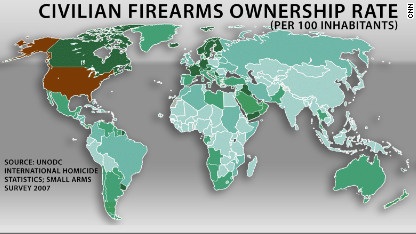
The NRA is the lobbying arm of gun manufacturers cloaked behind a bastardized interpretation of the Second Amendment and followed by a Kool-Aid drinking public.  Fact and common sense have no place in the conversation anymore.  Fact, the United States makes up 5% of the world’s population, but owns 50% of the world’s guns.  Look at this graphic from CNN.  Does anything stand out as being apart from the norm?

And yet, we can’t get Washington to approach gun control because of the fear politicians have of the NRA.  Where does it end for the NRA, .50 caliber sniper rifles to greet the mailman? Fissile material on eBay?  This paranoid mentality instilled on their flock is scary.  They believe that the Day of Confiscation is imminent, that the government is about to turn on them and subjugate them, that fascism and socialism are the new American order.  For people so concerned about the Second Amendment, they show no faith in a government that created it.  Every armory-owning yahoo is now a Constitutional scholar.  However, as the NRA was their teacher, they reduce the Amendment to an unimpeachable, fortune cookie-like “right to bear arms,” selectively forgetting the “well regulated militia” part.

It is frustrating.  Discussion dissolves into name calling and with the high ground (if not the moral high ground), the gun-owning majority dismisses a rational minority.  Congress is deadlocked on every issue, mirroring a public paralyzed by institutionally fed convictions.  We can be passionate about our convictions and open to discussion.  We are better than this.  Where are our heroes?

Labels

Labels.  We all use them, we all love them.  It’s our way of categorizing our lives, a way of making sense of the plethora of information that floods us every day.  Unfortunately, it’s also our way of imparting our biases and prejudices on every incoming piece of information.  Every label we use carries the metadata we have assigned to it.  We used to call them stereotypes, now we use terms like racial profiling.  Liberals, right-wing, Jews, blacks, Christians, immigrants, politicians, Wall Street, big business, Congress, hero.  They all conjure up images in our minds, whether positive or negative, which have nothing to do with either the piece of information we are receiving or the individual conveying it.  We have, usually without thinking about it, sorted the information by the labels we have assigned them.  We gravitate toward the information we like and dismiss the information relegated to the negative labels we have created.


By flushing the information we have assigned negative labels, we simplify our lives, but dismiss the value of discussion and argument, with the availability of our growing, understanding and altering our opinion obliterated.  It also leads to two other destructive results.  First, we harden our position to the point of dogmatic excess.  We don’t allow any discussion of our position.  We don’t allow any subset of our position to be challenged, lest we question our position and allow other tenets of our position to be challenged.  Second, we allow single-minded institutions to speak for us.  In our busy lives, we allow institutions to carry our position for us.  We believe their rhetoric.  We adopt their position as ours.  We believe the notion that an attack on one of our positions within a topic will lead to the “slippery slope” of ultimate defeat.  Pick a topic: gun control, abortion, religion or politics.  Our labels and intractable positions have lead to a stalemate.  There is no longer any discussion, no debate, no discussion.  The “other” side has been labeled “evil” and the conversation is over.  Unfortunately, this stalemate leads to paralysis.  Congress enjoys a 14% approval rating.  A Republican controlled Congress makes a Democratic President impudent.  Likewise, Republican Presidents have been made ineffective by Democratically controlled Congresses.  The game plan seems to be that a President is only in office for four years, so, we in Congress, can just wait him out.  Paralysis.


We, as individuals, need to be able to move the bar on our labels.  We need to see them and acknowledge that they exist.  We need to allow for the notion that not all of our positions are infallible.  It is the idiot who claims to know it all.  We need to stop allowing single-minded institutions to speak for us.  We need to encourage discussion and engage in debate.  In our case, the United States is in a state of self-inflicted paralysis.  We are better than that.  Our children deserve better and they are learning from us, while the world watches.