
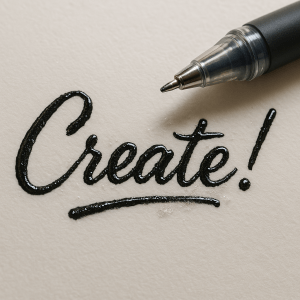
Our Ink Is Drying

As I write this, I can watch the gel ink dry into the paper behind each new word. Dried into the fibers, permanent. Immortal. Eternal—for as long as the paper exists.

Place this paper in a vault, and the words will live forever. But they will not live. They remain preserved, filed, and recorded. Yet unread, they exist only as part of the vault’s mass. Their weight merely added to the total.

To the living world, the paper does not exist.

The same can be said of us.

We are the ink. As it dries, we move on—the march of time relentless, unpausing, uncaring. Once the ink dries, it is finished. That is our past. Our memories.

And we are also the vault. Every memory exists within us, along with anyone else who experienced it while the ink was still wet. Once we are gone—once those who share our memories are gone—so too is the memory. So too is the ink, the paper, the vault.

And that is life. Our life. Everyone’s life.

There will come a time when even the thought of you is lost. A day when the last person who remembers you will recall your name or your story for the final time. Then you are gone—lost to eternal oblivion.

Clifton Fadiman once said:

“A cheese may disappoint. It may be dull, it may be naive, it may be oversophisticated. Yet it remains cheese, milk’s leap toward immortality.”

Creativity—our art—is our cheese. Write a book, and it may be read forever. Paint, and your strokes may hang long after your heartbeat fades. The internet has become our new Library of Alexandria. Our vault.

In Cosmos, episode eleven, Carl Sagan said—and I’ll never forget it:

“What an astonishing thing a book is. It’s a flat object made from a tree with flexible parts on which are imprinted lots of funny dark squiggles. But one glance at it and you’re inside the mind of another person, maybe somebody dead for thousands of years… Books break the shackles of time. A book is proof that humans are capable of working magic.”

Another favorite of mine, Oscar Wilde, wrote:

“All art is immortal. For emotion for the sake of emotion is the aim of art, and emotion for the sake of action is the aim of life.”

So create. Plant a tree. Paint a picture. Write a story—your story.

Oblivion awaits. But leave something behind that will outlive you—and outlive the memory of those who knew you.

Will you be remembered for it? Maybe. Maybe not. But your creation might.

I wonder if anyone will ever read this.
I wonder if anyone will remember it, if they did.

Our ink is drying.

The Tu Quoque Mirror

The Tu Quoque Mirror: The logical fallacy of accusing your opponent of your offenses.

No one has mastered this logical fallacy more than the loser of the 2020 presidential election, Donald J. Trump.

Accused of tampering with an election: Joe Biden and/or Hilary Clinton did it
Accused of improperly handing documents: Joe Biden and/or Hilary Clinton did it
Convicted of falsifying records: Joe Biden and/or Hilary Clinton did it
Convicted of paying hush money: Joe Biden and/or Hilary Clinton did it
Accused of rape, sexual assault, and sexual harassment: Joe Biden and/or Hilary Clinton did it
Accused of witness tampering: Joe Biden and/or Hilary Clinton and/or Hilary Clinton did it
Accused of weaponizing political infrastructures: Joe Biden and/or Hilary Clinton did it
Accused of mishandling the pandemic: Joe Biden and/or Hilary Clinton did it
Accused of foreign misdealing: Joe Biden and/or Hilary Clinton did it
Accused of a porous border: Joe Biden and/or Hilary Clinton did it
Defending Putin, Orban, Xi, or other dictators: Okay, that one’s Trump alone.

And those are the ones that come to mind in 5 minutes. There is no situation where, when accused, Trump doesn’t (without any evidence) turn it around to be his opponent’s offense. 

It is an extension of the ad hominem logical fallacy “whataboutism.” In that simpler (but no less simple-minded) deflection, you turned the argument by putting your opponent on the defensive by eliciting an example of their misdeed—deflection as a defense. And in the age of bumper sticker philosophy and 5-second sound bites, it works. It’s a gotcha moment just waiting to birth a meme. Except it never answers the original charge. And that’s the idea. Cut to commercial. Print the t-shirts. Hang the flags (and the vice president).

The death of debate and the rise of Trump acolytes have resulted in a catastrophically divided country. It has spawned not a political movement but a cult. And like all cults, it is sick—sick from within and diseased at the head. Like their leader, they obfuscate with whataboutism, like “chosen one” like sycophants. But all cults thrive until they don’t. When is that tipping point? Time will tell.

The tu quoque mirror version takes it a step further. Now, you no longer need to research misdeeds by your opponent. You accuse them of yours. It would be elegant if it weren’t childish. It’s Dorian Gray’s portrait, except he does not see himself, and Mr. Gray puts it on display for his cult.

Oscar Wilde may have summarized Trump best when he wrote, “”You will always be fond of me. I represent to you all the sins you have never had the courage to commit.”

Fighting Eternal Oblivion with Squiggles and Cheese

As I write this, I can watch the gel ink dry behind each subsequent word. Dried into the paper, permanently a part of the wood fiber. Immortal, eternal as long as the paper exists. Put the paper in a vault, and the words live forever. There they will remain preserved, filed, recorded, and likely unread.

The same can be said of humans. As the ink dries, we move on. The relentless marching on of time. Relentless. Never ending, never pausing, never caring. Once the ink dries, it is done. It is the past. It is our past. Our memories. We are the vault. And our vault, memories, and existence exist only as long as anyone who experienced something with us or heard a story about us exists. Once we are gone and those who recall us are gone, so are our memories, the ink, the paper, and the vault. That’s life. Our life. Everyone’s life.

There will come a day when the very thought of us as individuals will be lost. There will be a day when the last person who remembers you or recalls a story about you recalls it for the last time. You will be lost to eternal oblivion. Sure, there are individuals whose memory transcends time. Shakespeare, Caesar, Keith Richards, but for most of us, we will be lost to time, just a number in the ever-expanding pile of humans that once existed.

Is there a way to combat this eternal oblivion? Or is this simply an exercise of someone who just celebrated a birthday and is reminded that the road before him is shorter than the view in the rearview mirror? And, let me add that the road before him is neither clear nor guaranteed.

Clifton Fadiman said, “A cheese may disappoint. It may be dull, it may be naïve, it may be over-sophisticated. Yet it remains cheese, milk’s leap toward immortality.” Creativity (the arts) is our antidote, our cheese. Write a book, and it remains available forever. The internet is the newer, better Library of Alexandria. Paint something, sculpt something, and it exists long after you perish.

In episode eleven of Cosmos, Carl Sagan said something I’ll never forget, “What an astonishing thing a book is. It’s a flat object made from a tree with flexible parts on which are imprinted lots of funny dark squiggles. But one glance at it and you’re inside the mind of another person, maybe somebody dead for thousands of years. Across the millennia, an author is speaking clearly and silently inside your head, directly to you. Writing is perhaps the greatest of human inventions, binding together people who never knew each other, citizens of distant epochs. Books break the shackles of time. A book is proof that humans are capable of working magic.”

Another favorite of mine, again, capable of stringing together words far better than I’ll ever dream of, Oscar Wilde said, “All art is immortal. For emotion for the sake of emotion is the aim of art, and emotion for the sake of action is the aim of life.”

So, create! Rabindranath Tagore said, “The one who plants trees, knowing that he will never sit in their shade, has at least started to understand the meaning of life.” So, plant a tree! Paint a picture! Write a story! Write your story! Eternal oblivion awaits us. Leave something behind that outlives you, outlives the memory of the last person to recall you. Will you be remembered for it? Maybe. Maybe not. However, your creation will endure.

As the ink dries on that last word, I wonder if anyone will ever read this. I wonder if anyone will ever remember it if they did read it. Create, people! Our ink is drying!