

Forrest Gump is revered as a movie, in part because Forrest is a witness to or active participant in many historical events. he interacts with many cultural touchstones throughout the movie. These touchstones exist throughout popular culture, and when we participate in them or witness them, we are historians, chroniclers of culture, a modern-day Pliny.
Throughout our lives, we occasionally find ourselves in these situations. Sometimes we are unaware of the cultural significance at the moment; other times, we know we are creating memories. The birth of our child, the death of a family pet, or seeing a famous landmark on a business trip or personal vacation all qualify as these moments of instant memory. Still, at other times, we are made aware of the significance of the event we find ourselves in, either as witnesses or participants. Examples of these situations might include being in downtown Manhattan on September 11, 2001, seeing a young, unknown Jimi Hendrix perform in a nowhere club or as a background musician for another act, or seeing your favorite baseball team win in person as they start the fifteen game winning streak that propels them into the playoffs and to a World Series title.
This is a long-winded way of saying that memories, be they known at the moment or recognized after the fact, are branded into our conscience. My father used to say, “A good day is any day you create a memory.” I would edit that to limit it to a “good” memory. Bad memories are just as searing, just not as welcomed.
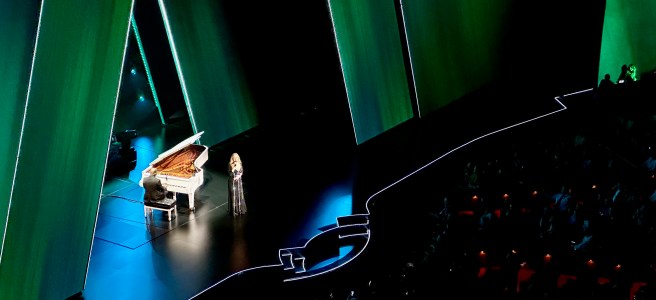
The previous few paragraphs represent the (half-formed) internal conversation I had in my head this past Saturday evening as my wife and I waited for Adele to take the stage as part of her Weekends with Adele residency at the Colosseum at Caesar’s Palace in Las Vegas. No opening act, no warm-up-the-audience comedian, just her and her band. She was outstanding. The show started with her and her piano player, Eric, performing about five songs together. Just them. She didn’t change outfits twelve times (she never changed outfits), and she didn’t have a choreographed dance routine for every song (she didn’t dance at all (and neither did anyone in her band)). I was just her, her powerful voice, and her band performing hit after hit. She honestly didn’t need a microphone or speakers. Her voice could have shaken the rafters and The Strip without them. Seeing her perform was one of those significant moments- an instant memory. And I knew it at that moment.
I reflected internally on how fortunate I was to be there to see her perform in her prime. I was at Red Rocks in Colorado once to see the Denver Philharmonic Orchestra perform Rachmaninoff and Tchaikovsky. The organic, cathedral-like venue cut into the mountain, and the moving music brought me to tears with the same emotions. How fortunate was I to:
- Appreciate art forms in their purest representation?
- Have worked hard enough to achieve the means to have enough disposable income to spend on the arts?
- To be in the right place at the right time to experience such artistry?
Dad would be proud to know I had a good day where I made a (good) memory.


 Thoughts at Large