
Twizzlers and Combovers

My sister has two children, a girl and a boy. But to be honest, she had three. Zodiac was her third. Zodiac was a Field Spaniel. Well, to be more precise, that was his breed. Zodiac was her child, friend, confidante, and roommate. My sister is a photographer, and by extension, Zodiac was the most photographed furry friend ever.

Gentle didn’t begin to describe him. Like most dogs, he had one mission: to love you. As a Field Spaniel, he had the traditional long ears and feathering on his chest, ears, and the back of his legs. He was all black but had gained some whisps of white as he aged. Years ago, like many Field Spaniels, he had ocular issues and lost one eye. But if you asked him (and if he could tell you), he’d have said it never bothered him to lose it. He just kept moving forward – and loving. The hair on his head was long and wispy and could be combed in any direction. His combover was always a source of entertainment over the years! Oh, and he loved Twizzlers. I bought them for him whenever I could, and my sister always had some on hand. She kept them in an upper cabinet in her kitchen. She has a two-step, painted wooden stool beneath the cabinet. Say the word “Twizzler,” and Zodiac would run to the step stool and stand on the top, patiently awaiting his treat. He’d help guide you to the location of the hidden treasures by pointing his nose at the upper cabinet. The paint had worn away on that step from his many trips there.

They say only the good die young. Perhaps that’s the price of loving. And since dogs always love unconditionally, their lives are shorter than ours. We’ve all heard the saying that a dog year is seven human years. Another way of thinking is that maybe they love seven times as much as we do in any given year. Either way, the cost of their loving is paid in shorter lives.
And we are left to carry the memories of their love with us through the remainder of our longer lives.
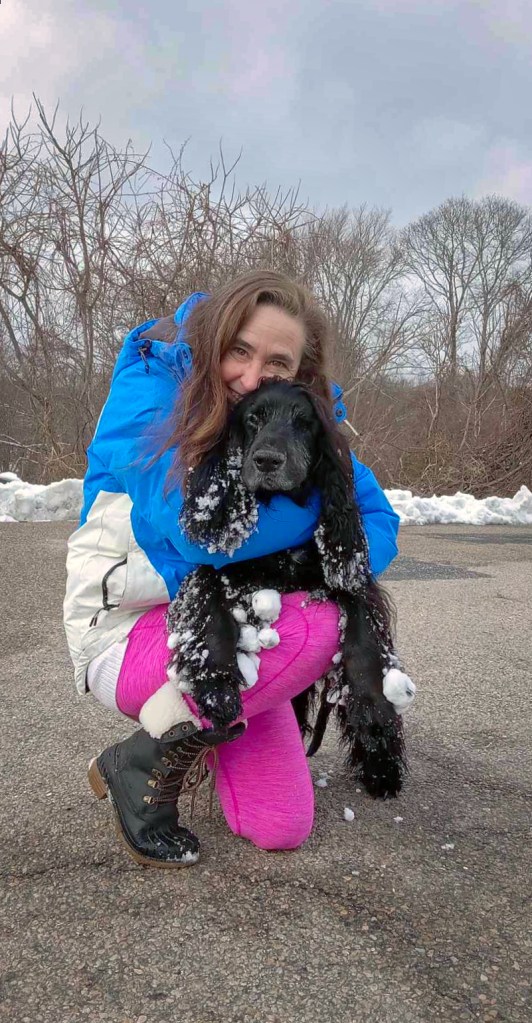
Zodiac crossed that mythical Rainbow Bridge tonight. And while I’m a skeptic, I’d like to believe in a place where our departed furry friends wait for us, their tails wagging out of control as we, at long last, approach. So, if you have a moment and are so inclined, have thought for my sister and her kids. If my theory’s correct, your compassion is a sign of sympathy, maybe empathy, and a form of love. It may cost you a moment of your life. And you may die a moment sooner because of it. But isn’t the love we give others, the love we give our furry friends, the love we have for nature, our garden, or our hobbies, isn’t that what makes our lives more than the total of our achievements, tasks, and obligations? If I must go sooner because I love, I will not fear the Reaper. And if I die at 99, I hope that means that without having loved, I would have died at 106. And when I go, please do me a favor, just in case. Stick a few Twizzlers in my pocket. Uncle Chris needs to be ready.

Everyone who ever knew you, Zodiac, is going to miss you. We’ll carry your memory.

Eyes

Grief is a hole carried deep within. It is the oxygen-deprived void, generally unseen by anyone else, living within our soul whose weight varies from day to day, moment to moment, from a quick catch of your breath to drowning suffocation.

Queen Elizabeth II died yesterday at the age of 96. Unless you’re 95, I don’t know anyone who wouldn’t sign that lifetime contract today. My cousin died yesterday, too. Life did not afford her 96 years. Absent the global outpouring of tears, her loss is no less devastating than that of the queen to her family. Grief is sure to wash over her family as sure as the queen’s.

Regardless of your feelings toward the British monarchy, whether you feel it is superfluous in 2022, an anachronism to modernity, or the steady hand on the till as time unfolds, the queen’s passing marks the end of an era. She worked with fifteen Prime Ministers throughout her long life, the first being Sir Winston Churchill. Churchill was born in 1874, a mere nine years after the end of our Civil War. She served as monarch for 70 years or about 28.5% of the entire history of the United States.

To remember a time when she was not monarch, you would have to be over 75 or 80 years old. Consider the changes the world has undergone during the time of her reign. Of course, few of us knew her. I can only project my interpretation of the video and deed she presented to the world. However, it seems that, whatever you feel about her, she sincerely believed in the queen’s duty above all else. No doubt, this came at a tremendous personal sacrifice. Whether it was a private life forfeited after her uncle’s abdication, a restructuring of her relationship with her husband Phillip in deference to her role, or the official position she had to take over any maternal impulses she may have felt, forbearance and sacrifice was her duty.

Grief is a hole carried deep within. However, there are occasions when it is visible. Words record the pain she endured at her father’s passing, King George VI, in 1952. Modern technological capabilities captured some insight into her grief after the passing of her husband. As we isolated ourselves in reaction to the savage viral death brought by COVID-19, the queen sat alone in St. George’s Chapel on that day in April 2021. Captured by Jonathan Brady of the Associated Press on that day, here she sits with her grief.

Look at her eyes. That is grief. The hole carried deep within, momentarily visible in her lost stare. I know that look. The paralysis grief creates, the mental gymnastics, and incomprehensible lack of understanding one goes through envisioning a world without a loved one are visible to anyone remotely aware. It is the eyes that expose our grief to others. It is through the eyes that tears flow. It is through sight that we feel sympathy and empathy. And it is through our eyes that grief reveals us shattered and lost.

If we are lucky, time softens the edges of our grief. We catch our breath at a memory, song, scent, or place, but we no longer suffer the drowning suffocation as often. We learn to control access to the most devastating memories; we learn to remember without reliving them. It is not an easy skill to learn.

The queen is gone. So, too, my cousin Gwennie. People worldwide may mourn the queen’s loss as if a steel and cement pillar of our societal foundation has crumbled and left us on infirm sand. Her family and my cousin’s will know grief exposed through our eyes. Be a comfort to those showing the signs of grief’s pain. None of us are immune to its theft of air any more than death steals life. The hole grief creates in its immediacy is devoid of oxygen. Help each other breath.

Sandra

My former mother-in-law, Sandra McIntosh, died on Friday. She had had multiple sclerosis since before I met her in 1987 and finally succumbed to ovarian cancer at age 81. This is a difficult piece to write.

I met her in 1987 when delivering her daughter’s baseball glove after she broke her leg during a company softball game. It was an excuse to see Lisa. Nothing more. We weren’t even dating at that point, but I had my sights set on her. Indeed, with a broken leg, there was not much need for a baseball glove! Sandra met me at the door and was very courteous if confused. That initial reaction held for the entirety of the time I knew Sandra.

Her husband, Doug, was my friend. When he was diagnosed with lung cancer in 1999, Lisa, our two young children, and I moved in with him and Sandra to care for him. He and Lisa had similar, effervescent personalities. It was a fool’s errand to try to keep up with them. But, oh, did we laugh.

In December of that year, he died in my arms as I tried to help him to a chair on the one night in all those months that Lisa left the house with her friend Naomi. Telling Sandra to stay in the bedroom while I called 911, and then Lisa felt like juggling cats underwater, my head drowning. Immediately after that, Sandra came to live with us. She lived in assisted living facilities off and on after that, sometimes living with us, sometimes living in ALFs.

Lisa was diagnosed with cancer in 2008. As many of you know, she, the kids, and I moved to Texas to treat her. Forgetting the dye had already been cast, and despite her Herculean efforts, she died in 2015. Sandra was with us in Texas from 2010 until the kids, Sandra, and I returned to Rhode Island in 2016 after the kids graduated from the University of Texas at Austin.

Before Doug died, he made me promise to take care of Sandra. It is a promise I have always tried to uphold. Lisa made me make the same promise. Two peas in a pod, those two. I promised her, too.

I don’t know why them and not me. It makes no more sense to me than knowing why cancer is, ultimately, suicidal, that it kills its host. To paraphrase Christopher Hitchens, “Why me?” “Why not,” said the universe.

Sandra was an only child. So was Doug. So was Lisa. We used to joke that Lisa didn’t have a family tree; she had a creeping vine. And now, they are all gone. However, the family tree/vine continues in Lisa’s children, my children: Samantha and Cameron. Thanks to IVF, they exist. Thanks to luck, they are not only children.

Sandra did not have Doug or Lisa’s electric personalities and never tried to keep up with them. Looking at family photos (or even photos from her high school yearbook), she rarely smiled in them. Most of the time, she isn’t even looking at the camera. However, that is not to say she didn’t enjoy herself. She loved crocheting, painting, drawing, family get-togethers, “cousin’s parties” at the Cape, and Christmas Eve’s at the DeCesare’s.

She learned to cover her not knowing something with wit, exaggeration, or obfuscation. She was either a graduate of a nursing school or any number of four-year universities to listen to her talk. Over the past twenty years, I’ve spent many hours with her in Emergency Departments. Invariably, she tells the nurse that she spent many years at that hospital as a nurse. Once, at dinner, she bonded with the waiter, who told us he was Hungarian. “I’m Hungarian, too!” she said. She put other’s minds at ease with her exaggerations and obfuscations, blending into conversations rather than dominating them. She made everyone feel they belonged indeed, that she belonged.

She did attend and graduate from a nursing program in Boston in the early 1960’s. After that, she worked briefly at a psych hospital. She then spent her adulthood watching Doug’s meteoric rise through the business world, attending board outings, professional dinners, and weekends at the Cape. She settled into life as a quiet wife and mother. She taught ceramics out of their basement and signed her works “Sugar.” Lisa never acquiesced to Sandra’s request that she sign her pieces “Spice.” Indeed, signing them “Oil” and “Water” might have been more appropriate. Mothers and daughters.

Now she is gone like Doug. And like Lisa. The family I married into, all gone. I feel bad for my kids. The unlived memories and stolen years with their mother and grandfather hurt more than the memories and years stolen from Doug or Lisa because the kids still exist to feel the pain. I can only offer stories and hope I did right by their grandfather and mother and the promise they made me make.

Funny thing about promises: anyone can make them to anyone else. I know Lisa made Naomi promise to look in on me occasionally, to see how I was doing, to see how the kids were doing. I appreciate it and, like everyone else, am doing the best I can to live a meaningful, productive life. I have remarried and am allowing myself to be happy. May we all have a reprieve from grief for a while? I wish I could promise.

Without You, Again

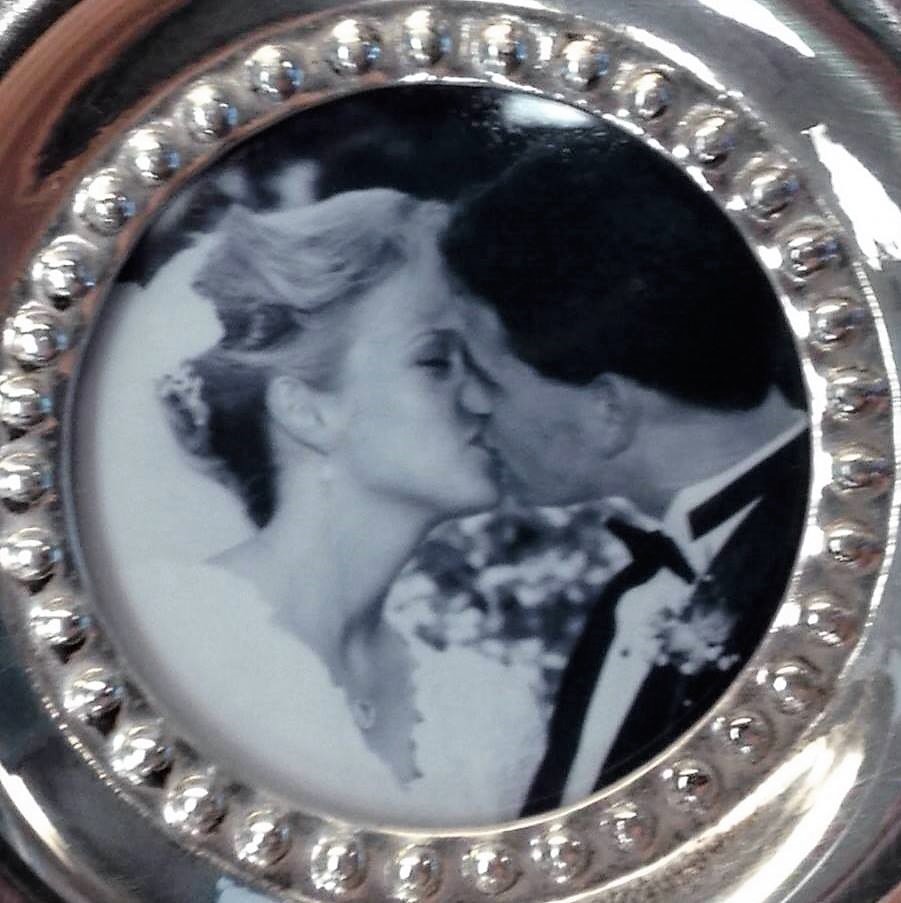
Wedding Photo

We were denied our 26th anniversary two years ago when cancer took you a week before. Now I’ve had to endure what should have been our 27th and 28th without you. If our vows said “until death do us part,” why does it feel as though part of me died when cancer took you? Happy anniversary, Lisa. I’m doing the best I can without you. Thank goodness for the kids. And fuck cancer.

Stage Whiplash

1808366

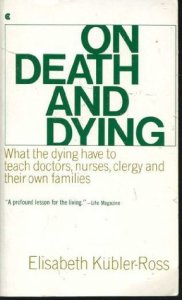
“There is not much sense in suffering, since drugs can be given for pain, itching, and other discomforts. The belief has long died that suffering here on earth will be rewarded in heaven. Suffering has lost its meaning.”                                                                                                                        Elisabeth Kübler-Ross

When Elisabeth Kübler-Ross wrote this in her groundbreaking 1969 book, On Death and Dying, she was, of course speaking of the patient, the person dying. In the book, she famously describes the “stages” the terminally ill patient goes through: Denial, Anger, Bargaining, Depression, Acceptance. The book was not meant to be considered a research study, a point she repeatedly makes. She also emphasizes that these stages may be skipped, occur concurrently or be returned to on the way to Acceptance. And yet we suffer. We all suffer.

As I watch my wife go through this process, I cannot help but realize how similar the process is for the caregiver, the family members, and the survivors. We, too, are passing back, through, over, and around these stages in our effort to understand what is happening to our loved one. My initial Denial and Anger had given way to Bargaining (“this is our new normal, we’ll take as much time as we can get”), when on any given day, I can slip easily into Depression and back to Anger only to wake up the next day after a dream in Denial. No seatbelt or ABS brake can prevent that whiplash.

I cannot imagine a day when I have reached Acceptance because Kübler-Ross also wrote:

 “The reality is that you will grieve forever. You will not ‘get over’ the loss of a loved one; you will learn to live with it. You will heal and you will rebuild yourself around the loss you have suffered. You will be whole again but you will never be the same. Nor should you be the same nor would you want to.”

Am I grieving already? Yes. Am I confusing the “stages” and grieving? Perhaps. All I know is that each day (and often times several times within a day) brings a new emotion for which I am unprepared, I thought I had made peace with, or I anticipated would bring me peace, only to find myself confused and lost again. And one of the worst emotions I carry is that I know that while I am suffering the whiplash of these stages, I am not the one dying, I am not the one suffering or actually going through Kübler-Ross’s stages of the terminally ill. As she also wrote, “Guilt is perhaps the most painful companion of death.” Suffering has lost its meaning because we all still suffer.