ConText

I have a confession. I was never exposed to most of the world’s best literature in high school.  Except for Mr. DeAngelis’s English class, where Shakespeare came alive, I have spent, much like disposable income, the personal time left over from life’s obligations, playing catch up with the rest of society by reading “the classics.”

Of course, no two lists of “Top 100 Books of All Time” are the same, but there is enough similarity between them all to create a market basket of tomes from which I feed. In fact, I was as condescending and derisive about Audible.com (“Nobody has read to me since I was a toddler. I can read by myself now!”) as I was about Toy Story‘s computer generated animation (“this is an abomination. Walt Disney must be rolling over in his grave!”). However, two things changed my mind. First, I loved Toy Story. Indeed, as always, it is the story that must first captivate us. The medium is secondary. (Also, Walt Disney was a pioneer in animation and, I think, would have embraced digital animation and become its greatest ambassador.) Second, my new job necessitates a one hour commute each way, five days a week. After several months, I found FM radio repetitive and AM radio repulsive. Enter Audible.com. For two hours a day I am able to immerse myself in another world, worlds created by the best authors humanity has ever known, allowing me to purge road rage and traffic jams from my thoughts as I move from one masterpiece to another. This “disposable time” is now my refuge.

I am also addicted to the internet and the instant access to information. As anyone who has read any article here knows, there are seldom entries made without various quotes or references from other sources. The smartest people know they are not smart and never stop learning. Who am I to think any different? I know I am not as smart as them!

So, it was with apprehension that I accepted the challenge posed to me by my son to write a post about a singular passage from the Bible “with this as your only inspiration. No quotes, research, other opinions. Just your reaction/thoughts.” Here, then, is my only source:

 “I do not nullify the grace of God, for if righteousness comes through the law, then Christ died needlessly.” – Galatians 2:21

 My first task is to understand the quote, excised from context. With my only clue being that it came from the Bible, I can make certain assumptions. The first being that the writer is religious and therefore considers God’s law above man’s. This spawns several thoughts.

First, although all civilizations are manmade, the majority of them are based on a morality based in some religious teaching, whether Christianity, Islam, Buddhism, or some other geographically concentrated religion. If this be so, then the quote is not altogether honest in its division of God’s law and man’s. Here in the United States, the religious right is always describing how this country was founded on Christian principles (Whether this has led to the systematic exclusion of “others” with different beliefs (here in the land of the free) is a discussion for another day). Therefore, if this country was founded on Christian beliefs, then the difference between God’s law and man’s is negligible and the argument moot.

Second, is this quote not a concatenation of two very different concepts? Whether righteousness comes from man’s law or God’s, that is not, as I understand it, the reason Christ died. Is not Christianity based on the concept that God sent his only son to earth with the expectation that he would be crucified for our sins? Again, as I understand it, repentance, even on one’s death bed after a life of debauchery and sin, grants one the proverbial “golden ticket” to everlasting paradise in heaven. If this be so, then neither God’s law nor man’s has any bearing on righteousness as long as one repents at the final hour. And if this be so, then why is there civilization at all? Why not selfish chaos all over the world? Is there a base level of kindness and compassion captured in no “law” other than our own desire to live, provide and thrive? Is compassion the “righteousness” referenced in the passage?

Finally, this quote, or the concept it attempts to convey, has been used (bastardized) countless times over the course of humanity’s time on this earth to disregard man’s law under the assumption one is doing “God’s will.” If one believes man’s law can be superseded by God’s, then the legal system of a civilization no longer carries any weight on the consciousness of the criminal. Think of the Crusades or the Nazis or any of the countless nitwits on Twitter calling for the execution of President Obama because he is some kind of  socialist usurper working to overthrow the republic in some Islamic globalization fantasy. Delusion (and a belief in a “higher law” as absolution) is the hallmark and calling card of the anarchist. But this does not make their actions righteous.

In summary, I think this quote is misguided and disingenuous. It attempts to assimilate the reason for Christ’s death with a link between God’s law and man’s that cannot be divided. Again, this is all taken out of context with no research or context, but too often, Bible quotes are taken out of context in order to “prove” a point. In what other book can one simply quote a chapter number and verse number in order to prove one’s superiority over another (less-read) human? I’ll keep reading.

The Wolfe of Main Street

1004607

“You can’t go back home to your family, back home to your childhood … back home to a young man’s dreams of glory and of fame … back home to places in the country, back home to the old forms and systems of things which once seemed everlasting but which are changing all the time – back home to the escapes of Time and Memory.”

Published in 1940, two years after the loquacious author Thomas Wolfe unexpectedly died, You Can’t Go Home Again belongs to a select group of novels whose title has entered American speech as a catch phrase. Catch-22 also enjoys this status of being a book few have read but we all seem to use the phrase in daily life with a winking acknowledgment.

We all know what “you can’t go home again” means, but a deeper understanding of the sentiment behind the phrase yields a bountiful crop of compassionate undergrowth.

To begin with the obvious, anyone returning to their hometown following a period away notices the changes. Gone is the local drug store, replaced by a pharmacy chain. Gone is the chain toy store you once protested against when it bought out the local toy store. Gone is the barber shop at which you used to get your hair cut, where they had to use the booster seat to allow you to sit high enough for the barber, who doubled as your neighbor. Mom and Pop stores are eaten by chains, which are, in turn, swallowed by larger chains; themselves prey to the threat from the internet and online shopping. Sure, the ice cream parlor still remains, but the menu has changed, the furnishings updated, the uniforms different and the charm captured by childhood gone. Restaurants change name, fields become strip malls and the potato farm beyond the outfield has grown into a neighborhood.

Still, the phrase refers to to time not distance or travel. How often is the frustration of the dieter who weighs themselves daily validated by the comments of those who do not see the individual on a daily basis? How many times do we catch our reflection in the morning mirror wondering who that old person is staring back? So too, is the change of “home” incremental yet perpetual.  Daily life contains checklists, both mental and written, which drive our actions.

  • Get up at 6:00, eat breakfast, shower, shave, dress
  • Run to the supermarket (we need bananas and bread (critical))
  • Must stop at the Post Office to drop off the package to ensure it arrives at Aunt Clara’s before her birthday on Tuesday
  • I’d like to get to Barnes & Noble to pick up that new book Charlie was raving about
  • Dinner with the group tonight (whose house is it at?)
  • Get to bed at a “decent” time tonight. That twitch in my lower eye lid is driving me crazy.

Seldom do we slow down enough to see how much has changed. Perhaps this is done on purpose. Each of us carries a mental picture of everyone else in their mind. Ask yourself, “When was this “picture” snapped?” My image of my grandfather (my father’s father) was snapped in his basement, hovering over his workbench. When was that? 1970-something? My image of my grandmother (my father’s mother) is of her sitting at her kitchen table scratching at the incessant itching in her hands, offering me one snack after another. When was that? My image of my other grandmother (my mother’s mother) resides in actual snapshots; photographs I’ve seen which merge with stories I’ve heard from those older than me, and thus capable of holding a memory. And so it is with everyone I’ve ever met. Name someone and I will unconsciously recall a moment in time and an age of that person at which they are forever frozen. This is one of the conundrums I have with the concept of heaven. Should I die and be admitted to the ultimate club and see my paternal great-grandmother (who, in my youth seemed to be Methuselah’s age when she died), how old would she seem to me? And at what age would she appear to her great-grandmother who died when my great-grandmother was in cloth diapers in Italy?

Memories rush up to meet us without recall demands made; the mystique of “family” softened by the endless waves of time. There is a promontory rock in my hometown against which an endless line of waves crash. This rock has endured wave upon wave since before my birth and will endure them for countless millennia after I die, with little change to the rock. Ovid said, ““Dripping water hollows out stone, not through force but through persistence.” Persistence measured in thousands of years eludes my capacity of comprehension.

And while Main Street changes over time, we cannot forget that it is a two-way street. Those exposed to the daily changes accept them as the new “normal.” Times change and we have to keep up! The reinsertion of the returning local into this new equation causes an unintentional sheering of expectations from memory. The resident expects the returning friend/relative to merge with the existing daily life to which they have become accustomed through the gradual hollowing out of the stone of the local landscape. The collision of the returning individual’s memory with the resident’s daily reality, coupled with the mental image we carry of the individual, can yield conflict and confusion. Family mystique is usually best carried by those who have physically had to relocate. A myth develops over time of something the individual perceives as having been taken from them, whereas the reality is simply human beings in one small community clashing and embracing, subject to the baggage we all carry. Grudges are held, “hatred” festers, blame is assigned and emotional distance creates a gulf where no physical distance exists. To the physically removed family member, these animosities seem petty and counterproductive. Consider the view of the astronaut aboard the International Space Station looking through the port hole at the earth as it passes constantly from daylight into night and back again. How meaningless do our conflicts seem from afar? How insignificant do national borders seem, religious differences resulting in warfare, the skin color or sex of one ant from another? Unfortunately, few of us have the ability to step back and observe from such a height, even figuratively. Wolfe expands upon his catch phrase below:

 Some things will never change. Some things will always be the same. Lean down your ear upon the earth and listen.

The voice of forest water in the night, a woman’s laughter in the dark, the clean, hard rattle of raked gravel, the cricketing stitch of midday in hot meadows, the delicate web of children’s voices in bright air–these things will never change.

The glitter of sunlight on roughened water, the glory of the stars, the innocence of morning, the smell of the sea in harbors, the feathery blur and smoky buddings of young boughs, and something there that comes and goes and never can be captured, the thorn of spring, the sharp and tongueless cry–these things will always be the same.

All things belonging to the earth will never change–the leaf, the blade, the flower, the wind that cries and sleeps and wakes again, the trees whose stiff arms clash and tremble in the dark, and the dust of lovers long since buried in the earth–all things proceeding from the earth to seasons, all things that lapse and change and come again upon the earth–these things will always be the same, for they come up from the earth that never changes, they go back into the earth that lasts forever. Only the earth endures, but it endures forever.

The tarantula, the adder, and the asp will also never change. Pain and death will always be the same. But under the pavements trembling like a pulse, under the buildings trembling like a cry, under the waste of time, under the hoof of the beast above the broken bones of cities, there will be something growing like a flower, something bursting from the earth again, forever deathless, faithful, coming into life again like April.”

Can all of this be summarized as “stop to smell the roses?” Maybe, but we never seem to take the time to add it to our list of things to do.

We can go home again, if only in our memories, and there, we have never left.

Shooting an Elephant – Again and Again

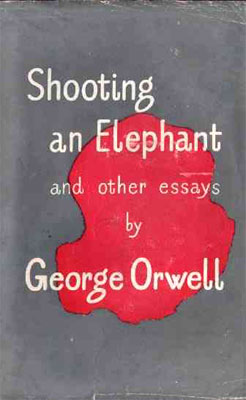
ShootingAnElephantIn 1936, George Orwell penned the following article in the autumn of 1936 for New Writings magazine in London. While rife with political analogies, the story, at face value, is compelling and disturbing. Having recently read it, I re-post it here in light of NBC’s decision to air the inhumane hunting show Under Wild Skies and the recent news that 90 of these gentle animals were poisoned with industrial cyanide in Zimbabwe by poachers eager for their tusks. Please read it and consider the consequences.

Shooting an Elephant

In Moulmein, in Lower Burma, I was hated by large numbers of people — the only time in my life that I have been important enough for this to happen to me. I was sub-divisional police officer of the town, and in an aimless, petty kind of way anti-European feeling was very bitter. No one had the guts to raise a riot, but if a European woman went through the bazaars alone somebody would probably spit betel juice over her dress. As a police officer I was an obvious target and was baited whenever it seemed safe to do so. When a nimble Burman tripped me up on the football field and the referee (another Burman) looked the other way, the crowd yelled with hideous laughter. This happened more than once. In the end the sneering yellow faces of young men that met me everywhere, the insults hooted after me when I was at a safe distance, got badly on my nerves. The young Buddhist priests were the worst of all. There were several thousands of them in the town and none of them seemed to have anything to do except stand on street corners and jeer at Europeans.

All this was perplexing and upsetting. For at that time I had already made up my mind that imperialism was an evil thing and the sooner I chucked up my job and got out of it the better. Theoretically — and secretly, of course — I was all for the Burmese and all against their oppressors, the British. As for the job I was doing, I hated it more bitterly than I can perhaps make clear. In a job like that you see the dirty work of Empire at close quarters. The wretched prisoners huddling in the stinking cages of the lock-ups, the grey, cowed faces of the long-term convicts, the scarred buttocks of the men who had been flogged with bamboos — all these oppressed me with an intolerable sense of guilt. But I could get nothing into perspective. I was young and ill-educated and I had had to think out my problems in the utter silence that is imposed on every Englishman in the East. I did not even know that the British Empire is dying, still less did I know that it is a great deal better than the younger empires that are going to supplant it. All I knew was that I was stuck between my hatred of the empire I served and my rage against the evil-spirited little beasts who tried to make my job impossible. With one part of my mind I thought of the British Raj as an unbreakable tyranny, as something clamped down, in saecula saeculorum, upon the will of prostrate peoples; with another part I thought that the greatest joy in the world would be to drive a bayonet into a Buddhist priest’s guts. Feelings like these are the normal by-products of imperialism; ask any Anglo-Indian official, if you can catch him off duty.

One day something happened which in a roundabout way was enlightening. It was a tiny incident in itself, but it gave me a better glimpse than I had had before of the real nature of imperialism — the real motives for which despotic governments act. Early one morning the sub-inspector at a police station the other end of the town rang me up on the phone and said that an elephant was ravaging the bazaar. Would I please come and do something about it? I did not know what I could do, but I wanted to see what was happening and I got on to a pony and started out. I took my rifle, an old .44 Winchester and much too small to kill an elephant, but I thought the noise might be useful in terrorem. Various Burmans stopped me on the way and told me about the elephant’s doings. It was not, of course, a wild elephant, but a tame one which had gone ‘must’. It had been chained up, as tame elephants always are when their attack of ‘must’ is due, but on the previous night it had broken its chain and escaped. Its mahout, the only person who could manage it when it was in that state, had set out in pursuit, but had taken the wrong direction and was now twelve hours’ journey away, and in the morning the elephant had suddenly reappeared in the town. The Burmese population had no weapons and were quite helpless against it. It had already destroyed somebody’s bamboo hut, killed a cow and raided some fruit-stalls and devoured the stock; also it had met the municipal rubbish van and, when the driver jumped out and took to his heels, had turned the van over and inflicted violences upon it.

The Burmese sub-inspector and some Indian constables were waiting for me in the quarter where the elephant had been seen. It was a very poor quarter, a labyrinth of squalid bamboo huts, thatched with palmleaf, winding all over a steep hillside. I remember that it was a cloudy, stuffy morning at the beginning of the rains. We began questioning the people as to where the elephant had gone and, as usual, failed to get any definite information. That is invariably the case in the East; a story always sounds clear enough at a distance, but the nearer you get to the scene of events the vaguer it becomes. Some of the people said that the elephant had gone in one direction, some said that he had gone in another, some professed not even to have heard of any elephant. I had almost made up my mind that the whole story was a pack of lies, when we heard yells a little distance away. There was a loud, scandalized cry of ‘Go away, child! Go away this instant!’ and an old woman with a switch in her hand came round the corner of a hut, violently shooing away a crowd of naked children. Some more women followed, clicking their tongues and exclaiming; evidently there was something that the children ought not to have seen. I rounded the hut and saw a man’s dead body sprawling in the mud. He was an Indian, a black Dravidian coolie, almost naked, and he could not have been dead many minutes. The people said that the elephant had come suddenly upon him round the corner of the hut, caught him with its trunk, put its foot on his back and ground him into the earth. This was the rainy season and the ground was soft, and his face had scored a trench a foot deep and a couple of yards long. He was lying on his belly with arms crucified and head sharply twisted to one side. His face was coated with mud, the eyes wide open, the teeth bared and grinning with an expression of unendurable agony. (Never tell me, by the way, that the dead look peaceful. Most of the corpses I have seen looked devilish.) The friction of the great beast’s foot had stripped the skin from his back as neatly as one skins a rabbit. As soon as I saw the dead man I sent an orderly to a friend’s house nearby to borrow an elephant rifle. I had already sent back the pony, not wanting it to go mad with fright and throw me if it smelt the elephant.

The orderly came back in a few minutes with a rifle and five cartridges, and meanwhile some Burmans had arrived and told us that the elephant was in the paddy fields below, only a few hundred yards away. As I started forward practically the whole population of the quarter flocked out of the houses and followed me. They had seen the rifle and were all shouting excitedly that I was going to shoot the elephant. They had not shown much interest in the elephant when he was merely ravaging their homes, but it was different now that he was going to be shot. It was a bit of fun to them, as it would be to an English crowd; besides they wanted the meat. It made me vaguely uneasy. I had no intention of shooting the elephant — I had merely sent for the rifle to defend myself if necessary — and it is always unnerving to have a crowd following you. I marched down the hill, looking and feeling a fool, with the rifle over my shoulder and an ever-growing army of people jostling at my heels. At the bottom, when you got away from the huts, there was a metalled road and beyond that a miry waste of paddy fields a thousand yards across, not yet ploughed but soggy from the first rains and dotted with coarse grass. The elephant was standing eight yards from the road, his left side towards us. He took not the slightest notice of the crowd’s approach. He was tearing up bunches of grass, beating them against his knees to clean them and stuffing them into his mouth.

I had halted on the road. As soon as I saw the elephant I knew with perfect certainty that I ought not to shoot him. It is a serious matter to shoot a working elephant — it is comparable to destroying a huge and costly piece of machinery — and obviously one ought not to do it if it can possibly be avoided. And at that distance, peacefully eating, the elephant looked no more dangerous than a cow. I thought then and I think now that his attack of ‘must’ was already passing off; in which case he would merely wander harmlessly about until the mahout came back and caught him. Moreover, I did not in the least want to shoot him. I decided that I would watch him for a little while to make sure that he did not turn savage again, and then go home.

But at that moment I glanced round at the crowd that had followed me. It was an immense crowd, two thousand at the least and growing every minute. It blocked the road for a long distance on either side. I looked at the sea of yellow faces above the garish clothes-faces all happy and excited over this bit of fun, all certain that the elephant was going to be shot. They were watching me as they would watch a conjurer about to perform a trick. They did not like me, but with the magical rifle in my hands I was momentarily worth watching. And suddenly I realized that I should have to shoot the elephant after all. The people expected it of me and I had got to do it; I could feel their two thousand wills pressing me forward, irresistibly. And it was at this moment, as I stood there with the rifle in my hands, that I first grasped the hollowness, the futility of the white man’s dominion in the East. Here was I, the white man with his gun, standing in front of the unarmed native crowd — seemingly the leading actor of the piece; but in reality I was only an absurd puppet pushed to and fro by the will of those yellow faces behind. I perceived in this moment that when the white man turns tyrant it is his own freedom that he destroys. He becomes a sort of hollow, posing dummy, the conventionalized figure of a sahib. For it is the condition of his rule that he shall spend his life in trying to impress the ‘natives’, and so in every crisis he has got to do what the ‘natives’ expect of him. He wears a mask, and his face grows to fit it. I had got to shoot the elephant. I had committed myself to doing it when I sent for the rifle. A sahib has got to act like a sahib; he has got to appear resolute, to know his own mind and do definite things. To come all that way, rifle in hand, with two thousand people marching at my heels, and then to trail feebly away, having done nothing — no, that was impossible. The crowd would laugh at me. And my whole life, every white man’s life in the East, was one long struggle not to be laughed at.

But I did not want to shoot the elephant. I watched him beating his bunch of grass against his knees, with that preoccupied grandmotherly air that elephants have. It seemed to me that it would be murder to shoot him. At that age I was not squeamish about killing animals, but I had never shot an elephant and never wanted to. (Somehow it always seems worse to kill a large animal.) Besides, there was the beast’s owner to be considered. Alive, the elephant was worth at least a hundred pounds; dead, he would only be worth the value of his tusks, five pounds, possibly. But I had got to act quickly. I turned to some experienced-looking Burmans who had been there when we arrived, and asked them how the elephant had been behaving. They all said the same thing: he took no notice of you if you left him alone, but he might charge if you went too close to him.

It was perfectly clear to me what I ought to do. I ought to walk up to within, say, twenty-five yards of the elephant and test his behavior. If he charged, I could shoot; if he took no notice of me, it would be safe to leave him until the mahout came back. But also I knew that I was going to do no such thing. I was a poor shot with a rifle and the ground was soft mud into which one would sink at every step. If the elephant charged and I missed him, I should have about as much chance as a toad under a steam-roller. But even then I was not thinking particularly of my own skin, only of the watchful yellow faces behind. For at that moment, with the crowd watching me, I was not afraid in the ordinary sense, as I would have been if I had been alone. A white man mustn’t be frightened in front of ‘natives’; and so, in general, he isn’t frightened. The sole thought in my mind was that if anything went wrong those two thousand Burmans would see me pursued, caught, trampled on and reduced to a grinning corpse like that Indian up the hill. And if that happened it was quite probable that some of them would laugh. That would never do.

There was only one alternative. I shoved the cartridges into the magazine and lay down on the road to get a better aim. The crowd grew very still, and a deep, low, happy sigh, as of people who see the theatre curtain go up at last, breathed from innumerable throats. They were going to have their bit of fun after all. The rifle was a beautiful German thing with cross-hair sights. I did not then know that in shooting an elephant one would shoot to cut an imaginary bar running from ear-hole to ear-hole. I ought, therefore, as the elephant was sideways on, to have aimed straight at his ear-hole, actually I aimed several inches in front of this, thinking the brain would be further forward.

When I pulled the trigger I did not hear the bang or feel the kick — one never does when a shot goes home — but I heard the devilish roar of glee that went up from the crowd. In that instant, in too short a time, one would have thought, even for the bullet to get there, a mysterious, terrible change had come over the elephant. He neither stirred nor fell, but every line of his body had altered. He looked suddenly stricken, shrunken, immensely old, as though the frightful impact of the bullet had paralysed him without knocking him down. At last, after what seemed a long time — it might have been five seconds, I dare say — he sagged flabbily to his knees. His mouth slobbered. An enormous senility seemed to have settled upon him. One could have imagined him thousands of years old. I fired again into the same spot. At the second shot he did not collapse but climbed with desperate slowness to his feet and stood weakly upright, with legs sagging and head drooping. I fired a third time. That was the shot that did for him. You could see the agony of it jolt his whole body and knock the last remnant of strength from his legs. But in falling he seemed for a moment to rise, for as his hind legs collapsed beneath him he seemed to tower upward like a huge rock toppling, his trunk reaching skyward like a tree. He trumpeted, for the first and only time. And then down he came, his belly towards me, with a crash that seemed to shake the ground even where I lay.

I got up. The Burmans were already racing past me across the mud. It was obvious that the elephant would never rise again, but he was not dead. He was breathing very rhythmically with long rattling gasps, his great mound of a side painfully rising and falling. His mouth was wide open — I could see far down into caverns of pale pink throat. I waited a long time for him to die, but his breathing did not weaken. Finally I fired my two remaining shots into the spot where I thought his heart must be. The thick blood welled out of him like red velvet, but still he did not die. His body did not even jerk when the shots hit him, the tortured breathing continued without a pause. He was dying, very slowly and in great agony, but in some world remote from me where not even a bullet could damage him further. I felt that I had got to put an end to that dreadful noise. It seemed dreadful to see the great beast Lying there, powerless to move and yet powerless to die, and not even to be able to finish him. I sent back for my small rifle and poured shot after shot into his heart and down his throat. They seemed to make no impression. The tortured gasps continued as steadily as the ticking of a clock.

In the end I could not stand it any longer and went away. I heard later that it took him half an hour to die. Burmans were bringing dash and baskets even before I left, and I was told they had stripped his body almost to the bones by the afternoon.

Afterwards, of course, there were endless discussions about the shooting of the elephant. The owner was furious, but he was only an Indian and could do nothing. Besides, legally I had done the right thing, for a mad elephant has to be killed, like a mad dog, if its owner fails to control it. Among the Europeans opinion was divided. The older men said I was right, the younger men said it was a damn shame to shoot an elephant for killing a coolie, because an elephant was worth more than any damn Coringhee coolie. And afterwards I was very glad that the coolie had been killed; it put me legally in the right and it gave me a sufficient pretext for shooting the elephant. I often wondered whether any of the others grasped that I had done it solely to avoid looking a fool.

1936

THE END

Give The People What They Want

Give The People What They Want

I am many things.

Male

White

Short

Overweight

Middle aged

Married

College educated

New England raised

Living in Texas

A son

A husband

A father

An uncle

A nephew

A friend

An enemy

Blue-eyed

Left handed

Employed full-time

Middle class

Homeowner

Car owner

Non-smoker

Independent

I am all of these things and these are measurable demographics used by all manner of people and organizations in order to sell me things and, in politics, theoretically, represent me.

Having been raised in Rhode Island, I grew up thinking the majority of the country was just like me, white, Catholic, middle class. There were blacks and Jews in school with me, and while they were the minority, I did not treat them any differently, nor did they see me (I hope) as an oppressor. They were my friends and part of my world.

As I grew, I began to see the political landscape of Rhode Island as the basis for the fabric of America. At the same time, I joined the workforce and began to understand Churchill’s remark:

“Show me a young Conservative and I’ll show you someone with no heart. Show me an old Liberal and I’ll show you someone with no brains.”

Rhode Island politics is dominated by trade unions. Democrats control the legislature and the state constitution essentially renders the Governor moot. As I began to bring home part-time, high school student paychecks with deductions to anagrams I did not understand, I began to think like a conservative (Republican). I worked for this money; don’t give it to somebody else. Business drives the economy. Without jobs there are no unions. Ayn Rand would have been very proud. But in retrospect, I think this reaction was more a rebellion against the Rhode Island Democrat mindset and less a political ethos. Taxes were too high, handouts too easy and I did not feel my hard work was being protected in the state house. I was a Conservative with no heart.

As with everybody, as we get older, the world gets smaller. College, just next door in neighboring Connecticut, opened my eyes to other religions. No longer was Catholicism the dominant religion. No longer did liberal tendencies dictate legislation. So, too, were these the days of Ronald Reagan’s trickle-down economy. As a burgeoning economics major, this philosophy made sense and met with my understanding and expectation of things. However, as a college student trying to get loans and seeing my parents struggle to shoulder the weightiest financial burden for two college aged children with a third coming up through the ranks, coupled with the seemingly never ending string of corruption issues emanating from the Reagan administration, my conservative leanings were shaken. Was this a reaction to the financial situation I found myself in? Was it a reaction to the broadening of my understanding of the country and the world? Or was it simply another shift against the grain?

Careers, a marriage and parenthood quickly followed. Once again, I found myself trying to provide for my family and build a career in an economy growing under Clinton’s watch through economic structures established by his Republican predecessors. And once again, living in the Rhode Island Union, I saw the expansion of social programs as a long term detriment to the local economy, but those were heady times and we were all (relatively) happy living on the dotcom bubble. When that burst, and September 11, 2001 hit, Rhode Island was slow to respond to the economic crisis that ensued. Like the rest of the country, I was angry and wanted to strike back at somebody for the evil perpetrated on my neighbors (Boston, from where the flights originated and New York). Following the morally damaged presidency of Clinton, I fell into the political pit warned about by Bertrand Russell when I voted for W:

“Our great democracies still tend to think that a stupid man is more likely to be honest than a clever man.”

I had ascribed FDR’s tenet, “I’m not the smartest fellow in the world, but I can sure pick smart colleagues” to W and assumed he would do the same. Unfortunately, I think Kurt Vonnegut put it best when he said:

“The last thing I ever wanted was to be alive when the three most powerful people on the whole planet would be named Bush, Dick and Colon.”

My wife’s diagnosis with an aggressive breast cancer in 2008 forced us to reevaluate our lives. Because family and her survival weighed so much more over career and home, we picked up stakes and moved to Texas to seek treatment at the University of Texas M.D. Anderson Cancer Center in Houston.

At first, this change of environment seemed to meet my expectations and stereotypes. Southerners were friendly and slower. Northerners were rude and always in a hurry. I ignored the conservative predispositions of Texas even though Texas-bred W took us to war in Iraq over bogus intelligence and OBL and the Taliban hid in the lawless Hindu Kush on the Afghanistan/Pakistan border. And even though Rick Perry, W’s intellectual equal, continued to gut the education system and pilfer jobs from other states, it didn’t matter to me as long as my wife was receiving the best medical treatment. My once expanded understanding of the world didn’t matter to me when my family was suffering.

Then, on December 14th of 2012, while working on my laptop at the hospital while my wife was undergoing restaging tests, news broke of a shooting at an elementary school in Connecticut. I read with horror as first the casualty total rose and then it was reported that children were among the victims. That day, coupled with the local reaction in the following weeks caused a seismic shift in my perception and attitude. No longer was Texas the friendly, slow state with questionable education standards and a job-pilfering, slow-witted governor, now it showed itself to be a gun loving, religious zealot, paranoid, racist, American anachronism. Unfortunately, as time elapsed, I came to understand that this political/religious background was neither limited to Texas, nor the south. “Red” states throughout the country began to show their prejudices, paranoia, fear and hatred. The “Gun Control” debate had ripped the genteel mask of civility off of otherwise, (seemingly) generous people. I saw the people who attended the NRA’s Annual Paranoia Jamboree here in Houston. I argued with them. I argued with the dimwitted grandfather who brought his grandson to a gun control rally in Austin to argue for more gun rights. I was scheduled to debate a state senator, who had introduced a firearm protection act, on television, until he chickened out. I had become a liberal without a brain.

And then it hit me. The Kinks were right!

Why, I asked myself, was I always going against the grain? Why were my political positions always running counter to the culture in which I lived? How could I be represented by people so contrary to my positions? Lightbulb! Ted Cruz was elected by people who were pleased by what he claimed to represent. Louie Gohmert was elected by people who believe what he believes. Steve Stockman was elected by people as deranged as him. And so it is. Give the people what they want.

And so, the reason congress is in a perpetual state of paralysis is because America is in a perpetual state of paralysis. We seek to impose our ideal democratic notion on the rest of the world while ignoring fractures at home. Russian president Vladimir Putin wrote, warning America not to consider ourselves exceptional. George Bernard Shaw wrote,

“Patriotism is, fundamentally, a conviction that a particular country is the best in the world because you were born in it….”

The fact I find most interesting is that Congress has a 19% approval rating, according to Gallup. If we elect representatives who represent our interests and convictions, why is our approval of the job they do so low? At heart, are we not happy with our own convictions? The devil is in the details and it is this process that divorces concept (patriotism and democracy) from reality (legislation and personal responsibility). We cannot give the people what they want because they are not prepared to work for that which they think they deserve.

Syriasly?

chemweapon

Protocol for the Prohibition of the Use in War of Asphyxiating, Poisonous or other Gases, and of Bacteriological Methods of Warfare.  Signed at Geneva, June 17, 1925.

French and English official texts communicated by the President of the Council, Minister for Foreign Affairs of the French Republic.  The registration of this Protocol took place September 7, 1929.

THE UNDERSIGNED PLENIPOTENTIARIES, in the name of their respective Governments :

Whereas the use in war of asphyxiating, poisonous or other gases, and of all analogous liquids, materials or devices, has been justly condemned by the general opinion of the civilised world; and

Whereas the prohibition of such use has been declared in Treaties to which the majority of Powers of the world are Parties; and

To the end that this prohibition shall be universally accepted as a part of International Law, binding alike the conscience and the practice of nations;

DECLARE:

That the High Contracting Parties, so far as they are not already Parties to Treaties prohibiting such use, accept this prohibition, agree to extend this prohibition to the use of bacteriological methods of warfare and agree to be bound as between themselves according to the terms of this declaration.

The High Contracting Parties will exert every effort to induce other States to accede to the present Protocol. Such accession will be notified to the Government of the French Republic, and by the latter to all signatory and acceding Powers, and will take effect on the date of the notification by the Government of the French Republic.

The present Protocol, of which the French and English texts are both authentic, shall be ratified as soon as possible. It shall bear today’s date.

The ratification of the present Protocol shall be addressed to the Government of the French Republic, which will at once notify the deposit of such ratification to each of the signatory and acceding Powers.

The instruments of ratification of and accession to the present Protocol will remain deposited in the archives of the Government of the French Republic.

The present Protocol will come into force for each signatory Power as from the date of deposit of its ratification, and, from that moment, each Power will be bound as regards other Powers which have already deposited their ratifications.

Signed by 138 countries. Signed by United States 6/17/1925. Signed by Syria 12/17/1968

Organisation for the Prohibition of Chemical Weapons

Chemical Weapons Convention

Articles

Article I. General Obligations

1. Each State Party to this Convention undertakes never under any circumstances:

(a) To develop, produce, otherwise acquire, stockpile or retain chemical weapons, or transfer, directly or indirectly, chemical weapons to anyone;

(b) To use chemical weapons;

(c) To engage in any military preparations to use chemical weapons;

(d) To assist, encourage or induce, in any way, anyone to engage in any activity prohibited to a State Party under this Convention.

2. Each State Party undertakes to destroy chemical weapons it owns or possesses, or that are located in any place under its jurisdiction or control, in accordance with the provisions of this Convention.

3. Each State Party undertakes to destroy all chemical weapons it abandoned on the territory of another State Party, in accordance with the provisions of this Convention.

4. Each State Party undertakes to destroy any chemical weapons production facilities it owns or possesses, or that are located in any place under its jurisdiction or control, in accordance with the provisions of this Convention.

5. Each State Party undertakes not to use riot control agents as a method of warfare.

Signed by 189 countries. Signed by United States 1/13/1993 Syria has not signed.

As a critic of the sea of steel the United States finds itself drowning in, namely the 310,000,000 firearms flooding society, I find the current debate regarding the potential use of military force in Syria to be humorous if it weren’t, like the gun debate, so deadly serious.

One of the arguments I hear all too often by the gun-hugging, “patriot” crowd (other than the banal argument that toting an arsenal around to get a skinny latte at Starbucks is a “God given right”), is the equally numb “criminals don’t follow the law” line. Because “they” don’t, these “patriots” argue, there is no sense in having common sense gun legislation such as universal background checks. This simplistic argument, if taken to its logical conclusion would suggest that we abolish all laws because, by definition, criminals don’t follow the law. Indeed, the Tea Party would suggest that we abolish the IRS, the Department of Education and the… uh, um, what’s the third one there? Let’s see… Oops. Of course, it is always every other department, other than the one which constitutes 20% of the federal budget, defense. When you spend $718 billion a year on defense, it becomes reasonable to want to play with the toys that Santa War brought you.

Which brings me to Syria and the mirror-image response many Americans have to Syria versus the gun debate. The United States and its citizens have assumed the mantle of “the world’s policeman” bestowed upon itself through the confluence of being the “victor” of the Cold War and the permanent paralysis of the UN to act. Unfortunately, one cannot be the policeman of the world with its altruistic, justice-seeking mandate and be a world power with “national interests” flavoring every decision. “Rescuing” Kuwait from Saddam’s clutches followed by two Gulf wars to “free” Iraq and another war  to “stabilize” Afghanistan have done little to convince the rest of the world that we are not just another mammoth imperial entity trying to dictate our ethos (and capitalism couched as democracy) on a misguided world. Our blind eye to the people suffering in Sudan, Congo, Somalia, Kashmir, Darfur notwithstanding, we are on the side of right; God is on our side. And therein lays the problem.

President Obama said in Stockholm today, “I didn’t set a red line — the world set a red line.” If that is the case, then the UN should handle the investigation and response. Of course, it might be faster to watch the polar ice caps melt than wait for the UN to act. If the world set the red line, then where is the international outrage and rush to punishment some Americans are salivating for? The UK listened to David Cameron’s position and said, no thanks. Where is the coalition of forces massing on the border to overthrow Assad and bring him to The Hague for crimes against humanity? I’ll wait.

The suffering of the people in Syria is horrific. The videos leaked on social media of the chemical attack show unconscionable pain. But being a country that suffered through its own civil war (has there ever been a more oxymoronic phrase in the English language?), imagine the headlines had France or Russia bombed Washington, D.C. in 1863 because Union forces were using steel ships. Why didn’t England bomb Paris in 1789 because French troops were busy shooting Gavroche? Why didn’t the United States bomb Pretoria or Cape Town when apartheid kept 85% of the population under the control of the white 15%?

Why? Because there is law; because if we ignore the law we are the criminals. Laws without punishment are impotent. The answer is not to abolish the laws, but to enforce them. If they have no teeth, change them. This is neither earth-shaking nor “God given”, but merely common sense. If Syria has chemical weapons in violation of the 1925 Geneva Protocol, the UN should send in inspectors to confiscate them under the tip of a multilateral UN-backed coalition of forces. Again, law with consequences. If the “good guy” with a gun suddenly becomes the “bad guy” with a gun, he should have his gun taken away from him under the tip of US-backed law enforcement. Laws must have consequences when violated. Unfortunately, the Congress will likely authorize “surgical strikes” (another military oxymoron) on Syria and continue to ignore the blood stained streets of America under a hail of gunfire and simple-minded patriotism. God bless the USA.

Character Candling

candling egg

From Merriam Webster:

candle (transitive verb): to examine by holding between the eye and a light; especially : to test (eggs) in this way for staleness, blood clots, fertility, and growth

Have you ever looked at a word you’ve written a thousand times as though it couldn’t possibly be spelled that way? You doubt yourself, double check it in the dictionary and carry on. I have recently had the opportunity to reassess personal relationships I’ve held sacred, but upon examination found I have done so without a compelling reason.  No longer a child, I held up these individuals to the same light of reason, logic, compassion and magnanimity  to which I would hope to be judged, not unlike candling an egg. Rather than record my observations, I sought insight from those more intelligent. Here are my thoughts via their appropriated words, alpha by author:

“Children’s talent to endure stems from their ignorance of alternatives.”     Maya Angelou

“Beware the man of a single book.”     St. Thomas Aquinas

“Never let your sense of morals prevent you from doing what is right.”     Isaac Asimov

“The basic stimulus to the intelligence is doubt, a feeling that the meaning of an experience is not self-evident.”     W.H. Auden

“I think we risk becoming the best informed society that has ever died of ignorance.”     Reuben Blades

“If you think education is expensive, try ignorance.”     Derek Bok

“There is no such uncertainty as a sure thing.”     Robert Burns

“The evil that is in the world almost always comes of ignorance, and good intentions may do as much harm as malevolence if they lack understanding.”     Albert Camus

“Never underestimate the power of stupid people in large groups.”     George Carlin

“The IQ and the life expectancy of the average American recently passed each other in opposite directions.”     George Carlin

“I prefer tongue-tied knowledge to ignorant loquacity.”     Marcus Tullius Cicero

“I am not ashamed to confess I am ignorant of what I do not know.”     Marcus Tullius Cicero

“He only employs his passion who can make no use of his reason.”     Marcus Tullius Cicero

“To live is to think.”     Marcus Tullius Cicero

“Confidence is ignorance. If you’re feeling cocky, it’s because there’s something you don’t know.”     Eoin Colfer

“Real knowledge is to know the extent of one’s ignorance.”     Confucius

“Ignorance is the night of the mind, a night without moon or star.”     Confucius

“The essence of knowledge is, having it, to apply it; not having it, to confess your ignorance.”     Confucius

“He who knows all the answers has not been asked all the questions.”     Confucius

“Where ignorance is our master, there is no possibility of real peace.”     Dalai Lama

“Ignorance more frequently begets confidence than does knowledge: it is those who know little, not those who know much, who so positively assert that this or that problem will never be solved by science.”     Charles Darwin

“And, in fine, of false sciences I thought I knew the worth sufficiently to escape being deceived by the professions of an alchemist, the predictions of an astrologer, the impostures of a magician, or by the artifices and boasting of any of those who profess to know things of which they are ignorant.”     René Descartes

“Military guys are rarely as smart as they think they are, and they’ve never gotten over the fact that civilians run the military.”     Maureen Dowd

“He who joyfully marches to music in rank and file has already earned my contempt. He has been given a large brain by mistake, since for him the spinal cord would surely suffice.”     Albert Einstein

“The measure of intelligence is the ability to change.”     Albert Einstein

“You are not entitled to your opinion. You are entitled to your informed opinion. No one is entitled to be ignorant.”     Harlan Ellison

“Fear always springs from ignorance.”     Ralph Waldo Emerson

“There are many things of which a wise man might wish to be ignorant.”     Ralph Waldo Emerson

“If we encounter a man of rare intellect, we should ask him what books he reads.”     Ralph Waldo Emerson

“Talk sense to a fool and he calls you foolish.”     Euripides

“Anger exceeding limits causes fear and excessive kindness eliminates respect.”     Euripides

“The test of a first-rate intelligence is the ability to hold two opposed ideas in the mind at the same time and still retain the ability to function.”     F. Scott Fitzgerald

“Stupidity lies in wanting to draw conclusions.”     Gustave Flaubert

“Being ignorant is not so much a shame, as being unwilling to learn.”     Benjamin Franklin

“The doorstep to the temple of wisdom is a knowledge of our own ignorance.”     Benjamin Franklin

“The only thing more expensive than education is ignorance.”     Benjamin Franklin

“We are all born ignorant, but one must work hard to remain stupid.”     Benjamin Franklin

“I wash my hands of those who imagine chattering to be knowledge, silence to be ignorance, and affection to be art.”     Kahlil Gibran

“There is nothing more frightful than ignorance in action.”     Johann Wolfgang von Goethe

“Point me out the happy man and I will point you out either extreme egotism, selfishness, evil — or else an absolute ignorance.”     Graham Greene

“If you’re gonna be stupid you gotta be tough.”     John Grisham

“The greatest enemy of knowledge is not ignorance, it is the illusion of knowledge.”     Stephen Hawking

“Man’s mind, once stretched by a new idea, never regains its original dimensions.”     Oliver Wendell Holmes Sr.

“The recipe for perpetual ignorance is: Be satisfied with your opinions and content with your knowledge.”     Elbert Hubbard

“God will not look you over for medals, degrees or diplomas but for scars.”     Elbert Hubbard

“The learned man knows that he is ignorant.”     Victor Hugo

“The tax which will be paid for the purpose of education is not more than the thousandth part of what will be paid to kings, priests and nobles who will rise up among us if we leave the people in ignorance.”     Thomas Jefferson

“Those who never retract their opinions love themselves more than they love truth.”     Joseph Joubert

“The only means of strengthening one’s intellect is to make up one’s mind about nothing — to let the mind be a thoroughfare for all thoughts.”     John Keats

“People demand freedom of speech as a compensation for the freedom of thought which they seldom use.”     Søren Kierkegaard

“Nothing in the world is more dangerous than a sincere ignorance and conscientious stupidity.”     Martin Luther King, Jr.

“A fool can easily be known by what proceeds from his or her mouth.”     Adedayo Kingjerry

“Living is easy with eyes closed.”     John Lennon

“Having children makes you no more a parent than having a piano makes you a pianist.”     Michael Levine

“I do not think much of a man who is not wiser today than he was yesterday.”     Abraham Lincoln

“A good head and good heart are always a formidable combination. But when you add to that a literate tongue or pen, then you have something very special.”     Nelson Mandela

“Military intelligence is a contradiction in terms.”     Groucho Marx

“A book lying idle on a shelf is wasted ammunition.”     Henry Miller

“We have now sunk to a depth at which restatement of the obvious is the first duty of intelligent men.”     George Orwell

“I would prefer an intelligent hell to a stupid paradise.”     Blaise Pascal

“And whenever anyone informs us that he has found a man who knows all the arts, and all things else that anybody knows, and every single thing with a higher degree of accuracy than any other man –whoever tells us this, I think that we can only imagine him to be a simple creature who is likely to have been deceived by some wizard or actor whom he met, and whom he thought all-knowing, because he himself was unable to analyze the nature of knowledge and ignorance and imitation.”     Plato

“A little learning is a dangerous thing; Drink deep, or taste not the Pierian spring; There shallow draughts intoxicate the brain, And drinking largely sobers us again.”     Alexander Pope

“There is no reply to the ignorant like keeping silence.”     Proverb

“Discussion is an exchange of knowledge; an argument an exchange of ignorance.”     Robert Quillen

“When ignorance gets started it knows no bounds.”     Will Rogers

“The fundamental cause of the trouble is that in the modern world the stupid are cocksure while the intelligent are full of doubt.”     Bertrand Russell

“A stupid man’s report of what a clever man says can never be accurate, because he unconsciously translates what he hears into something he can understand.”     Bertrand Russell

“Two things are to be remembered: that a man whose opinions and theories are worth studying may be presumed to have had some intelligence, but that no man is likely to have arrived at complete and final truth on any subject whatever. When an intelligent man expresses a view which seems to us obviously absurd, we should not attempt to prove that it is somehow true, but we should try to understand how it ever came to seem true. This exercise of historical and psychological imagination at once enlarges the scope of our thinking, and helps us to realize how foolish many of our own cherished prejudices will seem to an age which has a different temper of mind.”     Bertrand Russell

“Ignorant people see life as either existence or non-existence, but wise men see it beyond both existence and non-existence to something that transcends them both; this is an observation of the Middle Way.”     Seneca

“There is no darkness but ignorance.”     William Shakespeare

“A knavish speech sleeps in a fool’s ear.”     William Shakespeare

“The fool doth think he is wise, but the wise man knows himself to be a fool.”     William Shakespeare

“The shortest route to courage is absolute ignorance.”     Dan Simmons

“There is only one good, knowledge, and one evil, ignorance.”     Socrates

“It’s an universal law– intolerance is the first sign of an inadequate education. An ill-educated person behaves with arrogant impatience, whereas truly profound education breeds humility.”     Aleksandr Solzhenitsyn

“It is better to remain silent at the risk of being thought a fool, than to talk and remove all doubt of it.”     Maurice Switzer

“The stupid neither forgive nor forget; the naive forgive and forget; the wise forgive but do not forget.”     Thomas Stephen Szasz

“Ignorance and inconsideration are the two great causes of the ruin of mankind.”     John Tillotson

“We can know only that we know nothing. And that is the highest degree of human wisdom.”     Leo Tolstoy

“All you need in this life is ignorance and confidence, and then success is sure.”     Mark Twain

“Ignorance is a virus. Once it starts spreading, it can only be cured by reason. For the sake of humanity, we must be that cure.”     Neil deGrasse Tyson

“He must be very ignorant for he answers every question he is asked.”     Voltaire

“The more I read, the more I acquire, the more certain I am that I know nothing.”     Voltaire

“If your brains were dynamite there wouldn’t be enough to blow your hat off.”     Kurt Vonnegut

“Irony is wasted on the stupid.”     Oscar Wilde

“The public have an insatiable curiosity to know everything, except what is worth knowing.”     Oscar Wilde

“He had just about enough intelligence to open his mouth when he wanted to eat, but certainly no more.”     P.G. Wodehouse

“Ignorance is not bliss – it is oblivion.”     Philip Wylie

“Rich people have small TVs and big libraries, and poor people have small libraries and big TVs.”     Zig Ziglar

Which quote is your favorite?

Mine?

“Many wearing rapiers are afraid of goosequills.”     William Shakespeare.

Although you may recognize it as:

“The pen is mightier than the sword (or gun).”

Year One

blog

I started this blog one year ago tomorrow. Not that I expected anybody to read it, but as a way for me to pour burning liquid emotion onto my keyboard in hopes of having it coalesce on the screen into something resembling understanding, logic or rationality in order for me to carry on. All too often, I have failed.

My first post was simply a reposting of a blog entry made by Jessica Redfield who had escaped a mass shooting at the Eaton Center in Toronto. She had posted it on June 5th. One year ago tonight, she was one of twelve murdered and 58 wounded at the Century movie theater in Aurora, Colorado during a midnight screening of The Dark Knight Rises. Here, frozen forever, is her last Twitter post:

JessicaRedfield Twitter

Having been cast to live in Texas as a result of the world-class medical facilities at the University of Texas M.D. Anderson Cancer Center and seeing them as the best chance we had to fight my wife’s rare and aggressive breast cancer, I had become increasingly angry at the cavalier attitude Texans have with their guns. The “Come and Take It” crowd, most of them displaying Zimmerman-like bravado (when armed with a firearm), hiding anatomic shortcomings (if shoe size is a true indicator and not some urban legend) and compensating by driving the tallest, most ridiculous looking monster-trucks legal to drive on public roads.  The shooting in Aurora drove me to write. It was a cathartic exercise.

Mixed with equal parts sarcasm, anger, depression and pomposity, I put down in words my boiling rage. A few comments popped up, although in the vast universe of the internet I have no idea how these people tripped over my little blog. And so it went. Until December 14th.

I was sitting at the hospital while my wife was being restaged when the first news reports began to flash about a shooting at an elementary school in Connecticut. A shooting at an elementary school will be very traumatic for the children, I thought, assuming that the victim(s) would be adults involved in a deadly dispute of some kind. Slowly the details emerged. Children were among the victims and their numbers kept climbing. Like most of the world, I read the reports in disbelief, hoping for a clarification from the news outlets of a terrible mistake. Instead, the numbers continued to climb. More children were injured; more children were among the dead.  Like many other dates that are seared into our collective consciousness, I will never forget where I was when I heard the news. My wife and I made the hour drive home from the hospital that evening, although I cannot remember actually steering the car. That night, I shook.

The next day I told my wife that I needed to do something, anything to try to change the world in which I had sentenced my children to live. I was ashamed for my previous inaction and tacit acceptance of gun violence; I was ashamed for the country. The rest of the world looked upon America as a land populated by blood-thirsty renegades armed better than Dirty Harry with a fuse shorter than a Bruce Willis’s hair. Surely, after this mind-skewing, paradigm shift, Washington would act responsibly? Americans would demand it! Politicians would push and shove their way to the front of the line to co-sign responsible gun legislation! Unaware of any grassroots organizations and devoid of any previous political activism, I reached out to the one group I knew with a history of fighting the gun lobby, the Brady Campaign.

“I haven’t had a representative in the Houston area for three years,” said the head of the Texas Brady chapter. Roll that around in your head for a second. Houston is the country’s fourth largest city with a population of over 2 million people and the Brady Campaign has no local chapter? Hell, Connecticut has three!

And yet, in spite of my newly embraced activism, it all still seemed a little remote. I could still only partially allow myself to invite in the nightmare of what it would have been like if it had been my children. Emotionally, as a parent, as a human, it was a door I was only willing to open a crack, lest the devastating emotion behind it drown me. That all changed on a conference call.

The head of the Texas chapter of the Brady Campaign invited me to participate in a call with hundreds of other members and a guest speaker. It was scheduled for Monday, January 7th at 5:00. Because I was still at work, I stayed late and joined the call already in progress. There was a woman speaking with intimate knowledge of the shooting in Aurora. I listened intently, but removed and muted. However, as I listened, I began to piece together who the speaker was. At the moment my mind made the connection, she spoke the words that will forever haunt me. It was Jessica Redfield’s mother, and she was describing, in vivid detail, the events of that night and how, where and why her daughter had been murdered. I could no longer prevent that nightmarish door from opening. Jessica Redfield’s mother was telling me how that door had been ripped from its hinges and cast into space. Suddenly, it was all very real. I had come full circle. What I had started in July as an angry blog by simply cutting and pasting an entry from a theater shooting victim had brought me to listening to the mother of that same victim on a January night. Surreal. Emotional. Devastating. Goose bumps. Real.

I assumed I would write a few articles and make a few calls on behalf of the Brady Campaign. However, soon, word spread and I was being asked to speak at local area democratic clubs. Then I was asked to debate a state representative on a local PBS television program. (The Tea Party twit backed out at the last minute!) Immediately, armed with logic, a rational ethos and compassion, my inner Toby Ziegler/Josh Lyman/Josiah Bartlet took over. I carried photos of the Sandy Hook victims in my wallet. My speech ballooned to 45 minutes. I was able to scan the crowd, in front of whom I was soon to speak, and pick out the planted RWNJ’s itching to ask me to define an assault weapon. It became my personal goal to piss off at least one person in the crowd at each speech, although living in Texas, that was not a lofty challenge. Panel discussions followed and more speeches.

But soon, I found that while the name “Brady Campaign” got me in the door to speak, they did little else locally. I believe the Brady Campaign in Washington continues to do wonderful things standing up to the vitriol of the NRA and battling in state legislatures across the country. However, I needed to belong to something at the local level. What I found was my gender shutting me out of the most amazing group of people I had met in this fight.

It seemed that whenever I was asked to speak, so too was a rotating posse of equally exorcised and like-minded members of the Houston chapter of the newly formed Moms Demand Action for Gun Sense in America, or just Moms Demand Action. These women were phenomenal. Educated, passionate and ready to go toe-to-toe with any gun rights wing nut, this group of similarly accidental activists bolstered my spirits and strengthened my resolve. Fuck not with a mama bear protecting her cubs, lest you unleash her limitless wrath. Enrage 100,000 of them and I pity the NRA. In short, they were the grassroots organization I longed for. I longed to be an “honorary Mom.”

We saw each other everywhere. From speech to speech, there they were. They were on-stage at a rally on the steps of the state capitol in Austin where I managed to get into a verbal confrontation with a RWNJ who tried to crash the proceedings (with his young grandson in tow). They were at a protest outside the Houston-hosted, annual paranoia jamboree (officially known as the NRA Annual Conference) where, again, I got to piss off a different RWNJ. It was there that I saw Neil Heslin, father of Jesse Lewis. Jesse was just one of the 20 children murdered at Sandy Hook. I stood ten feet from Mr. Heslin and wanted to speak to him, but my brain could conceive of no combination of words that could pacify him or rally him. What could I say that didn’t sound shallow, condescending or meaningless?  His eyes conveyed a pain, a hollowness that seemed to match the emptiness he must have felt inside, an ember and ash hole where his heart had once lived, a void which Jesse once filled.  I also saw Erica Lafferty, daughter of Dawn Hocksprung, principal of Sandy Hook and one of the first killed on that still inconceivable day. Ms. Lafferty had the same look of pain, but also a sense of fury behind her eyes that I wanted to bottle. And the Moms were there at a press conference with United States Representative Sheila Jackson Lee outside the Rothko Chapel commemorating Dr. Martin Luther King, Jr. and beseeching the Senate not to filibuster the Manchin-Toomey amendment. This was a cause with character (and characters). I was not alone in this. There were now faces and voices with which I could bond.

And so, it has been one year since Aurora and 217 days since Newtown. The challenges that lie before us are still all there. Washington is still lethargic and paralyzed. The Texas legislature has passed 14 laws weakening gun laws. Countless assault rifles have been sold to those paranoid “patriots” convinced that the president will come knocking on their door to confiscate their guns. And the American public, with their fruit fly length memory and fickle attention span have moved on to other more current atrocities, shifting their outrage to a new target, resigned to the fact that their demand for gun control legislation (within the confines of our instant gratification society) was not fulfilled.

 Brady Fact Sheet

It has been one year since Aurora. One year, but for me, this is only Year One. We haven’t done enough. But we are not alone and we are not dissuaded. In a country awash in guns, there will be another mass shooting. Americans will again display their transient outrage and, maybe, Washington will listen. It is a long road through an unfair and uneven process, but change will come. We will be here fighting for those who cannot. And when change does come, ask yourself, “What did I do?” Let this be your Year One.

Observations from a Recent Holiday

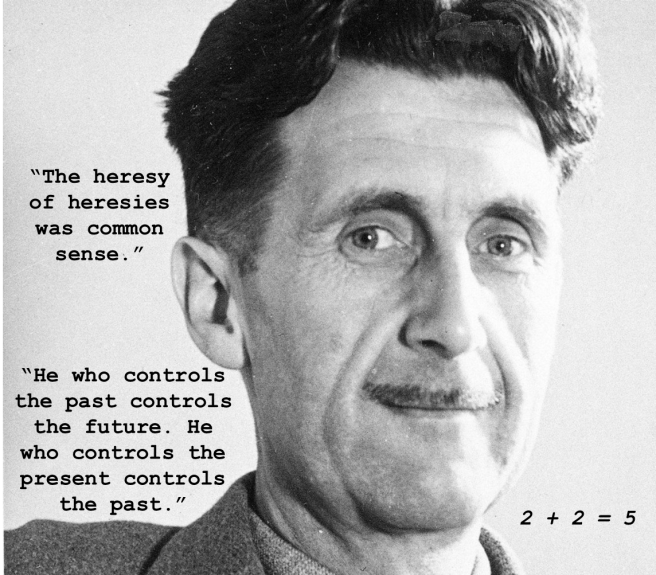
Orwell 1984

War is Peace

Freedom is Slavery

Ignorance is Strength

George Orwell, Nineteen Eighty-Four

A change in my wife’s chemotherapy regimen recently opened up the opportunity for us to visit Paris and London. It was originally supposed to be an early 25th anniversary gift to my wife last September (our 23rd anniversary), but a sudden, nasty infection forced us to cancel the trip hours before we were to leave for the airport. Crestfallen doesn’t begin to cover our disappointment. When presented with this window of time (before she began a new phase II clinical trial), we decided to schedule a last minute trip and take our twins with us who were home from their freshman year at college.

Armed with my own agenda of sights and attractions I wished to see, I found that instead, I saw the trip through the eyes of my family. My daughter, studying fine art and enamored with art history, provided me with a different appreciation of the architecture, style, culture and art of these cities that I would otherwise have missed. My son, the philosopher, showed me the political and societal differences beyond language that I would otherwise have missed. My wife, showed me that while the Champs Elysses essentially looked like Fifth Avenue or Oxford Street or any chain-choked mall in suburban America, it was the small side streets two blocks removed from the tourist centers that offered the best food, flowers and shopping. And together, they all agreed that while it was important to tick-off as many items from our “bucket list” as possible, we all enjoyed and appreciated sitting at a sidewalk café eating tomato, basil and mozzarella sandwiches on the most amazing bread while watching the world go by the most. To a person, we all agreed that we wished it was our second trip to these wonderful cities so that we could immerse ourselves in the local culture and pace without the pressure of “seeing” everything. I was forcing us to run everywhere, to the detriment of my wife and the chagrin of my children.

Having never traveled outside the country before, it was also interesting to see both how other countries existed, but also how they perceived Americans.

My son noticed (and was not a little bothered by) the soldiers patrolling the Eiffel Tower armed with very large weapons. So too did he notice the constant government monitoring in London via video cameras. These were visible on motorway markers and Tube stations, as well as mentioned repeatedly on notices throughout the city. Ironic, that London (Airstrip 1), would spark this observation in my son. Although to be fair, the only mustachioed poster we saw was not of Big Brother but of Brad Pitt on a poster for World War Z. We neither saw Winston Smith, nor any IngSoc signs.

Rather, I had an interesting conversation (or perhaps only a glimpse of a conversation) with the taxi driver (who was an (East) German expat). Sitting in the passenger seat of the small minivan on the way to the apartment we were renting, he asked me where we were from.

Instinctively, I replied, over the whine of the small engine, “The States.”

“Not Canada?” he asked, shooting me a quick, knowing look.

I admit that it took me a few seconds to digest the meaning of his question. Full of ourselves for being the “world’s police,” United States citizens somehow have managed to believe that we can belittle the rest of the world’s population while assuming  we are both more civilized and, therefore, more entitled and have convinced ourselves that the rest of the world is somehow beholden to us. Apparently, more cautious travelers hide their US heritage beneath a more innocuous Canadian visage.  Surely an interesting question from an ex-East German citizen obviously more sensitive to European viewpoints of Americans than me!

Other, more obvious, observations include the size of the cars driven. Nowhere did we see the parade of Tahoe’s, Suburban’s or tricked-out F-150’s that I see on my way to work here in Houston on a daily basis. Rather, the number of Vespa’s, motorcycles and bicycles moving like fruit flies in and out of traffic in Paris showed that the sudden appearance of a Suburban near the Arc du Triomph would generate both a traffic jam and trigger an enormous number of iPhone photos. All of the cars were very small, and yet, we saw no horrific accidents (or even a fender bender). And while they drive aggressively, there is no animosity in their intentions. It is simply a matter of getting from point A to point B. Perhaps “Road Rage” is an American phenomenon (which, coupled with the number of guns in our population can only lead to more problems). Something else we noticed was the absence of bumper stickers on the cars. There were no French flags or Union Jacks on the rear windows, no stick figures of every family member, no honor roll declarations, no personalized high school football/basketball/baseball/swimming/band/dance stickers, no NRA stickers, no Molon Labe stickers, no Come and Take It stickers, no NASCAR stickers, not even stickers of universities or professional sports teams. Apparently, rear view windows are there to provide visual clearance and bumpers are there to absorb collisions rather than replace our Facebook pages.

Another observation was the amount of complaining we heard. Parisians are very animated in their discussions with those with whom they are dining. And yet, there was, again, no animosity in their demeanor. While I couldn’t possibly understand what they were discussing, the physical cues they exhibited showed them to be in stark difference on whatever subject they were discussing. And while voices were occasionally raised, never once (and this goes for London’s pubs as well) did I feel that a disagreement was about to escalate into a brawl. That cannot be said for most places I’ve been in America. Testosterone and bravado seem to flood the American male much quicker than their European counterparts. In fact, the only complaining we heard in all of the lines we stood in was from Americans.

The gardens at Versailles are enormous, dwarfing the colossal chateau itself. As my wife is saddled with the side effects of chemotherapy (and despite her Herculean spirit), we thought it was a wonderful idea to rent a golf cart to tour the gardens, rather than expend her energy walking the estate. The firm contracted to provide the carts could expand their supply a hundredfold to meet the demand, therefore, the line was long and did not move quickly. As we (finally) reached the front of the line, the young man working there, who spoke English and was of Indian decent) took me aside and said that his family was visiting him in France and he was going to give them the next cart. My first thought was, hey, those are the perks of working here! Good for you! However, the woman from Kansas two couples behind us was not so understanding and went on and on about how she would have done this and that to the kid, blah, blah, blah. Truly, the only complaining we heard was from Americans.

I am not naïve enough to think that everything we saw was perfect, nor that what we did see constituted the “average” life of a citizen of these cities. However, there were stark differences and while I continue to struggle with paralysis in Washington, the torpid national response to everyday gun violence in America, the wholesale abdication of personal responsibility, the vitriol of the Tea Party, the ongoing religious hypocrisy of the right wing, the adoration of celebrity, the acceptance of lower educational performance, the increasing fracturing of societal ethos, epistemic closure as an unintended consequence of the internet and the vapid, ossified acid spewed on AM radio, I am reminded that is up to us to make tomorrow better than today. Our children are watching, and so is the rest of the world, and like our children, they will not wait.

GUEST POST: From a Friend

05nra_span_cnd-superJumbo

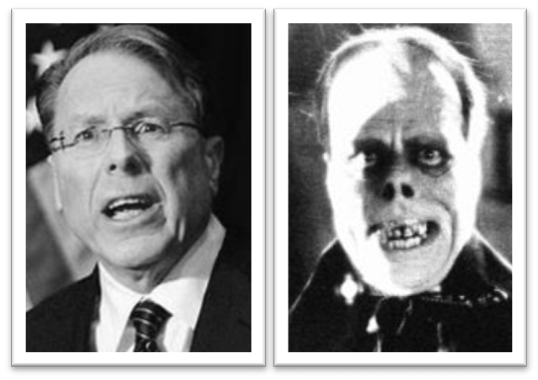
Today, NRA Vice President Wayne LaPierre asked the question in his NRA conference keynote speech “How many Bostonians wished they had guns two weeks ago?”, while rhetorical, I took the time to answer.

Wayne,
I can’t speak for everybody in the city, but when I was terrified for my life and all sense of security, the first thing that I thought of was not “I wish I had a firearm”, in fact, that thought was probably the last thing in my mind. I didn’t even begin to entertain that possibility until long after things had settled down. And when I did entertain that possibility for a fleeting moment, I cast it aside as baseless paranoia that would only endanger in the long run, not protect. My first thoughts were about my loved ones and a desire to stay safe through smarts, caring, and a trust of those authorities that remained. Not through a desire to display my ‘self-defense’ by having the leverage to impose a threat upon others, but though a solidarity in my community that was holding each other in its arms, and not pointing its arms at each other.

What I learned a few weeks ago is that if those impulses to have a gun and succumb to your fear are what strikes you immediately, you are probably an unstable person. You are probably a frightened person, and you are probably buying a gun in this spur of the moment decision out of a personal fear. Because its the easy way out, and we’re inclined to take that action as human beings. But it’s also the dangerous way out, people make horrible decisions while dictated by fear, that’s one of the reasons why terrorism is horrifically dangerous. If me and thousands of other Bostonians had a gun, things may have been escalated to state of uncontained paranoia, with shots fired at people mistaken for a home intruder, or a naive view of a who the terrorists were leading to the slaying of individuals who were outside who were Chechnyan, muslim, or whatever John King was suggesting the bombers were at a given time. Because that’s what happened without a gun, some people got assaulted, or yelled at, or falsely accused, but at least they didn’t die. Fatal actions occur when we act on our fear instead of acting with tact and logic. The situation may have been a lot worse if we all had guns.

But many say these events were a sign of a police state. Yet, trough trusting the state government of Massachusetts, and the Watertown and Boston Police Departments, we still were not in a police state, we were in a middle ground where we respected government instructions and everything turned out OK. What the NRA and Wayne LaPierre fail to understand is that a firearm is not the ultimate way to be defensive, and that it’s not the only way to be safe. It turns out, when it does its job right, government protects. So does staying smart, and listening to instructions and advisories can save lives a whole lot more than giving each individual an unbelievable power to slay. Just because we have the right to a well-regulated militia, doesn’t mean we should depend on it at the first sign of panic. These things should only be used when all other options are gone, and we shouldn’t be using fear and vitriol as the NRA does to suggest that all other options are gone.

So yeah, that’s my little ramble about why the actions that shook my life didn’t impact me enough to get a firearm, nor will I get one in case I am ever afraid in the future. Fear can make monsters of us all, and the last thing a monster needs is a weapon.

I don’t know, I may just be crazy to think this, but at least I’m not Wayne LaPierre crazy.

Your pal,

Boston Strong

BlinkerMan!

550px-Turn_signals_4
Is this the hand of BlinkerMan?

This is the story of one Lionel Moore, accountant, pizza aficionado and, who, on a cold March morning, became the hero/vigilante known as BlinkerMan.

Where he came from and where he lives now does not matter. The car he drives is known only in whispers and hushed tones, based on the unreliable reports of witnesses and passersby. Some claim it to be an old Mercury Grand Marquis, the color of which is debated as grey, tan or white. Others claim it is either a Honda CR-V or a Toyota RAV4. Still others claim it is not a car at all, but a blue 1964 Vespa. His actions have taken place in areas as widespread as Middletown, Rhode Island and Storrs, Connecticut to Burke, Virginia and Houston, Texas. It seems the only thing people can agree on, whether supporters or detractors, is that he was there and he made a difference.

The first reported incident occurred in Rhode Island in March of 1983 in the town neighboring that picturesque seaside tourist destination, Newport. Witnesses claim that following one particularly long red light on West Main Road, a disadvantaged late model red Ford Explorer, devoid of the once ubiquitous directional stem coming off of the steering column changed lanes without notice. According to eyewitnesses, what followed is reported here:

“All I did was change lanes,” claims Bob (whose last name was withheld at his request).

“It’s true,” said 86 year old Mary P. of Bristol, “I was behind him when he suddenly pulled in front of me. There was no warning, no directional light, nothing!”
Thanks to the cat-like reflexes of Mary P. she was able to swerve onto the sidewalk and avoid an accident only to mow down the prized rose bush of Middletown resident Sadie McQwerty and come to a stop only after pinning her rose bush and mailbox to Ms. McQwerty’s garage door.

“It’s sad,” said Ms. McQwerty, “Where is the governmental oversight? How can we, as law abiding citizens, be forced to purchase automobiles without the directional stem being required on all cars? There was a time once, when all cars had blinkers. Not now. I can’t believe we have to endure this. I miss that rose bush. You know, I tried to prune it back after the accident to see if it could be saved, but her rear tire snapped the bud union and there was no saving it.”

Which leaves this reporter to wonder, was Ms. McQwerty’s rose bush the first fatality caused by the automobile manufacturer’s assembly line malfeasance? Of course, what happened next caused a statewide stir and generated newspaper headlines and letters to the editor for weeks afterward.

According to Bob (whose last name is still being withheld at his request), unaware of the rose bush murder taking place behind him, he continued northward on West Main Road when:

“All of a sudden, this car came up on the right side of my Explorer and, out of the corner of my eye I saw his driver’s side window going down. The next thing I knew my passenger side window exploded inward, covering the Big Mac I was eating while driving in shards of broken glass, and lying next to my fries, covered in special sauce was a directional stem! I took the stem, wiped the special sauce on my shirt and stuck it in the hole on the steering column in which I used to keep my lit cigarette while I was texting and driving. It fit like a charm! I clicked it down and the left blinker blinked! I clicked it up and the right blinker blinked! I don’t know who that person was but they’re a hero to me!”

And so it was that reports started to surface, first in Rhode Island and then further out into Connecticut of windows being smashed and directional stems appearing. In one particularly strange occurrence, outside of a Panera north of Houston, Texas last week, a patron who had arrived at the restaurant earlier in the afternoon found a directional stem tucked under the windshield wiper of their pickup truck.

“What struck me odd, in addition to the stem, which I had never seen before, was how BlinkerMan was able to get it up under the windshield wiper of my truck. As you can see, my truck is a good twelve feet off the ground.”

As if to prove the point, eighteen year old Austin Bibble removed the specially constructed stepladder assembly from under his truck’s chassis and leaned it against the open driver’s side door in order to climb up into his vehicle.

“See, it’s not easy! I don’t know how he did it. Oh, look, I can see Oklahoma from up here!”

Reports of this kind now seem commonplace across America. It seems that BlinkerMan continues to traverse the roadways of our nation, constantly on the prowl for cars not equipped with directionals, smashing windows and leaving their startled drivers with a safety device once under consideration by many in Washington, D.C. as mandatory and in the public’s best interest, but whose existence was snuffed out by the ever behemoth NRA who claimed back in 2006 that the requirement of these implements was an infringement of the Second Amendment.

“We fought to have that particular piece of legislation struck down because it was only created by misinformed and uneducated liberals who sought to penalize the good law abiding people of this country by requiring this so-called “safety” device. We saw it for what it was, a backdoor attempt to extend this to a national gun registry and the first steps toward a run up to a national Day of Confiscation of all guns,” replied Wayne LaPierre while clutching his custom red, white and blue leather wrapped AR-15 with a particularly fetching American flag wrapped silencer.

When asked if he ever personally used the directional in his car, Mr. LaPierre replied, “I have told my driver to NEVER use that symbol of an overreaching Obamastan tyrannical government, or I would shoot him.”

Attempts to reach BlinkerMan have failed repeatedly. Requests posted on his Facebook page and Twitter accounts have gone unanswered. Unconfirmed reports out of Hollywood claim that a movie version is being planned with Woody Allen in the lead role and Lon Chaney in full Phantom of the Opera makeup as Wayne LaPierre. According to Mr. Allen, “Hey, it can’t be worse than the Hulk.”

Phantom Wayne
Phantom Wayne

Here is a How-To link for those unfamiliar with the concept. More on this story as it develops. Until then, drive safely.