Pointillism Polemics

Isolation became as much a pandemic as the COVID-19 virus that caused it. And the social paradigm shift left in its long wake continues to affect millions of people. Social pastimes such as going to the movies, going out to dinner, visiting friends and relatives, comedy clubs, concerts, art shows, vacations to amusement parks and bucket-list cities all foundered. And like the millions of virus victims, many of these venues and pastimes did not survive.

We were left to entertain ourselves at home. And some of us did this better than others. The American Journal of Emergency Medicine said domestic violence cases increased by 25% and 33% globally, with an increase in the United States by over 8%. In my house, crafts replaced excursions. It began when my daughter, Samantha, came to my house wearing a stylish three-ply mask she fashioned from a curtain. In what might have been a humorous episode of a sitcom (you fill in the blank), she proceeded to sew another mask at the dining room table while watching me try to do the same with her guidance. Ultimately, my finished product was less fashionable and (probably) less effective. Still, I wore it to the grocery store until better masks were readily available. I still have it. 

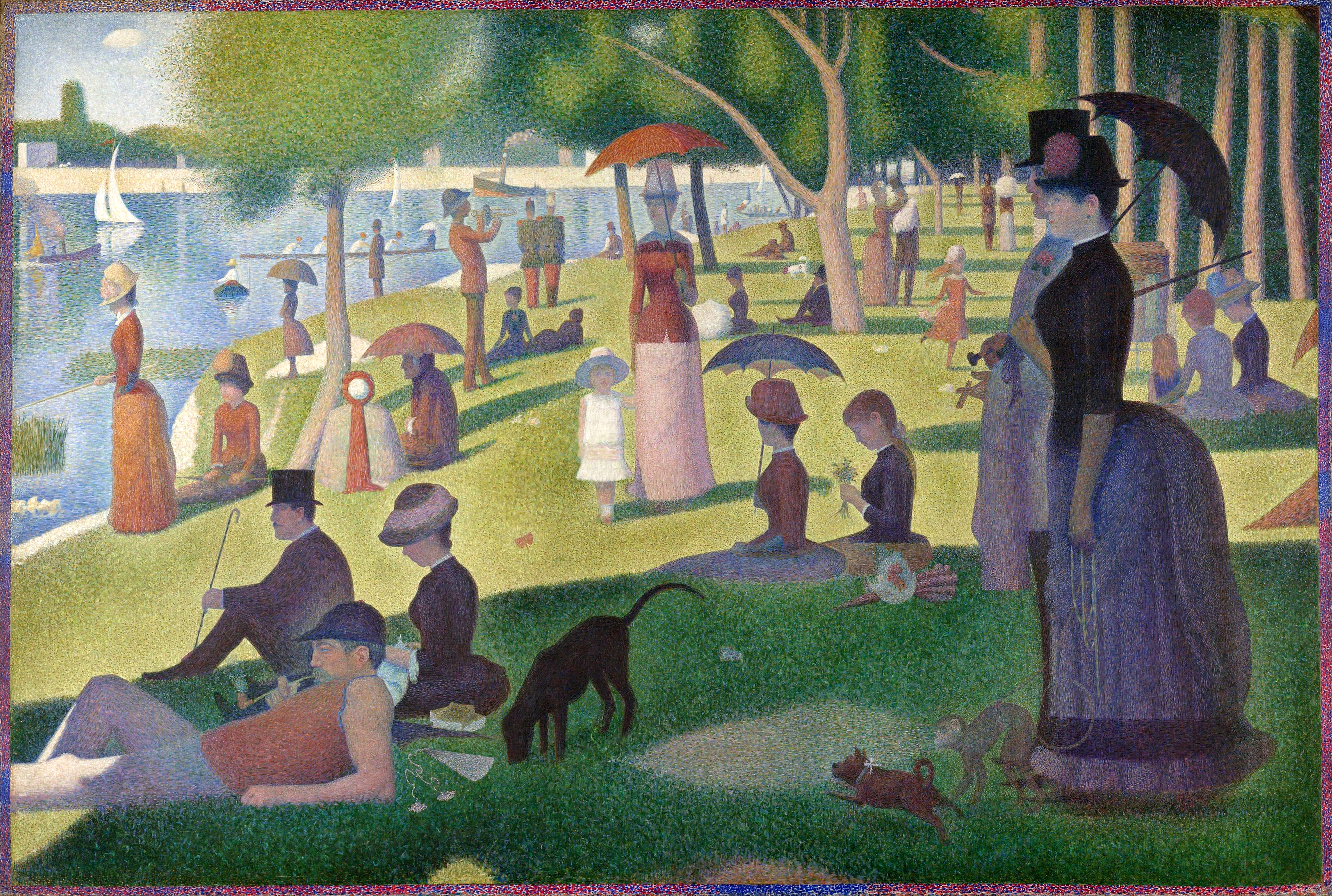
And then there were the crafts. Let me back up. Pointillism is a method of painting developed by Georges Seurat and others in 1886. It is an offshoot of the impressionists (Monet, Manet, Cassatt, Degas, Pissarro, Renoir, and Cezanne). In pointillism, artists use dots of paint to form images. It was the precursor to pixels on televisions, monitors, and cell phones. Seurat’s most famous painting is A Sunday Afternoon on the Island of La Grande Jatte

Incidentally, my son Cameron and daughter Samantha saw the 2017 revival of the Sondheim penned Sunday in the Park with George musical on Broadway; itself a fascinating statement on art, artists, people, humanity, and human interaction as the painting comes alive before the audience. Little did we know how human interaction would be a recipe for a lethal worldwide pandemic just three short years later. Ironically, Johnson & Johnson, supplier of one of the COVID-19 vaccines, was created in the same 1886 that Georges Surat created pointillism. Pfizer was formed in 1849. Thanks, Google.

Art proved to be the salve for my family and me. And as a corollary to my last post, art proved once again to forestall being lost. This time, while writing continued to provide me a venue to consolidate my disparate thoughts, “dipping dots” consumed our time and provided hours of entertainment (and a few sore necks!). Of course, they are not called “dipping dots.” Those are the frozen pebbles of ice cream found at hockey games and stadiums. I refer to the tiny, colorful plastic dots (or squares) on a sticky canvas.


My wife (and sometimes my two stepdaughters (although typically, they would start a project and we would finish it)) saw these projects devour hundreds of hours of quarantine and isolation during the pandemic. I also know every word to every pop song played on the radio over the last 50 years as we listened to these songs on a loop while working our dipping dots. These craft projects (I differentiate here between creating (art) and producing (crafts) so as not to offend artists who create original works) were terrific distractions from the horror of the pandemic and the schism of politics.

Both mindless and intoxicating, these projects consumed us. We couldn’t wait to finish working for the day so we could “dip dots.” Maybe it was a consequence of the work we each do. My wife works for an insurance company and spends most of her days in meetings. I live in Microsoft Excel spreadsheets, deep in the weeds of cells and formulas. Although we both work from home (I have worked exclusively from home since moving back to Rhode Island in 2016 while she was new to the concept, as were millions of others affected by the coronavirus), there was no tangible evidence of our daily efforts. She ends the call; I close the file. There is nothing to see, nothing to hold up as real progress or something that will exist beyond the next call or following report. Dipping Dots projects checked that box. It exists today, tomorrow, and always as a physical manifestation of effort.

Again, to create is to exist and to endure. Tiny plastic dots, pixels, or pointillism gave me a productive outlet during a worldwide pandemic and many enjoyable hours with my family. These are but a few of the many projects we completed during the lockdown. They were good times in an awful time, centering and fun while the world spun off its axis.

Fighting Eternal Oblivion with Squiggles and Cheese

As I write this, I can watch the gel ink dry behind each subsequent word. Dried into the paper, permanently a part of the wood fiber. Immortal, eternal as long as the paper exists. Put the paper in a vault, and the words live forever. There they will remain preserved, filed, recorded, and likely unread.

The same can be said of humans. As the ink dries, we move on. The relentless marching on of time. Relentless. Never ending, never pausing, never caring. Once the ink dries, it is done. It is the past. It is our past. Our memories. We are the vault. And our vault, memories, and existence exist only as long as anyone who experienced something with us or heard a story about us exists. Once we are gone and those who recall us are gone, so are our memories, the ink, the paper, and the vault. That’s life. Our life. Everyone’s life.

There will come a day when the very thought of us as individuals will be lost. There will be a day when the last person who remembers you or recalls a story about you recalls it for the last time. You will be lost to eternal oblivion. Sure, there are individuals whose memory transcends time. Shakespeare, Caesar, Keith Richards, but for most of us, we will be lost to time, just a number in the ever-expanding pile of humans that once existed.

Is there a way to combat this eternal oblivion? Or is this simply an exercise of someone who just celebrated a birthday and is reminded that the road before him is shorter than the view in the rearview mirror? And, let me add that the road before him is neither clear nor guaranteed.

Clifton Fadiman said, “A cheese may disappoint. It may be dull, it may be naïve, it may be over-sophisticated. Yet it remains cheese, milk’s leap toward immortality.” Creativity (the arts) is our antidote, our cheese. Write a book, and it remains available forever. The internet is the newer, better Library of Alexandria. Paint something, sculpt something, and it exists long after you perish.

In episode eleven of Cosmos, Carl Sagan said something I’ll never forget, “What an astonishing thing a book is. It’s a flat object made from a tree with flexible parts on which are imprinted lots of funny dark squiggles. But one glance at it and you’re inside the mind of another person, maybe somebody dead for thousands of years. Across the millennia, an author is speaking clearly and silently inside your head, directly to you. Writing is perhaps the greatest of human inventions, binding together people who never knew each other, citizens of distant epochs. Books break the shackles of time. A book is proof that humans are capable of working magic.”

Another favorite of mine, again, capable of stringing together words far better than I’ll ever dream of, Oscar Wilde said, “All art is immortal. For emotion for the sake of emotion is the aim of art, and emotion for the sake of action is the aim of life.”

So, create! Rabindranath Tagore said, “The one who plants trees, knowing that he will never sit in their shade, has at least started to understand the meaning of life.” So, plant a tree! Paint a picture! Write a story! Write your story! Eternal oblivion awaits us. Leave something behind that outlives you, outlives the memory of the last person to recall you. Will you be remembered for it? Maybe. Maybe not. However, your creation will endure.

As the ink dries on that last word, I wonder if anyone will ever read this. I wonder if anyone will ever remember it if they did read it. Create, people! Our ink is drying!

Memories, Art, and Adele

Forrest Gump is revered as a movie, in part because Forrest is a witness to or active participant in many historical events. he interacts with many cultural touchstones throughout the movie. These touchstones exist throughout popular culture, and when we participate in them or witness them, we are historians, chroniclers of culture, a modern-day Pliny.

Throughout our lives, we occasionally find ourselves in these situations. Sometimes we are unaware of the cultural significance at the moment; other times, we know we are creating memories. The birth of our child, the death of a family pet, or seeing a famous landmark on a business trip or personal vacation all qualify as these moments of instant memory. Still, at other times, we are made aware of the significance of the event we find ourselves in, either as witnesses or participants. Examples of these situations might include being in downtown Manhattan on September 11, 2001, seeing a young, unknown Jimi Hendrix perform in a nowhere club or as a background musician for another act, or seeing your favorite baseball team win in person as they start the fifteen game winning streak that propels them into the playoffs and to a World Series title. 

This is a long-winded way of saying that memories, be they known at the moment or recognized after the fact, are branded into our conscience. My father used to say, “A good day is any day you create a memory.” I would edit that to limit it to a “good” memory. Bad memories are just as searing, just not as welcomed. 

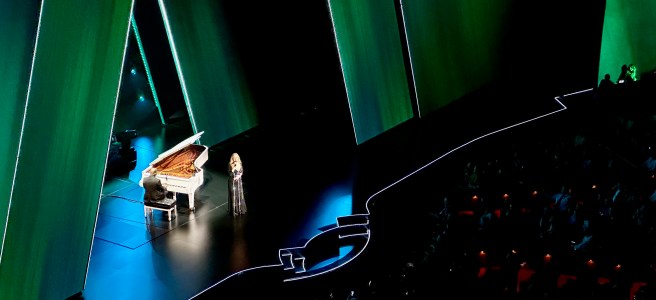
The previous few paragraphs represent the (half-formed) internal conversation I had in my head this past Saturday evening as my wife and I waited for Adele to take the stage as part of her Weekends with Adele residency at the Colosseum at Caesar’s Palace in Las Vegas. No opening act, no warm-up-the-audience comedian, just her and her band. She was outstanding. The show started with her and her piano player, Eric, performing about five songs together. Just them. She didn’t change outfits twelve times (she never changed outfits), and she didn’t have a choreographed dance routine for every song (she didn’t dance at all (and neither did anyone in her band)). I was just her, her powerful voice, and her band performing hit after hit. She honestly didn’t need a microphone or speakers. Her voice could have shaken the rafters and The Strip without them. Seeing her perform was one of those significant moments- an instant memory. And I knew it at that moment. 

I reflected internally on how fortunate I was to be there to see her perform in her prime. I was at Red Rocks in Colorado once to see the Denver Philharmonic Orchestra perform Rachmaninoff and Tchaikovsky. The organic, cathedral-like venue cut into the mountain, and the moving music brought me to tears with the same emotions. How fortunate was I to:

  1. Appreciate art forms in their purest representation?
  2. Have worked hard enough to achieve the means to have enough disposable income to spend on the arts?
  3. To be in the right place at the right time to experience such artistry?

Dad would be proud to know I had a good day where I made a (good) memory.