Meeting a Hero

Having lost my wife last month and my father in November of last year, I know the awkwardness caring people bring with them when they want to express their condolences. Both my wife and my father died of cancer, an insidious, destructive disease that kills from the inside out. But what do you say to someone who has had a loved one taken from them violently? We anthropomorphize cancer and speak of the “battle” waged against a nefarious foe. But what “battle” can we speak of having been waged against an instantaneous, violent death? It is simply chaos from the cosmos, dropped upon the heads of those who survive. In some cases, it is the Damocles sword of gun violence befalling someone dear to us without warning.

So it will be with my meeting Sandy and Lonnie Phillips tomorrow at a meeting of Moms Demand Action for Gun Sense in America. As none of you will remember, my very first blog post was simply a reposting of their daughter Jessi’s blog about having just missed a mass shooting at a mall in Toronto on June 2, 2012. She was murdered 48 days later at the movie theater shooting in Aurora, Colorado on July 20, 2012.

In fact, despite continuing to write about it on my little blog, it wasn’t until the murder of twenty schoolchildren and 6 of their educators at Sandy Hook Elementary School that I was forced to act. It was while listening to a conference call of the Brady Campaign on January 7, 2013, that I heard Jessi’s heartbreaking story told by Sandy Phillips. The next week I was speaking out at Democratic clubs around Houston of the need for action to quell the violence guns were having on American society.

I consider my need to act an outpouring of love for my children. No longer could I look them in the eye and deplore gun violence without taking a stand and working to affect change. Whatever effect I might have (however small), had to be done for my children and their future. However, I attribute any courage I had to speak out publicly to Jessi, Sandy, and the parents and family members of those who were killed at Sandy Hook. But especially Sandy. Because while I had a hard time imagining me ever getting out of bed again should something so horrible befall my children, Sandy was out there speaking and acting, every day, despite the pain of her loss. And I know that change cannot be made without the efforts of those beyond the parents and family members of gun violence victims. People like you. People like me.

At a counter-rally outside the 2014 Annual NRA Paranoia Jamboree in Houston, I saw Erica Lafferty, daughter of Dawn Hockspung, murdered principal at Sandy Hook Elementary. I also saw the father of one of the murdered children. Despite their proximity and my desire to meet them, I was embarrassed to introduce myself. But was it the simple awkwardness attributed with expressing condolences or was it my guilt for not acting sooner to address gun violence? I don’t know the answer to that. I left them alone, content to stand alongside them that day in opposition to the more guns everywhere agenda of the NRA.

Tomorrow will be interesting. I am nervous, anxious and excited. I consider Sandy Phillips a hero. I don’t want to injure her or embarrass myself by saying something stupid or insensitive. It has been over three years now since I became active in this movement and I’ve seen it gather momentum despite roadblocks and disappointments. So, in spite of my nervousness tomorrow I will meet Sandy Phillips. I admire her too much not to attend.

MOMentum (or Thinking Big)

MDAWhen I started speaking out about gun violence prevention at local Democratic clubs around Houston in January of 2013, it was a hot topic because of the recent murder of twenty schoolchildren and 6 educators at Sandy Hook Elementary School in Newtown, CT a month earlier. Like many others, I had reached my breaking point knowing I could no longer look my children in the eye as a responsible adult if I did not act. So I spoke. I didn’t think big enough. Shannon Watts, a mother from Indiana, launched a Facebook site to show her anger at the Sandy Hook shooting, and it instantly resonated with other mothers. The group grew exponentially within months and soon, not only was I sharing the floor at Democratic clubs with equally impassioned moms, but there were branches of the movement in every state. Moms Demand Action for Gun Sense in America touched a nerve.

And then something incredible happened. Nothing. Congress failed to pass any gun laws. Not universal background checks, not reporting of large ammunition sales, not a ban on large magazines or clips, no revisitation of the assault weapons ban, no consideration of gun trafficking becoming a federal crime. Nothing. That was followed by a fickle public blinking to see what Justin Bieber did yesterday, and gun violence prevention faded from the public eye. Until the next mass shooting. And the next. And the next. Soon gun violence was never out of the public eye.

All the while, Moms Demand Action continued to grow as a social media movement. Focus shifted away from the national political stage to the corporate boardroom. Several high-profile companies asked their customers to leave their firearms at home before entering their stores. And then, with the focus still on corporate responsibility, legislative fights were started in statehouses across the country at the local level. A war was being waged between activist mothers and the NRA juggernaut, and moms began racking up victories in states like Washington, Connecticut, and New York.

And then Michael Bloomberg’s Mayors Against Illegal Guns saw the symbiosis of effort and merged with Moms Demand Action to form Everytown for Gun Safety. Finally, two of the many gun violence prevention organizations had joined forces and brought their considerable resources and talents to bear. No longer was the movement hopelessly fractured or outspent. Everytown had the social media wherewithal to pressure politicians and corporations and the financing to compete with the heretofore untouchable NRA.

And now as the number of school shootings since Newtown eclipses 150, the number of mass shootings surpasses 1,000, and 33,000 Americans continue to die from gun violence each year, there is a more equitable fight for the conscience and accountability of America. The movement is still splintered, but economies of scale aside, politicians are listening, and the public is responding. There is momentum. The apoplectic vitriol from some gun rights enthusiasts is proof that their previously sacred ground is shifting beneath them. No longer do people resign themselves to the NRA’s stranglehold on politicians or the inevitability of another wave of gun-related deaths. No longer do they accept as uniquely American the deaths and injuries inflicted upon our families and neighborhoods. Momentum is building for change; the momentum that will wash the streets clean of our national bloodbath. Thank you, Shannon, for thinking big.

Today’s Tomorrow

Seneca

“People are frugal in guarding their personal property; but as soon as it comes to squandering time they are most wasteful of the one thing in which it is right to be stingy.”

Lucius Annaeus Seneca wrote the above 2,000 years ago and yet his sentiment is as prescient today as it was when he was a tutor to Roman emperor Nero. In De brevitate vitae (On the shortness of life), he continues:

“Can anything be more idiotic than certain people who boast of their foresight? They keep themselves officiously preoccupied in order to improve their lives; they spend their lives in organizing their lives. They direct their purposes with an eye to a distant future. But putting things off is the biggest waste of life: it snatches away each day as it comes, and denies us the present by promising the future. The greatest obstacle to living is expectancy, which hangs upon tomorrow and loses today. You are arranging what lies in Fortune’s control, and abandoning what lies in yours. What are you looking at? To what goal are you straining?”

As I look back on the life that might have been this advice seems obvious if cynical. The future plans I worked toward, only to see cancer obliterate, seem like wasted time. However, was it? Are we not supposed to make plans? How can one go from day to day, “living in the moment” with no care for tomorrow? The clue comes in another Seneca quote, “Life is long, if you know how to use it.” But how do we tease a life out of this kernel of truth?

We all seek to leave a mark on history as we careen through time at the speed of life. The uncertainty with which we live is like the cosmic dust trail left behind a comet, slowly sapping the comet of its size and us of our time. John Lennon, appropriating a sentiment from decades earlier wrote, “Life is what happens to you while you’re busy making other plans.” Drawn out to its ultimate conclusion, it is captured again by Seneca as, “Often a very old man has no other proof of his long life than his age.”

So how do we live a life full of todays, without sacrificing our wellbeing tomorrow? My wife and my future died a little over a month ago. Everything we worked toward is gone. I am fifty years old and alone. How do I start again? What am I working toward? How can I have any faith in a future I now build now knowing my recent future died with my wife? Where do I turn to begin? Neither time nor money seems important now. With whom will I share either? I do not want to travel alone, hell I don’t even want to eat dinner alone. Where I will live next year is based on no future plans with anyone, no school system for the kids, nothing. I am rootless, floating on the ocean of time with neither heading nor concern. Where I land means nothing.

Thankfully, I have my children. Without them I would not even carry an anchor. However, I know that they will settle someplace and I will want to be near them. But graduate school and careers stand like so many seasons and storms before I reach land. Perhaps it is a good thing that I am uprooted at this point. Perhaps the grieving process requires a certain amount of time and the kid’s blowing about like dandelion seeds will afford me the time to find myself and see a future alone. But that takes me back to Seneca. How do I live a life now without concern for the future and without sacrificing my sanity? Does living for today have to indicate a rudderless life? Seneca was a stoic and lived frugally. Without material goods, it is easier to ignore the requirements the future, but that is not how we are groomed. I would like a balance between Seneca’s today and propriety’s tomorrow. However, today I simply attempt to stay busy and tomorrow means nothing. Maybe in time it will change. I guess the question is, how many todays will be wasted? Seneca has no answer to that.

Obsequious

Five days after the horrific shooting at Umpqua Community College in Oregon and President Obama’s angry response, the governor of Texas tweeted the following message on his personal Twitter feed:

Abbott after Oregon

Isn’t he cool? Aren’t Texans just total badass? Or is he publicly pandering to his NRA overlords, keeping his A-rating and victim blaming? Let’s take these in order.

Abbott has a long history of currying favor from the gun-rights crowd, even going so far as to say that he would sign any gun right legislation passed by the legislature. I guess that makes him cool. Here is a copy of him on the cover of Texas Monthly. Cool.

Abbott Texas Monthly

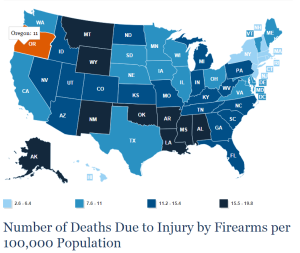
Texans are badasses. Unfortunately, that’s not necessarily a good thing. Texas ranks in the middle for gun deaths per capita in America (10.4/100,000) and has seen its share of both horrific mass shootings and accidents involving children over the past year. When taken as a whole, the entire South suffers as some of the highest ranking members of the gun deaths per capita club. In fact, every state south of Virginia ranks higher than the national average (10.4/100,000). I wonder if the old phrase “southern hospitality” shouldn’t be replaced with “southern hostility.”

Gun deaths per 100,000

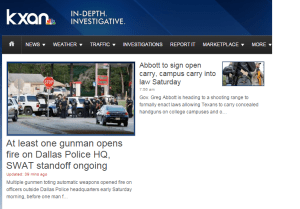
Abbott routinely tags his tweets with the NRA hashtag. As AG, Abbott played host to the annual NRA paranoia jamboree in Houston. He signed open carry and campus carry into law at a gun range (isn’t he cool?) on the same day as a gunman opened fire on the Dallas Police HQ leading to this ironic juxtaposition on a news website:

613

So it should come as no surprise that Abbott blames the victims for their injuries and deaths, conveniently ignoring the fact that there were students carrying concealed who chose to wait for the police to intervene rather than embrace the “good guy with a gun” myth.

Abbott and his views will be shown, in time, to be anachronistic and wrong. For now he is just obsequious and endangering his constituents. Keep cashing the checks, Governor.

images

Thankful

As I wait for the anger and sadness to give way to acceptance, I’m forcing myself to look for any positives I can find in this situation. The pain of Lisa’s loss is still raw, and I cannot go more than a few minutes without feeling the immediate sting again. And yet it has almost been a month since she left us. Since I know that she would want me to move forward and stop with all the maudlin and lugubrious posts, I’m penning this piece in hopes of sparking some positive thoughts.

I am thankful for the (almost) 26 years we were married. Marriage is not the honeymoon. It is a process of learning to love someone while you both grow and age. Sometimes I was at my worst, and she was at her best. She still loved me. Sometimes she was at her worst, and I was at my best. I still loved her. Sometimes we were both at our worst, but we still loved each other. Again, it is understanding, accepting, and cherishing the quirks in a personality that allows one to love that person at their worst. You also don’t go into a marriage thinking that you can change someone. We all grow as we age. Change is part of life (as I’m learning). The greatest change I experienced after marriage was the knowledge that I was part of a team, a team against any obstacle thrown in our way. I say our way because it is understood that an obstacle thrown in front of one of us was an obstacle thrown in front of us, and we were determined to overcome (or embrace) it. I counted, and until death parted us, we were married for 9,489 days (7 days short of our 26th anniversary). In that time I think I felt every emotion one can experience toward a person, some good, some bad, but all toward the goal of forging ahead against seen and unseen foes. Whether it was an economic crisis, an emotional crisis, an employment crisis, or a medical crisis, we faced it together and won. We didn’t always win the battle against our foe, but we won the war of facing it together and moving forward as a team. That’s love. That’s marriage. That was Lisa and me.

I am thankful for my children. My kids are wondrous. To experience what they have been forced to face over the past seven years, and to do so without complaint and with the ability to succeed personally, academically, and physically is astounding. Consider this recipe: Start with the fact that you are a teenager, complete with all of the insecurities and body changes associated with that time in your life. Add to that the fact that you have been told that your mother had been diagnosed with a terminal illness. Add to this mixture the fact that the local doctors don’t have a plan to fight her particular disease. Now blend that with the fact that you will be moving 2,000 miles away to start school in a different part of the country because that is where the hospital with the best opportunity to fight your mother’s disease exists. Don’t forget that you will be leaving all of your friends and everything you’ve ever known.  Combine all of these ingredients in only six weeks (only allowing time to pack up your home to get to this other, strange part of the country so you can begin school on time). Now concentrate on your studies while your mother undergoes chemotherapy, surgery, and radiation, your dog suffers a potentially blinding eye injury, and your friends go on with their lives independent of you. Follow that up with a move back home for your sophomore year. The good news is that you think your mother has beaten her disease. Nine months later, having finished your academic year, you find out that your mother’s disease has returned, and you will be permanently moving back to Texas to be near the hospital and that the metastasis now prevents a cure to her disease and that she will live on chemotherapy for as long as it is effective. Are you still focusing on your studies? Are you looking ahead to college? Can you see past Friday? Time passes, and you’ve done incredibly well in school and now face college. Now you move away from home to school, away from your mother who continues to endure standard chemotherapy and clinical trials and all of their horrific, systemic side effects. You don’t want to leave, but over the course of your first three years in school you pull down a 3.5 GPA in one of the tougher, larger schools in the country. Now the worst happens, your mother dies, and you are expected to continue with your studies in your final year of college. Distracted and disheartened, you continue to excel at school, all with an eye toward graduate school. I’m sorry, but that is a recipe for disaster for many teenagers. And yet my kids continue to flourish in this bizarre reality. And they do so with genuine love and concern for each other and love and concern for me. I couldn’t be prouder.

I am thankful for my family. My father died on November 17th. It has been an incredibly difficult year. Being 2,000 miles away from home is difficult enough. To hear about the pain my father was enduring at the end was awful, and yet, it was nothing compared to what my mother, sister, and brother saw being by his bedside. There’s only so much I could do from this distance. The pain I saw, when I visited, was inhuman. And yet, both my brother and sister, reacting differently (as my children have) brought their considerable talents to bear in aiding both my father and mother. My mother found a strength I didn’t know she had, and my father stayed strong and committed to his faith to the end. Since then, my family has turned their concern and care to my and the kids. Again, it has been an incredibly difficult year. I cherish their show of concern and the love they have shown all of us.

I am thankful for my friends. These past seven years have shown me an extended ring of friends cast as far away as the U.K. and as near as next door. It is truly a testament to Lisa’s personality. I have heard from so many of you that it humbles me. I also know there is an inner circle of Lisa’s confidants that has been charged with staying in touch with me and the kids throughout this healing process. Friends have offered so much to me, but at a time when I am lost and second-guessing myself, it is hard to avail myself of their generosity. Please know it is neither my strength nor a shutting out of good friends that prevents me from asking for help; rather it is my limitation right now of not knowing what I don’t know. Someday I hope to have a better handle on things, and when that day arrives, I am confident that this circle of friends will still be there for the kids and me.

I am thankful for my job. No employer could have been kinder to me throughout this entire process. My chain of command has been nothing but supportive and eager to help. The only time I got into trouble was when I worked too many hours from home, not too few. I never wanted it to seem that I was taking advantage of the situation to get out of some work. Rather, when I did work, it was both a necessary distraction and an opportunity for me to feel that I could exert some control over my spinning life. For that and for their generosity I am extremely grateful. I don’t know where the kids and I will end up after they graduate, but I will make every effort to show my appreciation for everything my employer has done for me by attempting to remain a loyal employee.

I am thankful for my health. The past four months have been extremely difficult. I have worked from home the entire time and sat at my desk at the foot of Lisa’s bed. I have worked and eaten. The yard went to hell late in the spring, and I have not spent any time there to tend to it. In short, I’ve gained some weight being so sedentary and worried. I am now on an austerity program that would make Germany happy. I will begin to take better care of myself as it was one of the main things upon which Lisa insisted. Feeling that I needed to be here for the kids once she was gone (and for a long time after that), I will work to become a smarter eater and take better care of myself.

It still hurts. My stomach is still in knots trying to process the fact that I will never see Lisa again. Every time something happens I want to reach for my phone, to call or text her about it. God, I miss her. After writing this, I am still angry and sad, but I am thankful for the time we had together, for my children, for my family, for my friends, for my job, and for my health.

Quirks

She had too many clothes

She drove like a madman

She was always running late

She was honest to a fault

She shoved her leg under me while I was sleeping

She drank Diet Coke for breakfast

She never put milk on her cereal

She put too many lights on the Christmas tree

She recited silly campfire songs

She was not perfect

Thankfully

It is the differences that make us interesting

It is the differences that attract us

It is the differences that can repel us

When we accept the differences in another

We call them quirks and learn to live with them

Now that she is gone, it is the quirks I miss the most

I don’t have too many clothes

I don’t drive like a madman

I’m never running late

I believe in the value of a white lie

I miss her leg under me

I now drink Diet Coke for breakfast

But I still put milk on my cereal

I don’t want to put up the Christmas tree

I miss those silly campfire songs

Because she was perfect to me.

Anger and Pain

When I held Lisa, I knew that two inches below my embrace, inside her lung, was a demon bent on her destruction. And now she’s gone. The demon won. Now all I have are pictures that can’t kiss back, photos of her long blond hair I cannot tussle; the dimples in her cheeks are now flat, photo paper and ink. I know this is the nature of all living things: we live, we die; but being three weeks out from that painful night, the shock is still palpable. God, I miss her.

I am still lost; second-guessing my every decision. “Zerrissenheit” still reigns. I have grown to hate nights and weekends. The structure of work provides comfort. But each night and weekend feels like the four walls of the house are closing in on me, and I can’t stand the silence. The television is always on or, and if not, music is filling the void once filled with her laugh. When will I be granted a good night’s sleep? 2:00 a.m. seems to have some subconscious awakening charm on my slumber. After that, the thoughts of the empty place in the bed next to me overwhelm me in the silence and the dark, and sleep eludes me.

Someone told me that I will come to appreciate all of the time we had together and no longer begrudge the time cancer stole. Speaking from experience, I trust this individual, but I’m not sure it won’t come down to my personality and not time to transform this anger. Is it the well-adjusted individual who ultimately finds peace? If so, my keel is not keeping the ship upright. And I do not think I have the personality (or capability for forgiveness) to right the ship.

Elizabeth I, to the Countess of Nottingham said, “God may forgive you, but I never can.” At this point, I cannot forgive God. Of course, we can hide behind the old analogy that we (humans) are not wise enough to see God’s grand blueprint, but right now I cannot help but to think that either there is no God (which is less painful) or there is one, but who is either capricious or lacks the omniscience attributed by humans. If I am wrong, then I will follow Maurice Maeterlinck’s advice when he said, “It is always a mistake not to close one’s eyes, whether to forgive or to look better into oneself.” I will forgive God as I look into myself. But right now the only thing inside me is anger and pain.

Zerrissenheit

Shattered FutureGive sorrow words; the grief that does not speak                                                         Whispers the o’er-fraught heart and bids it break.                                                                              Shakespeare, Macbeth, IV, iii, 209

A very dear friend of mine gave me Anne Morrow Lindbergh’s book Gift from the Sea following my wife’s September 2nd death. It was a wonderful little book and contained a German word that accurately describes my emotional state: “zerrissenheit.” It is described as “torn-to-pieces-hood.”

The thing I am learning about grief is that it does not follow a linear path. One does not travel from one emotion to the next, leaving the first entirely contained in the rearview mirror. Rather, from minute to minute, I can wander from disbelief to acceptance to anger to sadness back to disbelief. This emotional whiplash takes a physical as well as an emotional toll. While I am back at work, my mind is not. This mental “zerrissenheit” manifests itself in a lack of confidence, second-guessing, a lack of focus, and sudden confusion. I was so much more confident when Lisa was here. I check my pockets a dozen times before leaving the house to make sure I have everything I need: keys, wallet, phone, etc.. In a word, I am lost.

And it isn’t that I don’t smile or laugh. I do. But so often I find myself reaching for my phone to text or call Lisa to tell her the joke only to realize that the call will never be completed again. I am having a hard time with the concepts of “never” and “forever.” I know that someday I will be glad for the time we had, but right now I am angry over the time that has been stolen (not to mention the time wasted fighting cancer when we should have been living our lives together). “Never” and “forever” are as daunting to me as the size of the universe is to a child.

It has been two weeks now, and the house is silent. I don’t know what the future holds anymore. We are taught to plan, to prepare as we enter adulthood. I did. This is not what I planned for; this is not the future I wanted. I am alone. My best friend was stolen from me. And while she would tell me to snap out of it and start living my life, this grief-triggered “zerrissenheit” is involuntary. I miss her so much.

No Autopilot When Spiraling In

spiral

As we continue our corkscrew toward the ground, we took another turn today. My wife can no longer easily swallow, causing her to cough when taking medications. Because she is so short of breath, she cannot cough up that which she has aspirated and she begins wheezing which results in her vomiting. Because she is not eating, the only thing she vomits is green bile from her stomach. It is a vicious circle as we spiral in.

The kids are convinced now that something will happen the day I drive them back to college. Given how we have tightened the spiral, I’m not sure I disagree.

Looking outward from inside this corkscrew is disorienting. As soon as I am convinced that something has settled, the wings tilt inward still further and we spin that much faster toward the ground. But one can find focus in this spin. When I least expect it and am most ill prepared, the gravity and magnitude of the situation (essentially the finality of it all) clubs me with a mighty blow after which I find myself gasping for breath, crying and floating directionless in the air until the reality of current circumstances force me to see the spinning and rapidly approaching ground through the windscreen.

There is no peace when spiraling in. Life’s obligations and daily tasks still require our attention: the dog needs to be fed and given his meds, the laundry never stops, groceries still need to shopped for, bills still need to be paid, work still needs to be done. However, there is a certain feeling of mechanization about it all. We go through the motions of shopping, eating, dressing, sleeping, as we have all summer, but there is no soul in it. Put your seats in the upright and locked position, return your tray table to its stowed position, tighten your seatbelt tight and low around your waist. The captain has exited the aircraft and will not be returning. Cancer is now piloting the aircraft. Thank you for flying the terminally ill skies.

The insanity of the situation is that all but one of us will survive the inevitable crash. We will survive but in what condition? And as hard as this flight has been, I cannot imagine how we will carry on after we bore into the ground. And it is approaching ever faster and filling my field of view. Unfortunately (or fortunately), I cannot see it clearly, because of the blinding rage and constant tears.

Stage Whiplash

1808366

“There is not much sense in suffering, since drugs can be given for pain, itching, and other discomforts. The belief has long died that suffering here on earth will be rewarded in heaven. Suffering has lost its meaning.”                                                                                                                        Elisabeth Kübler-Ross

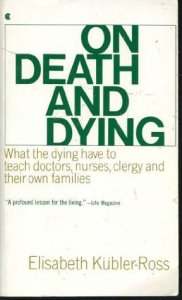
When Elisabeth Kübler-Ross wrote this in her groundbreaking 1969 book, On Death and Dying, she was, of course speaking of the patient, the person dying. In the book, she famously describes the “stages” the terminally ill patient goes through: Denial, Anger, Bargaining, Depression, Acceptance. The book was not meant to be considered a research study, a point she repeatedly makes. She also emphasizes that these stages may be skipped, occur concurrently or be returned to on the way to Acceptance. And yet we suffer. We all suffer.

As I watch my wife go through this process, I cannot help but realize how similar the process is for the caregiver, the family members, and the survivors. We, too, are passing back, through, over, and around these stages in our effort to understand what is happening to our loved one. My initial Denial and Anger had given way to Bargaining (“this is our new normal, we’ll take as much time as we can get”), when on any given day, I can slip easily into Depression and back to Anger only to wake up the next day after a dream in Denial. No seatbelt or ABS brake can prevent that whiplash.

I cannot imagine a day when I have reached Acceptance because Kübler-Ross also wrote:

 “The reality is that you will grieve forever. You will not ‘get over’ the loss of a loved one; you will learn to live with it. You will heal and you will rebuild yourself around the loss you have suffered. You will be whole again but you will never be the same. Nor should you be the same nor would you want to.”

Am I grieving already? Yes. Am I confusing the “stages” and grieving? Perhaps. All I know is that each day (and often times several times within a day) brings a new emotion for which I am unprepared, I thought I had made peace with, or I anticipated would bring me peace, only to find myself confused and lost again. And one of the worst emotions I carry is that I know that while I am suffering the whiplash of these stages, I am not the one dying, I am not the one suffering or actually going through Kübler-Ross’s stages of the terminally ill. As she also wrote, “Guilt is perhaps the most painful companion of death.” Suffering has lost its meaning because we all still suffer.