
Fly Me To The Past

On an unseasonably warm night in February 2018, as the rain fell gently outside the beautiful Providence Performing Arts Center, I saw thousands of people travel back in time.

I was sitting in the back of the theater next to my mother. The audience was mainly older people, some with canes and wheelchairs. They were all there to see a legend. Tony Bennett took the stage, and the crowd roared. He was 91 at the time. His voice was thinner, but the emotion with which he always sang was still there. He knew what he wanted to do with his voice even if the vocal cords could no longer deliver. He gave prominent time to his band to shine and for him to rest. His daughter was there and sang her own songs and duets with him. None of us knew it at the time, but he had been diagnosed with Alzheimer’s disease two years earlier. Several times during the concert, he sang the same song during medleys of hits, but no one minded. He was 91 years old on stage in front of an audience of fans – and a magician.

Because I was seated in the very back of the theater, I had the benefit of being able to watch the audience. I can’t tell you how many watery eyes I saw, how many elderly couples held hands, and how many smiles I saw as each one traveled back to when each song was first released. In their minds, every man with a cane became a youthful stud, and every woman in a wheelchair became a beautiful young dancer. Sitting beside my mother, I could feel the void she felt, missing my father. Couples rocked back and forth, smiling and reliving their youth. It was indeed magical to watch.

Tony Bennett died today at 96. I have no idea how many in the audience that night preceded him. The wonder of memory is recalling events long past with others who were there. The curse is being the last and having no one to share it with. I will remember that night as long as I draw breath. If I’m the last, the bittersweet recollections will soothe me with memories of a beautiful evening with a magician who enabled an audience to time travel.

Memories in a Bucket

When I was young, my sister and I were charged with going to the Newport Creamery each night to get my father a pint of Maple Walnut and Walnut Fudge mixed. The bottom half of the pint was Maple Walnut ice cream, and the top half was Walnut Fudge ice cream. We did this most nights. It’s a memory my feeble brain still recalls. My sister is a year younger than me. We lived on the west side of West Main Road in Middletown, Rhode Island. The Newport Creamery was about half a mile away on the east side of West Main Road. Getting there required us to cross West Main Road at dusk or early evening when we were 10 or 12. And we thought nothing of it.

Seeing that road now, both with the volume of traffic and speed at which cars travel, it’s a wonder we saw our teens. And that’s one of the problems with viewing yesterday’s events through today’s lens. When we were younger, speed limits meant something. And while Aquidneck Island was always a tourist spot and Navy town, traffic back then was a fraction of what it is today.

The Newport Creamery holds a special place in my heart. Many an evening, after a Little League, Babe Ruth, American Legion, or High School baseball game, or just on a warm summer evening, “The Creamery” was a welcoming place to celebrate a win or lament a loss. I thought they had the best chocolate chip (and coffee) ice cream. And their Junior Hamburger was my favorite. Two, with a side of fries, please! And then a Turtle Sundae my way (chocolate chip ice cream, hot fudge sauce, caramel sauce, marshmallow topping, whipped cream, and a cherry).

They also have a milkshake made with iced milk instead of ice cream called an Awful Awful. Despite its off-putting name, it is so called because it is “Awful Big and Awful Good.” The challenge on the menu said if you could drink three, you’d get the fourth free. How could a teenage boy not accept that challenge? And at least once, I got my fourth free Awful Awful. Always vanilla flavored (for me), the marginal return on enjoyment waned dramatically on the second and third, only to rally for the free one. And then I’d walk home feeling the liquid slosh around inside me like my stomach was at high tide during a named storm.

The Creamery also sells half gallons of their ice cream in plastic buckets. Every home in Rhode Island has a few buckets holding various items (buttons or ribbons in the craft area, multiple nails and screws in the garage, marbles and toys in the kid’s room). And if I had access to the photographs in every home, I could find a photo of every child with the bucket on their head. I know I have them of my kids.

The Newport Creamery has had financial troubles in the past decade or so, and while I don’t know what the future holds for any of us, despite heavier and faster traffic than when I was a kid, I hope The Creamery exists for a long time into the future. There are many Awful Awfuls to drink and plastic buckets for kids to wear. And while my sister will argue that Frosty Freez is the iconic summer ice cream stand on “the island,” especially given that she worked there many a summer (and I concede to making a pilgrimage there a few times each summer), The Creamery holds many more memories for me.

No one has a perfect childhood or flawless life. But there are idyllic memories of youth and raising children, and The Creamery holds both for me.

Fighting Eternal Oblivion with Squiggles and Cheese

As I write this, I can watch the gel ink dry behind each subsequent word. Dried into the paper, permanently a part of the wood fiber. Immortal, eternal as long as the paper exists. Put the paper in a vault, and the words live forever. There they will remain preserved, filed, recorded, and likely unread.

The same can be said of humans. As the ink dries, we move on. The relentless marching on of time. Relentless. Never ending, never pausing, never caring. Once the ink dries, it is done. It is the past. It is our past. Our memories. We are the vault. And our vault, memories, and existence exist only as long as anyone who experienced something with us or heard a story about us exists. Once we are gone and those who recall us are gone, so are our memories, the ink, the paper, and the vault. That’s life. Our life. Everyone’s life.

There will come a day when the very thought of us as individuals will be lost. There will be a day when the last person who remembers you or recalls a story about you recalls it for the last time. You will be lost to eternal oblivion. Sure, there are individuals whose memory transcends time. Shakespeare, Caesar, Keith Richards, but for most of us, we will be lost to time, just a number in the ever-expanding pile of humans that once existed.

Is there a way to combat this eternal oblivion? Or is this simply an exercise of someone who just celebrated a birthday and is reminded that the road before him is shorter than the view in the rearview mirror? And, let me add that the road before him is neither clear nor guaranteed.

Clifton Fadiman said, “A cheese may disappoint. It may be dull, it may be naïve, it may be over-sophisticated. Yet it remains cheese, milk’s leap toward immortality.” Creativity (the arts) is our antidote, our cheese. Write a book, and it remains available forever. The internet is the newer, better Library of Alexandria. Paint something, sculpt something, and it exists long after you perish.

In episode eleven of Cosmos, Carl Sagan said something I’ll never forget, “What an astonishing thing a book is. It’s a flat object made from a tree with flexible parts on which are imprinted lots of funny dark squiggles. But one glance at it and you’re inside the mind of another person, maybe somebody dead for thousands of years. Across the millennia, an author is speaking clearly and silently inside your head, directly to you. Writing is perhaps the greatest of human inventions, binding together people who never knew each other, citizens of distant epochs. Books break the shackles of time. A book is proof that humans are capable of working magic.”

Another favorite of mine, again, capable of stringing together words far better than I’ll ever dream of, Oscar Wilde said, “All art is immortal. For emotion for the sake of emotion is the aim of art, and emotion for the sake of action is the aim of life.”

So, create! Rabindranath Tagore said, “The one who plants trees, knowing that he will never sit in their shade, has at least started to understand the meaning of life.” So, plant a tree! Paint a picture! Write a story! Write your story! Eternal oblivion awaits us. Leave something behind that outlives you, outlives the memory of the last person to recall you. Will you be remembered for it? Maybe. Maybe not. However, your creation will endure.

As the ink dries on that last word, I wonder if anyone will ever read this. I wonder if anyone will ever remember it if they did read it. Create, people! Our ink is drying!

Field of Memories

Baseball has the ability to transcend time. Look at that photograph. Can you hear it? Ball meeting bat. Can you feel the contact in your hands? Not the connection of springtime baseball, the shock traveling from your seemingly electrocuted hands through your arms and into your teeth, but the solid contact made only in deepest summer. What position are you playing? Are you the batter? The pitcher? Infield? Outfield? On deck? On the bench? Can you hear the people in the stands? Can you smell the grass during the warm summer months? Look up. Can you see the soft white clouds watching the action as they carelessly pass overhead. That is baseball, and this was Basin Field in Newport, RI, in 1910.

Basin Field has hosted baseball games since the railroads backfilled the area initially used as a drainage area for steam engines. It is one of the oldest baseball fields in the United States and a gem.

Bernardo (Vlardino) Cardines was born in Venafro, Italy on November 15, 1895. After his father emigrated to Providence, Rhode Island, and paid for his son’s transatlantic crossing in 1907, they worked as tailors on Thames Street, eventually living with his aunt and uncle a block from what would become his namesake ballpark. Bernardo registered for service in June 1917, was drafted in April 1918, and was killed in action in France during World War I in September of that same year. Initially buried in France, his remains were exhumed and reburied in his hometown of Venafro at his father’s request, who had returned to Italy. Basin Field was renamed Bernardo Cardines Field in 1936. He may have been watching this game in 1910.

Perhaps it’s the story of the Italian immigrant, who, it is said, played baseball at the YMCA, or maybe it’s that baseball field that lives in my soul. It might be remnants of the recently played Field of Dreams game in Dyersville, Iowa, between my beloved Cincinnati Reds and the Chicago Cubs intertwined with scenes from the movie. It might be the link I share with my late father and brother, knowing we all played at Cardines. It could be that I’m just getting older and find myself warmed by the glow of glory days past, thinking of my teammates and adversaries, games and plays, moments and memories. Maybe it’s memories of watching Sunset League games played under the lights as a kid, knowing the 9 pm horn would sound from the fire station across the street and still jumping out of my skin when it went off. Cardines was the equivalent of Fenway Park or Yankee Stadium as a kid. The dream of eventually playing there was the equivalent of playing in the major leagues.

The photograph above struck me as a handshake reaching across time. The players in that photo are long gone. And yet, we share the experience of playing baseball on the same spot of land in Newport, Rhode Island. I know nothing about them other than they enjoyed the game. And that’s enough for us to be teammates and foes, brothers and friends.

Control

Can this be how it works? I’m 57 years old and see more life in the rearview mirror than the open road ahead. With that perspective, I find it’s become essential to reflect on what I’ve done with my time on this planet. Blissfully ignorant of the repercussions of news events growing up in bucolic suburbia, adulthood, parenthood, citizenship demanded my attention as I aged. I’ve experienced events no one wants. People summarize it as “life” when you see death. I’m not special. Just frustrated.

After the massacre at the movie theater in Aurora, CO, I began to write. Not with the expectation of affecting change, but rather to give my anger, my emotions, an outlet, an offramp for the toxic blood poisoning my body. I saw gun violence stealing a generation. While some social issues had moved the Overton Window, political intransigence (keep cashing the NRA’s checks!) and eventual American ennui accepted gun violence as baked into the American fabric in the name of “freedom.”

After the Sandy Hook Elementary School massacre in Newtown, CT, I began to speak. Surely, a tragedy of this scale would shock Americans (and politicians) out of their stupor. Nope! I talked to groups in Texas as the lone spokesperson for the Brady Campaign in Texas. The only one. That alone tells you all you need to know about the calculus of “I NEED my gun, dead kids and teachers be damned.” Thoughts, prayers, and sad face emojis flooded social media until America’s fruit fly attention span moved on to the latest “tragedy” affecting Kim Kardashian.

My anger peaked with the death of my wife. Fuck cancer makes a great tweet, a guttural reaction without consequence. Utterly suicidal and dying with my wife, I could not yell at the tumor. I took it out on God for a while (also useless) and even turned to God for a bit (utterly meaningless). There was no one to blame, no revenge to be had. No offramp for my anger.

And then Americans, in the obvious next step for a society that had abdicated all personal responsibility and suffered no consequences, elected a narcissistic moron president—a billionaire (if you believe him) speaking for the uneducated rubes. Merit and logic were dead. With each lie, with each crime, I expected consequences. None came. Robert Mueller fumbled the ball with no defenders anywhere near him. Facts were relegated to the trash bin. Tweets became governmental edicts. And I waited. Furious.

When I get angry (when I get down), it is because things should be easier. “Keep the simple things simple; the hard things are hard enough.” But nothing was easy. Changing a light bulb resulted in the glass bulb snapping off the metal base, a trip or two to Lowes, and a call to the electrician. Nothing was easy. Ultimately, I realized it was an absolute lack of control. There was nothing I could do about any of it. My wife was dead, guns were more important than life, freedom from fact and responsibility replaced actual democracy, and rabid evangelicals believed in Trump as the messiah. Stop the world; I want to get off.

And now we have Ukraine. Again, one man brings the world to the point of a world war—one man. Ukrainians are fighting to survive- as a nation and a people. “Denazifying” Ukraine? Really?

I’m reminded of Carl Sagan’s Pale Blue Dot speech as I watch an army destroy entire cities. Stepping back for a second, it seems bizarre that NATO and the UN watch the massacres with tepid financial penalties because Ukraine doesn’t belong to their club. It’s like a high school clique turning its back on a less cool student getting beaten up because they don’t wear the “right” jeans. I understand the political ramifications of engagement. But on a human level, it seems callous and impotent.

So here I am—no one special, poisoned with anger and unable to control or change anything. Hell, I can’t even watch baseball now! The billionaires are too busy fighting with the millionaires. I get the feeling that if aliens did visit earth, they’d look down and say, “Nah, they’re petulant adolescents with nascent technology and a penchant for killing each other. Keep driving.”

So, my clock continues to tick down, and I’m not ignorant enough for its promised bliss. I’ve read Viktor Frankl and Thomas Paine but still cannot find reason or acceptance. How do I accept all of this? How do I “let it go?” No, seriously, I’m asking.

When Does MY Freedom Count?

Land of the free because of the brave. Can we edit this to be land of the susceptible because of the selfish?

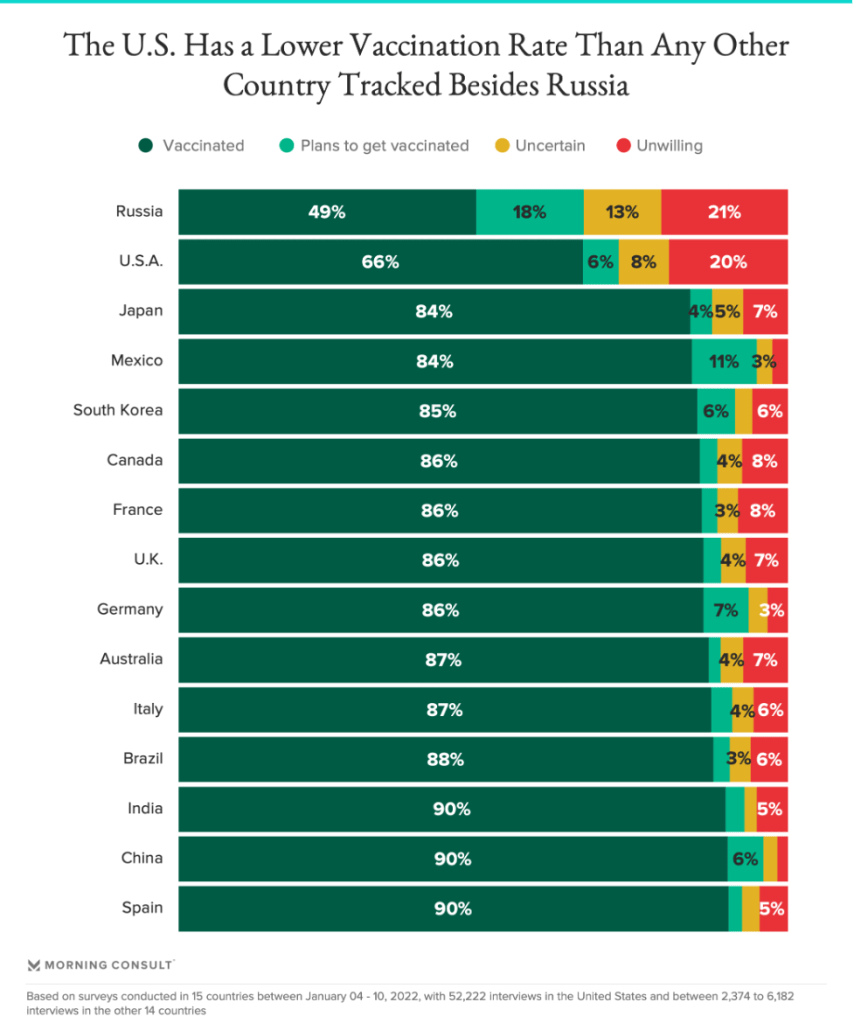
Sixty-six percent of Americans are fully vaccinated. Two-thirds of us. Another 6% “plan to get vaccinated.” Not sure what kind of schedule these people have that they couldn’t possibly squeeze a 2-second shot into their lives (to save their lives). Another 8% are “uncertain.” I have no idea how someone can be uncertain in the face of a global pandemic. The remaining 20% are “unwilling” to be vaccinated. Fully one-fifth of us are unwilling to be vaccinated to end this pandemic. And the overwhelming reason given by these armchair physicians who have done their own “research” is personal freedom.

By way of comparison, look at the chart below to see how American exceptionalism is an oxymoron:

While Putin wants to return Russia to the “glory” of the 1970’s Soviet Empire, Republicans in America wish to return antebellum American “glory.”

 Science, medicine, and fact dictate that the coronavirus is real. It’s not something you can “believe in” like the Easter bunny. It’s real, and it has killed almost 800,000 Americans. However, all of us who have done what common sense and common decency dictated (socially distance, wear a mask, get vaccinated, get boosted) are still stuck in an America paralyzed by the virus. I have a question for MAGA nitwits, what about my freedom? When (If) this ever ends, I don’t get to reset the clock and get these two/three/x number of years back. I’ll only be this age once. What about MY freedoms? When do I get to start living a “normal” life (defined as pre-COVID-19)?

I did what was right. I wear a mask more to protect those unvaccinated and vulnerable than to defend myself. Some people (immunocompromised (many chemotherapy patients)) cannot get the vaccine. The others, the 20% “unwilling” to get the vaccine, are infringing upon my freedoms. The three unalienable rights enunciated in the Declaration of Independence are “life, liberty, and the pursuit of happiness.” This is not a prescription for freedom without responsibility or accountability. And while MAGA nitwits will consider this communism or socialism, what I do impacts my neighbors. What I do affects my neighbor’s inalienable right to life, liberty, and the pursuit of happiness. If I do not get vaccinated, if I do not wear a mask at the grocery store, or socially distance, I may sacrifice my neighbor’s happiness, liberty, and life. Eight hundred thousand of us are no longer here to attest to this fact.

66% of us are fully vaccinated. A two-thirds majority. Nowhere near where it should be if we were all considerate and had a modicum of either dignity or common sense, but a majority. Where is the wave of anger among us, people who have done everything demanded and still living in an America paralyzed by COVID-19? Omicron is easily transmissible and less lethal. The subsequent mutations, the following variant may not be. It may be far more lethal. And it will only exist because there are enough unvaccinated people to allow the wild virus time to mutate. Enough idiots are waving their lack of concern (cloaked as “freedom”) to enable the virus to change itself enough to survive.

My freedoms should count. The freedom of 66% of us should matter. It should matter more than 20% of Americans, the steely-eyed cowboys staring down the wimpy virus, evangelicals convinced the virus is Satan’s test, conspiracy theorists convinced injecting sunlight or bleach will protect him (instead of getting the magnetic, tracker-enabled vaccine), or Republicans (including on the Supreme Court) working nonstop to prevent Biden/Democrats from leading us out of this pandemic). However, until we rise, the vocal, imbecilic minority will continue to hold the rest of us hostage, destined to live in an America subject to thousands of deaths per day, endless variants, and time evaporating from all of our lives.

When does my freedom count?

Hard Drive

My heart, like a hard drive, is permanently partitioned. Part of it comprises my 26-year marriage, the raising of my children, the hopes and dreams I had, and the sickness and death of my wife. The other part is unwritten upon, ready for a future I can’t even begin to understand. The problem is that at any given point it can switch between partitioned sections rendering my personal operating system glitchy and subject to crashes.

Such was the case this past week. While performing within normal parameters, my system suddenly switched to the hidden partition, and it has left me grief stricken and paralyzed. There was no warning. I understand that this switch was not the result of bugs or a virus. It is the result of a significant loss and the fact that I know I will never be whole again.

The hard part of all of this is that while attempting to begin a relationship with a woman, my first since I was 22, this wave of grief has me questioning whether I am being unfair to this woman; if I am incapable of giving myself wholly to another given my permanently partitioned heart. The grief tsunami that hit me this week, like all others before it, came without warning. There needn’t be a trigger. More likely, it was a thousand paper cuts, memories rising up during the past few weeks, poking me in the heart, not causing any immediate damage but collectively, over time, shattering my heart again. Now I am emotionally frozen, inextricably operating in a painful past, and incapable of addressing the present or the future.

I like to write because, while I assume that no one will ever read what I write, it usually helps me to understand my position on a topic or my underlying feelings if I put them down on paper (or up on a computer screen). However, while this usually is the case, dealing with grief is a topic no reasoning or processing can vanquish. I was incredibly sad for several days over the past week. It seems that every small event over the past few weeks correlated to something either my wife did, we did together, involved our kids, or it was something we planned to do together. Today I find myself bridging the realms of sadness and anger, perhaps on the path toward processing this wave and getting on with life, perhaps not. Perhaps these steps lead nowhere. Perhaps I will transition back to sadness, or onto negotiation, maybe even onto acceptance. I don’t know how to end this note. All I know is that I am stuck where I am, and no good wishes or caring hugs can hope to dislodge me.

Tony Webster, the protagonist in Julian Barnes’ excellent book The Sense of an Ending comments at one point that he “avoided being hurt and called it a capacity for survival” and “for whom ecstasy and despair soon became just words once read in novels.” He is a character who, like all of us, has a faulty memory, and has used Time to smooth out the jagged parts of an ordinary life to put meaning to his existence. I have never been one to live in the past. In fact, because of a terrible memory, I remember very little about my past. You would think that would force me to live in the present, to appreciate those around me, to smell the roses and embrace those around me. However, while I did not live in the past, I neither lived in the present. I did not appreciate those around me and assumed daily events had no significant bearing on my expectations of the future I believed would exist. No, I tended to live in the future. Everything I did was for some future date. At 15, I had figured out that in the incredibly far off year 2000, I would be 35, imagining what life would be like. I have always faithfully contributed to my 401(k) in the expectation that I would cash it out at some point and travel the world with Lisa or buy a two-room shack on a beach somewhere to live out our lives together. Now I find that I live in the past. Not the archetypical love of any lost high school glory, but of my life with Lisa. Even after eight years of caring for her as she underwent one barbaric medical treatment after another, and experiencing her withering and eventually dying while our children and I sat around her, I cannot help but to relive the life we lived together as a couple and a family and lament paradise lost and a future that will never be.

And so, awash in memories and residing in the past, my permanently fractured hard drive (my heart) is expected to give over control of the operating system to a brain that understands that life goes on. A mind that knows that while these waves of grief will never recede and will continue to destroy me forever, the troughs between them will, over time, expand, and it is in these troughs that I am expected to forge a new life and build a new future. It all seems so logical for a computer system, but my heart bleeds blood, and my eyes cry tears, not bits and bytes. Makes me wish I were a computer sometimes. I don’t know how to end this note. It just is what it is.

To Live Again

7617471_s

Friends, both near and far, have helped me navigate this past year without Lisa. For that, I will be forever grateful. The current world in which I now find myself is both dystopian and exciting, but mostly just foreign. No amount of research could prepare me for the world in which I now live. The changes I have endured over the past year have been as dramatic as they have been challenging. Moving from Texas back to Rhode Island was the smart thing to do, and I appreciate being near family more than I ever have. To be close to my mother, sister, and brother brings me comfort and peace as much as living in Rhode Island brings me reconciliation, familiarity, and appreciation.

Attempts at a social life have so far resulted in few successes and some crushing defeats. This is one area in my life where, while I am incredibly grateful to have my children at home with me, I know I have few prospects. Having the kids around since their graduation has kept me moving forward with purpose. Getting used to a new home is difficult enough, but to have to do it alone would have been far worse. Starting a new social life is very hard for me. I am not the most outgoing person in the world! But starting to reach beyond my comfort zone is what I now find myself confronted with if I ever want to “have a life.”

Unfortunately, a problem far greater for me beyond getting out of the house is my constant need to get out of my own head. This has always been an issue for me. I tend to overthink everything while pessimism erodes healthy feelings or hopes.  Some friends have been kind to me beyond all reason as if they signed a pledge with Lisa to look out for me. Other friends have been standoffish, probably unsure how to address my situation. I cannot blame them for their squeamishness; it is a difficult situation and one with no easy solution. I find myself mourning one friend in particular who ended things with me after telling me we were headed in different directions in life. She was right, but that doesn’t make the wound hurt any less.

I cannot help but think that I am destined to be alone now, and I’m not sure how I feel about that. On the one hand, I long to be in a relationship, feel I still have much to offer and need, while on the other hand, I feel guilty for having these thoughts because I will forever miss Lisa. One year has gone by now, and I’m both better than I was following her death and more confused than ever. I don’t know if this is normal, but the “normal” I am now living is very different than the normal under which we have been living for the past eight years. No longer do I see cancer hiding behind every smile, determined to undercut our happiness. No longer do I go to hospitals and doctor’s visits; no longer are we Hospice clients. But too, no longer do I have that epic battle to wage every day on behalf of someone for whom I would gladly have given my own life. I tend to do better when facing a crisis than normal life.

Ultimately, a new life will require me to get out of the house regularly and out of my head even more. Any thoughts on how I can do that would be greatly appreciated!

Phoenix (or Ashes and Brambles)

compass


Too often during this process of grieving, I have been angry. As I addressed in the last post, I had been charged with creating an imaginary entity to which I can assign the anger. I chose God. The next chapter in this process is to determine what will make me happy. How do I want my life to look in five years? As one who has been burned by planning in the past, with ashes the only remaining vestiges of the future I once built, this is an immeasurably more difficult assignment.

I want my children to be happy and successful in whatever endeavor they choose. I want them to live wherever they want but I want them to remain close to me emotionally. I want to be the person from whom they seek advice or from whom they seek comfort when life throws them a nasty curve. Outside of that, I want to continue in my job, which brings me joy and satisfaction. I would like to travel. I want Sam to be my tour guide in Italy and Cam to be my guide in the UK. I would like to learn French or Italian. Not because I plan on living there of traveling extensively, but because I have always had problems learning a foreign language and I like the challenge. I would like to learn to play the piano. I would like to read all of the classics. I would like to learn art history.

But will doing these things make me happy? What will people say of me five years from now? Will they say that I survived my wife’s death well? Will they say that I was able to move on and formed a new life outside of my new identity as a widower? Will I be alone? Will I find love again? Will I survive?

The answers to these questions plague me. In many ways, the question is the same: What will make me happy and what will people think of me five years from now? These both boil down to having a fulfilling life following a major upheaval. When I applied for the job I currently hold, I was asked by my boss’s boss where I saw myself in five years. That was four years ago. Rather than dazzle him with my ambition and tell him that I wanted his job in five years, I reflected on the future which lay in tatters before me. And so, I told him that I did not know where I would be in five years. That I respected that I was new to the company and that I would need to learn the company and the industry before laying out a career path. I don’t know if that was the perfect answer, but he told me I was correct to temper my ambitions with reality. I got the job.

Today I feel that I am being asked the same question. Where do I want to be in five years? But rather than a career path question, this is a life path question. Again, I feel that I must have the same response. I need to learn the landscape of this new life, acknowledging that it is new and different than the life I lived before. In many ways, I am newborn. I have the second part of my life before me. But I must respect that I have little in the way of plans or ambitions that bear any resemblance to the life I led before. True, I’ve always wanted to travel, but now I face the prospect of travelling alone or as a third wheel when my children take their eventual families on vacation. This does not excite me. It’s a little like being the afterthought invitation for a party after you’ve heard about the party but hadn’t been originally invited.  Other ambitions (reading, learning a foreign language, playing the piano) are nice wishes, not life plans. True, they will bring me joy and occupy my time, but are these life plans? I don’t know. My life plans before were to work until I was ready to retire, then Lisa and I would travel together around the country and around the world, with or without the kids, depending on their station in life. We would spend our time in our home together or on the Cape. But as I pull at that thread now, there is little desire to travel alone and the thought of an empty, silent home (soon to also be devoid of our little white ball of canine love) terrifies me.

And so, to this question, I have no firm response. The future before me is a blank slate, equal parts terror and excitement. Perhaps over time, I will see the shimmering outline of a path through the thicket, but right now there are only brambles and thorns, silence and loneliness. And so I read my classics, look forward to studying piano, and tackling French or Italian. My future, in ashes, will rise like the phoenix, whether I want it to or not, whether I plan it or not. Better to have a say in the process than be overrun with other’s expectations. To the question, how do I want people to see me in five years, I can only say that I hope they see me as living my life, a different life, maybe a better life maybe not, but a life denied my wife.

I Hate This Life

38515506_m

The bell strikes one. We take no note of time                                                             But from its loss.                                                                                                                                 – Edward Young, Night Thoughts. Night I, l. 55, 1742.

I hate this life. In fact, it is “life” only in name. I continue to inhale and exhale and my heart continues to beat, but I really only exist. The day begins with my alarm at 4 am. I open my eyes to the empty space in bed where Lisa used to sleep. I get ready for work and feed Delbow, whose pancreatitis and pneumonia are being treated but for whom I can do nothing. I leave for work at 5 am and listen to a book on the way. At work, I am either busy or try to stay busy until 3 pm when I drive home listening to the same book. I open the door and greet Delbow, giving him a cookie. I change and sit in the living room. It is 4:30. And time stops.

I prepare everything for the next morning. I ready Delbow’s medications. I feed him. I feed myself. It is all mechanical, devoid of interest. The house is no longer a home. It sits unused. The gardens are overgrown and weedy. All of Lisa’s belongings still reside where she left them. Her glasses. Her purse. Her walker stands folded in the laundry room. I watch television because it passes the time. It too is lifeless. Hours of “How It’s Made” on the Science channel. After an interminable amount of time, I look up. It is 7:30. Is it too early to go to bed? To escape this mental prison? I go to bed deciding to read a book. My mind is incapable of concentrating these days and I gloss over a page of text before realizing I have absorbed nothing of the story. I put the book down. I cannot sleep yet. I turn the television back on. There is a Modern Family repeat on. I’ve seen it twelve times before. I anticipate the lines of the show, wishing I could  sleep. Finally, after a marathon of Modern Family and The Big Bang Theory reruns, I turn off the television and shut off the light. My mind races and thinks of all things Lisa. I cry. At some point, I fall asleep.

Oh, I know what Lisa would say. First, she would give me a Cher to Nicholas Cage in Moonstruck slap and tell me to snap out of it.Then she would tell me that I need to live because I can and she cannot. She would tell me that I have to stay healthy, physically and mentally, for the kids. That they are relying on me and taking coping cues from me.  I don’t want sympathy. I don’t want a shoulder upon which to cry. I want Lisa. Everything will get easier with time, they say. Time. I have time! I have too much time and not enough answers. I understand all of these things in my head, but my heart is broken and empty, grieving for what it cannot have.

At 3 am the phone rings. It is Samantha. She has had a bad dream about Lisa and wants to talk it out. I am grateful for her call. She relates the details of the dream and I cry too. How can I not? It is heartbreaking. I tell her I hate this life and she says she understands. We talk about her art and try to change the subject. Eventually, she says she feels better and apologizes for calling. I tell her I’m glad she called and she says she can go back to sleep. I say I love you, she says she loves me, and she hangs up. It is 3:40. I lay there replaying the conversation until the alarm goes off at 4 when I look over at the empty space where Lisa used to sleep. Rinse. Wash. Repeat.