
RED, white and BLUE

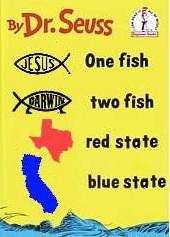
The presidential election is in four days and the divide in America has once again been colorized for our dim amusement.  It’s the red states versus the blue states! We should all get t-shirts for the $10 billion being spent on the race, a patriotic “shirts versus skins” game for the world to observe.  Is this a case of north versus south, east versus west, the egomaniacal one-per-centers versus the torpid proletariat, big business versus farmers, cities versus the heartland?  Classify it however you want.  Categorize it until it meets your expectations.  But the differences are there.  First, the facts:

Blue States Red States
Population 63.4% 36.4%
Land Mass 35.9% 64.1%
Population Density, people per sq. mile 659 75
Median Age 37.4 36.0
White America 67.9% 73.8%
Black America 10.6% 11.7%
Latino America 12.6% 8.3%
Asian America 5.4% 1.8%
Foreign Born Americans 11.5% 5.5%
High School Graduation Rates 87.4% 85.5%
Bachelor’s Degrees 30.6% 24.2%
Home of Top 50 Universities 40 10
Veterans 62.2% 37.8%
Military Recruits, per 1,000 eligible 18-24 2.07 2.49
Median Home Value $260,089 $141,129
Median Household Income $56,293 $46,696
Unemployment 7.8% 7.0%
Poverty Rate 12.2% 14.9%
Obesity Rate 25.5% 28.7%
Businesses 66.8% 33.2%
Women-Owned Businesses 15.7% 15.2%
New Home Construction 50.8% 49.2%
Marriage Rates, per 100,000 7.9% 7.3%
Divorce Rates, per 100,000 3.5% 4.1%
Belief in God 66% 78%
Gun Ownership 28.0% 47.1%
Deaths by Firearm, per 100,000 9.5 13.7

One could spend all day searching for correlations among these characteristics; however, a few do stand out more prominently than others.  For example, combining several characteristics, one can state that the Blue States tend to be better educated with higher high school graduation rates, more bachelor degrees and more of the top universities.  Blue States also tend to spend more on their houses (4.6 times their median income) versus Red States who spend only 3.0 times their income on a home.  True, this could be due to the fact that there is more available land in the Red States presumably making lots cheaper to build on.  However, then isn’t it strange that new home constructions are split about evenly between Blue and Red?  And while the overwhelming numbers of businesses reside in the Blue States, their unemployment rate is higher than in the Red States.  However, the poverty rate and obesity rate is higher in Red States.  There is also a strange dichotomy in the Red States.  While being comprised of the “Bible Belt,” they yet have lower marriage rates, higher divorce rates, higher gun ownership and more deaths caused by firearms.  What would God think of that combination?

Blue State Propaganda

Politically, it is also a mixed bag.  When polled, Americans consider the economy to be the overriding theme of this presidential election season.  To borrow a phrase from Bill Clinton’s White House, “It’s the economy, stupid.”  But while you would think the states with the highest unemployment would lean toward Mitt Romney and his job creating (albeit mathematically mystical) juggernaut, it is quite the opposite.  Is this a case of mass delusion or a schadenfreude miasma?  Similarly, if Barack Obama is the embodiment of a socialistic welfare state, why then would the region with the highest household income, the most businesses and a lower poverty rate bother to look at him? Were they all working late and missed his soporific first debate?

Red State Propaganda

It is in these mysteries that this election is wrapped.  God bless the RED, white and BLUE.  Now go vote.
Undecided No More

Image from The New Yorker

My son, a freshman in college, and I were on the phone last night discussing our impressions of the latest town hall debate between President Barack Obama and former governor Mitt Romney.  Given the particularly rancorous tone the debate had, a mirrored reflection of the actual campaign, I commented that I found it hard to believe that there were enough undecided voters in the country to fill the audience, let alone that many in Nassau County; but there they were.

Rabid, robotic sycophants in each party leave no room for the truly undecided voter to express their uncertainty with a candidate lest they be subjected to immediate internment in the opposing camp, suddenly responsible for each plank in a platform in which they are ill-prepared and unwilling to defend.  Are these undecided voters genuinely inquisitive, searching for positions on a myriad of issues or are they the dull, unread and oblivious?  For the sake of the future of the United States, I hope it is the former while concerned it is the later.

The polarization of politics, the fracturing of consensus and absence of debate, the removal of concession as a tool toward progress has paralyzed politics.  A shattered media, where any myopic obsession with one particular issue is rewarded with its own cable channel and a thousand militant websites, encourages the electorate to choose a candidate for their position on a single issue and while ignoring the candidate’s position on every other issue as “somebody else’s problem.” You’re concerned about the economy? The environment be damned.  You’re concerned about healthcare? Jobs be damned. And so on…

Neither candidate has successfully escaped this reality.  In a perfect world, Mitt Romney would be able to express the desire for small business (“the economic engine of the country”) to thrive and grow.  He would be able to encourage the celebration of the individual based on their genius and initiative (not their celebrity quotient), rewarded with the fruits of a capitalistic marketplace or starved by the same; where wealth is seen, not as the unconscionable greed plundered by the mindless “looters” of Ayn Rand’s Atlas Shrugged, but celebrated as the moral destination of individual gain.  In this perfect world there would be more Hank Rearden’s and Dagny Taggart’s and fewer Wesley Mouch’s and Jim Taggarts.  Unfortunately, this industrial utopia ignores the choices people make.  Atlas Shrugged spends an exhaustive number of pages explaining that the choice a mother makes to give the last piece of bread to her child is not a sacrifice and not given out of pity, but the rational choice of a rational mind.  In the real world, choices like this are made by individuals on a daily basis with no expectation of societal support in return.  Honor is held internally by these individuals, as they navigate life’s course, carved by the choices they have made and determined to persevere.  There are no children in Atlas Shrugged and no characters ravaged by illness, excepting, of course, that a conscious refusal to think for one’s self is terminal. In reality, there are those whom Fortune has betrayed, felled by disease or events beyond their control for whom that proverbial “governmental safety net” should be axiomatic.

Conversely, President Obama has not been able to effectively convey a perfect world where government involvement in the minds and pocketbooks of citizens is not for the benefit of the lazy takers and looters, but where an “audacity of hope” lifts all boats; where society’s infrastructure is measured in the tons of steel and yards of cement in our roads and bridges and not in the number of governmental agencies handing out food stamps and welfare checks to the unworthy.  He has not been able to sell his opponents on a middle class worthy of the platitudes bestowed upon it by Democrats as the hardworking backbone of America, and not the resource-sponging Pablum vilified by Republicans.  To assume that every citizen is doing their best and ignoring society’s leeches does nothing but invite deserved criticism.    No amount of rhetoric can make up for the picture of the able-bodied young man who has fathered countless children without concern for their future, waiting in line for a government check rather than searching for work, laughing in full belief that the government “owes” him.  Nor has the president escaped the portrait, painted in dazzlingly surreal colors by the “Confiscation Day” fear-mongering NRA, of  him as a soft, yellow, liberal hoplophobe, as opposed to a father and leader legitimately questioning why regular citizens need to own AR-15’s with 100 round drums.

Each side sees only the idealized version of themselves in the mirror and ignores the Dorian Gray painting in the corner while only seeing the Dorian Gray painting of their opponent.

My son suggested that the town hall format, while colloquial and folksy did little to further either candidate’s command of the undecided.  He, himself an accomplished high school debater, suggested that there be two debates scheduled for future presidential campaigns.  Each candidate selects the most partisan member of the media they can find, crafts pointed questions and directs them at their opponent, knowing that their opponent will have the same opportunity in the next round.  In fact, why not remove the commentator altogether?  This would eliminate the bias claims leveled at every commentator by partisan hacks and conspiracy theorists.  Simply have one debate where the Republican candidate asks questions directly to the Democratic candidate and a second debate where the Democratic candidate asks questions directly to the Republican candidate.  These debates should be limited to six hours in length and broadcast on every cable and radio station.  Proof of viewership (of both debates) should be required of every voter on election night, thus ensuring that an informed electorate is a prepared electorate, undecided no more.