The Tu Quoque Mirror: The logical fallacy of accusing your opponent of your offenses.
No one has mastered this logical fallacy more than the loser of the 2020 presidential election, Donald J. Trump.
Accused of tampering with an election: Joe Biden and/or Hilary Clinton did it Accused of improperly handing documents: Joe Biden and/or Hilary Clinton did it Convicted of falsifying records: Joe Biden and/or Hilary Clinton did it Convicted of paying hush money: Joe Biden and/or Hilary Clinton did it Accused of rape, sexual assault, and sexual harassment: Joe Biden and/or Hilary Clinton did it Accused of witness tampering: Joe Biden and/or Hilary Clinton and/or Hilary Clinton did it Accused of weaponizing political infrastructures: Joe Biden and/or Hilary Clinton did it Accused of mishandling the pandemic: Joe Biden and/or Hilary Clinton did it Accused of foreign misdealing: Joe Biden and/or Hilary Clinton did it Accused of a porous border: Joe Biden and/or Hilary Clinton did it Defending Putin, Orban, Xi, or other dictators: Okay, that one’s Trump alone.
And those are the ones that come to mind in 5 minutes. There is no situation where, when accused, Trump doesn’t (without any evidence) turn it around to be his opponent’s offense.
It is an extension of the ad hominem logical fallacy “whataboutism.” In that simpler (but no less simple-minded) deflection, you turned the argument by putting your opponent on the defensive by eliciting an example of their misdeed—deflection as a defense. And in the age of bumper sticker philosophy and 5-second sound bites, it works. It’s a gotcha moment just waiting to birth a meme. Except it never answers the original charge. And that’s the idea. Cut to commercial. Print the t-shirts. Hang the flags (and the vice president).
The death of debate and the rise of Trump acolytes have resulted in a catastrophically divided country. It has spawned not a political movement but a cult. And like all cults, it is sick—sick from within and diseased at the head. Like their leader, they obfuscate with whataboutism, like “chosen one” like sycophants. But all cults thrive until they don’t. When is that tipping point? Time will tell.
The tu quoque mirror version takes it a step further. Now, you no longer need to research misdeeds by your opponent. You accuse them of yours. It would be elegant if it weren’t childish. It’s Dorian Gray’s portrait, except he does not see himself, and Mr. Gray puts it on display for his cult.
Oscar Wilde may have summarized Trump best when he wrote, “”You will always be fond of me. I represent to you all the sins you have never had the courage to commit.”
God, the Universe, Chaos Theory, or any deity you think is running things has a peculiar penchant for piling on. When one thing goes bad, seemingly, every other hanger-on in your life decides now is the time to make the wheel squeak. And the problems fall like rain.
I’ve written before about how no good deed goes unpunished. The ultraviolet bookend to that infrared light is that bad deeds also go unpunished. The guy who cuts you off in traffic and weaves in and out of traffic will have his feet up at home while you’re adhering to the rules of the road. He will also be responsible for an exponentially disproportionate number of accidents in which he will not participate.
When told the money promised to me was being taken away, I was given notice by an attorney to sign, notarize, and return a document giving away my promised portion. Not that it was a choice, but I “agreed” because it was the “right” thing to do, even if the execution/request was unbelievably insulting and hurtful, and contact with me was a mere afterthought. Still, I acquiesced. That is when God, the Universe, Chaos Theory, or your deity of choice decided to pour acid on the open wound.
Our house is 22 years old. In house years, that is young. However, when my wife and I noticed rotting OSB plywood under a window in the garage, we contacted our handyman friend to repair it. What we discovered can only be described as catastrophic. He chased where the leak originated and determined it began above the window. The decorative header above the window was installed incorrectly by the original builder. Nailed directly into the siding on top of the clapboards and without the standard spline of thick sticky tape placed around the window, the nails invited water into the OSB plywood and destroyed the wall from the inside. With that fixed (which involved removing the entire window and reframing the wall), he poked around other similarly constructed windows on the front of the house. Every window had the same rot and destruction. We are rebuilding the front of our home from the outside in. And when they cut out the old studs, they cut into the drywall inside the house, requiring that, too, to be patched and repainted. What started as a simple job now costs us tens of thousands.
Piling on is contagious. This week has been hot by Rhode Island standards (high 80s). We called the HVAC contractor when the downstairs air conditioning system malfunctioned. While 22 years is not old for a house, it is for HVAC systems. Replacing it will cost another $12,000.
I haven’t mentioned that the next year also includes us paying for a baby shower, a bridal shower, and a wedding—our fourth wedding in four years. Piling on is contagious.
I would not have received the amount I gave away for many years. Paying for the house problems now will cause us to tap into our retirement. The fact that I will not see that amount in the future compounds the insult without consideration by anyone involved. Indeed, the amount we will soon be out of pocket today, withdrawn from our retirement account, is equal to the amount I would have received in the future. It would have been an offset mitigating today’s hemorrhaging. Not having that amount in the future doubles the financial impact. God, the Universe, Chaos Theory, or your deity laugh while man plans. What a sense of humor. No good deed goes unpunished.
The only information I have regarding home building is from watching This Old House. With that limited knowledge, I know you use pressure-treated 2x4s on the sill plate (the wood placed on the concrete foundation. My house does not. Tommy Silva on TOH instilled in me that you always use the wide, sticky tape as a spline around windows and doors to seal disparate connections to prevent water infiltration. My house does not have this around any window or door. This begs several questions. Why would the home builder not use these standard building elements? How did the town building inspector not identify these omissions? Did money change hands somewhere to look the other way? We found a patch in three locations, indicating the previous homeowners knew of the problem. Why did they not disclose it when selling the house?
Ah, but there must be some recourse we can take to compensate us for this monumental cost! Alas, no! Our homeowner’s insurance policy only covers mold and mildew, not ridiculously poor construction. The statute of limitations against the builder expired ten years after construction. The town has immunity (nice!). Even the inspector we hired before purchasing benefits from a three-year statute of limitations (not that he would have seen anything behind the clapboards and shingles). We could go after the previous owners; however, considering the cost of attorneys and court fees, we would never be made whole or satisfied. There is no punishment for bad behavior.
We have our health, save for the foot surgery I had at the end of May to place screws inside bones that did not heal from a break last October. The frustration, anger, and resignation we feel cannot be erased because we have our health. It is cumulative. We are frustrated, angry, and resigned, AND we have our health.
Nice guys finish last, and jerks succeed. And karma? The jerks invented karma as an empty promise to those upon whose necks they place their boot.
Writing is cathartic for me. I know the situation does not change when I vent on paper, but somehow, I feel better—a little better. If you can take anything from this story, all the better. Caveat emptor and cave familiam.
My late wife had a best friend whose friendship rivaled any as the benchmark of friendships. From elementary school through her death eight years ago, Naomi and Lisa were connected at the proverbial hip.
In the years since her death, Na continues to call me every few weeks to catch up. I’m pretty sure it’s the last act of friendship requested by Lisa and carried out by Na. She checks up on me, asks about the kids, and fills me in on her husband, son, parents, brother, and sister. I appreciate her calling. It’s as if she’s maintaining a thread through the universe and time whose story has expired, but no one told the cloth.
Two days ago, Na called to tell me her dad had died. I did my best to ask the right questions, say the right things, and console Na. Inside, I broke down, and despite my best efforts, some of it snuck through. The last thing I wanted on that call was for Na to console me. I did okay. At least until I hung up. I knew I now had two more calls to make. One to each of my children. They have known Na and her family their entire lives, and Na checks up on them as Lisa’s emissary, too. Those calls hurt even more. I know I didn’t do okay.
Na’s dad liked to talk. And once he started, short of a natural disaster, there was no way of exhausting the discussion. One of my memories of him was that at every party I attended at Na’s house, I always talked to her dad for hours. Everyone else seemed to drift away, leaving me alone. They chuckled. I was the fresh meat. Except I never felt stuck. There was never one conversation I had with him that I regretted. And I know why.
As the newcomer in a relationship as long-lasting and deep as Lisa had with Na (and her family), I was obviously the outsider. To be taken in by Na’s dad felt like acceptance. As if he thought, “If Lisa thinks he’s okay, he must be okay.” I felt like I belonged. Now, he may have been just as comfortable talking to a lamppost for hours on end, but I don’t regret those times talking with him. I have no idea what he thought of me, but he was genuine enough that even my dimwitted perceptive skills probably would have gleaned insincerity in him.
He was a bull who owned his own machinist shop. If asked, to a person, I know one of the first traits people would mention about him was how he was the hardest working person they knew. He would also do what he thought was right. Some would argue that his demeanor may have hindered his medical treatment over the past year. More likely, his hardheadedness kept him going. Let me explain.
Have you ever seen a football game where the running back is handed the ball, gains a few yards, and is tied up but not tackled by a defender? Then another defender makes a hit, and they still can’t take down the running back together. Then, two more join in as the running back’s legs keep moving him forward. Finally, either the pile collapses or the whistle is blown, ending the play. For Na’s dad, the play only ended when circumstances and the universe conspired to overwhelm him with too many medical priorities. He was a force any running back would envy.
As a hardheaded bull (like Lisa and her enormous personality), I know it was hard watching this once-strong man wither and finally succumb. I saw every decrease in Lisa’s health through the end. I did not see his decline. However, I know how hard witnessing it is and what a toll it takes on caregivers. He is at peace now, like Lisa. If there’s a heaven, Lisa greeted him with a smile, a hug, and a cutting joke. I hear him laughing, a cigar in one hand and a popsicle in the other.
If you’re so inclined, have a thought for Na and her family today. They lost a giant.
Beatrice took the initial leap into online dating six months after her divorce was finalized. “Irreconcilable differences” is the catch-all chasm into which most marriages fall. The details of her failed marriage were still fresh in her mind. The words they had used against each other still burned like a branding iron. The house she had built with timbers and dreams now sits empty while her world falls apart. The courage it took to make that first monumental leap into online dating filled her with equal measures of dread and courage. Fear at the vulnerability required to look for love again and courage because she had taken that tenuous first step.
The first few days were an amusing buffet of swiping, laughing, and swiping. Silently, it also played tricks on her fragile self-esteem. On one hand, it made her wonder if any man was out there with the characteristics she thought she valued. On the other hand, it bolstered her confidence as she realized how much better she deserved (and had always deserved).
And then Drew crossed her screen. On “paper,” he was everything any woman could ask for. He was successful, lived in Hawaii, owned his company, and had grown children. He said he was religious and read the Bible. Daily interactions followed their first tentative texts. He said all the right things and made her feel like the center of the world. He said he traveled often and had a friend who lived near Beatrice. Oddly, though, he could never visit his friend and meet with Beatrice. Something always came up. Always.
Then, with the help of her intrepid sister (who had snooping skills the NSA would find envious), she learned that much of what he had claimed could not be verified. His company website was filled with stock photos. The leadership team photos were lifted from other sites or modeling agencies. Two individuals were the same person, dressed differently! As she reread his texts, she realized they sounded canned, almost a cut-and-paste plug-in, as if he worked at a telemarketing company. “If they say this, you say this.” It was personalized just enough to be believable but cookie-cutter in every other respect. Beatrice then watched Tinder Swindler, the HBO documentary about grifters preying on vulnerable women to enchant them and then con them out of their money through an ever-tightening series of faked “catastrophic” events. The documentary might have been called Is This You, Drew?”
Beatrice was skeptical and confronted Drew. He denied everything as a coincidence and had a pat answer for everything. She broke it off, blocked him, and started swiping again.
Between the waves of single-minded men who, if you’ll pardon the pun, “exposed” their intentions quickly, Rick contacted Beatrice. Rick was shy, he said. The most recent book he had read was the Bible. His favorite movie was The Notebook. He was originally from Ukraine. Their conversations were cordial; he was kind, and he was fake.
Let’s break down some of the keywords and character traits in both Drew and Rick. They both considered themselves religious and read the Bible. Are spiritual women part of their target demographic? The Notebook might have been another trigger. How many men claim that as their favorite movie? Drew’s company was in Hawaii. Could he want prospective targets to project themselves in a relationship with him and envision being together in Hawaii? Rick claimed to be of Ukrainian descent. Is it possible he wanted to engender sympathy for his homeland from prospective targets?
It is hard enough to put yourself out there, online or in person. One must open oneself to potential heartbreak and ridicule. They must be willingly vulnerable and open themselves to possible pain. They should be celebrated for their courage (if they are online for the right reasons). To have someone target you as a victim of their financial ruse is unconscionable.
Dante Alighieri began writing his 14,233-line narrative poem in 1308. The first book, Inferno, has nine circles of hell. The eighth is reserved for the greedy. The eighth circle is called Malebolge or “evil ditches” in Italian. There are ten of these ditches or “Bolgia.” The first of these concentric trenches, arranged in a sloping grade or Bolgia I, is filled with seducers and panderers. They walk in two lines facing each other around the trench while being whipped by demons for eternity. Honestly, the damage to Beatrice’s self-esteem each time requires a much harsher penalty for me.
Beatrice deserves better. She deserves a real person. Somewhere, a man is looking for a partner, a real man looking for a real woman. His name is Virgil.
I am a middle-aged white man. And I can recognize some, but not all, of the societal privileges afforded to me for no other reason than I am a white man. I feel it is important to establish that upfront. I have accomplished things in life partly due to my efforts and partly because of my accident of birth. Accident of birth. What else can I call it? In addition to being born a white male, I was also born in the United States. Again, not of my choosing. But here I am, and I accept the failings in my life as my burden, my fault. I take full ownership of my failures but share my victories as being due to my efforts, others’ efforts, white privilege, and the combination of those factors occurring here in the United States.
The paragraph above is enough to exclude me from the Libertarian party, who believe they alone are responsible for the air they breathe, and they’d like you to thank them for making enough for you like it’s Reardon Steel.
With that backdrop established, let me tell you a little about my upbringing. My first best friend was black. We shared the same first name. When he or I moved away, I’m not sure what happened (I was young and cursed with a terrible memory), my next best friend was Jewish. And the thing is, it didn’t matter. I didn’t care. Or I hadn’t learned from society to hate yet. The only thing I now hate is willful ignorance. I learned so much from my friend about Judaism, its holidays, and the amazing food! I was raised Catholic (as was most of the state in which I was raised). I assumed everyone was Catholic. It wasn’t until much later that I learned Catholicism was itself but a branch of Christianity and Christianity a branch of organized religion.
Throughout my life, until I was probably 30 years old, I assumed that the problems of the past were destined to be solved by my generation. Racism being foremost in my mind and the easiest to solve. It was just wrong! That’s easy to fix, I thought. It was, I thought, the low-hanging fruit of justice, and I assumed I no longer lived in a country responsible for strange fruit (listen to the song). I also thought later in life that gun violence in America would be easily fixed after 26 first and second-graders (and educators) were slaughtered at Sandy Hook in Newtown, CT. In both situations, I learned there was a generational fallacy in my thinking. I assumed my and subsequent cohorts, armed with better information, compassion, and the benefit of 20/20 hindsight, would see the obvious path to social justice. How I was wrong! Chronological snobbery? Maybe. I now believe it is a combination of regional biases and willful intransigence that prevents solving society’s problems.
Dr. Martin Luther King, Jr. would be 94 years old now if he had not been murdered at age 39 in 1968. What he did, what all who fought for civil rights in America in the 1950s and 1960s, and accomplished, cannot be appreciated using today’s time prism. The Overton Window has undoubtedly shifted on civil rights and many other topics. What they accomplished then, at great personal risk and, for some, with their lives, is monumental. However, the Overton Window is not a slider moving in one direction but a pendulum constantly swinging between the warmth of progress and the cold intransigence of those benefiting from the status quo. “Make America Great Again” is the most recent example of this philosophical ossification. “Progress” is seen as a threat to their privilege. Equity and equality are, ironically, seen as unfair. Diversity, Equity, and Inclusion programs are seen as nefarious as Affirmative Action. After George Floyd was murdered by the police, DE&I programs blossomed nationwide, and workplaces and communities benefited from new thinking. Unfortunately, today we see the pendulum swinging the other way and DE&I programs being cut in red states all across an even more divided America.
I saw an interview with Martin Sheen recently. He has been arrested for protesting more times than he can count. And it has cost him roles. He said, “If what you believe doesn’t cost you anything, then you’re left to question its value.” He is 83 years old now. And I couldn’t help but appreciate his passion.
I confess to being a West Wing fanatic. I adored that show (especially the first four seasons written by Aaron Sorkin). I think the season finale of the second season (Two Cathedrals) is the best episode of television ever created. That said, and while I remain a devout fan, I also think it ruined politics for me and a generation of those like me. I assumed life was a meritocracy and not the plutocracy and cleptocracy it truly is. I appreciated the sincere debate depicted in the show and assumed that was how politics worked. Today, there is no debate, only sound bites, social media gotcha’s, net zero wins, and tribalism, where a foundation of facts cannot be agreed upon. We can’t even agree on what is a fact!
Martin Sheen lives how Aaron Sorkin writes.
Contrast that with today’s news that 25-year-old NASCAR driver Noah Gragson was suspended indefinitely for liking a disgusting meme laughing about George Floyd’s death. He’s 25 years old. So, no, I no longer believe my generation will solve society’s ills no more than I think my children’s generation (or Noah Gragson’s) will move us forward.
They say the first step in solving a problem is acknowledging there is a problem. We haven’t graduated from that simple first step. There is no low-hanging fruit when those on the other side will embrace any atrocity rather than let you “win.” And for that, society loses.
My generational fallacy has cost me. Not as much as those in the fight every day. It is a cost for which I feel the need to apologize. It has cost me from seeing the issues clearer. Evidence of that is easy to see. Reread this and count the number of times I say a version of “assume.” However, contrary to the familiar American saying, in this case, it has only made an ass out of me. I hope to do better. I dream of our country doing better. And now, not generationally.
I want to take a moment and thank someone. Someone who, after all she’d been through, passed one more lesson on to someone needing a class.
Tamara (Lukowicz) O’Hara had every reason to be me. Every reason to be angry, pessimistic, defensive, and assuming, a person who only saw what was wrong with the world and never what was good. A victim. The war I saw my late wife Lisa wage against cancer scarred me eternally as sure as it took her life. I have guilt that will never be assuaged. It can never be mitigated despite logic and reason, regardless of the assurances from my children that my guilt is misplaced. I have bottled rage with no pressure relief valve. There is no one to complain to or in charge with whom to debate my points.
And I found myself bitter. Angry with the unfairness, inconsolable in my rage.
As a child, Tamara had childhood cancer. She battled it and beat it. She was Lisa’s cousin. I only met Tamara as a young adult after I began dating Lisa in the late 1980s. It was either a Thanksgiving at Lisa’s parent’s house or a Christmas Eve party at Lisa’s mom’s cousin’s apartment. I found her bubbly, engaging, and happy when I first met her. She greeted everyone, me included, with a smile and a story. Her parents and her sister were all there. The whole family was approachable and energetic. I took to them all fast. At the time, I think she was the only person I’d ever met who had survived cancer. Not that I ever asked. At that time, cancer was as foreign to me as hieroglyphics and certainly not a polite topic of dinner conversation.
Every time I saw Tamara, she was the same. I never once heard her complain about anything. Not the dinner, the people, the conversation, work, life, nothing. Ever. Over time, as I matured into marriage and had twins, her perpetual bubbliness I relegated to goofiness! She was goofy! Happy beyond all reason, charismatic seemingly without cause. And that’s when I first missed the opportunity to learn from her. She wasn’t goofy. She was alive in every way.
As we age, relationships fade, faltering, not through animosity, but as our lives are dominated by the mundane. Work consumes our days as we seek to purchase the bread our families eat at night. The kids’ kindergarten work morphs into helping them build a trebuchet for high school. And soon, or so it seems, after decades of this march, we see extended family members at weddings and funerals. We see ourselves taking another step up in the generational parade.
A corollary consequence of this separation is the paralysis of others in time. A different cousin of Lisa’s had a daughter who recently graduated from Columbia. I missed it! Without the periodic injection of news (touching base with that faction of the family), she was forever a student there. It is the mirror image of how we miss the small changes in those in our household. Those that have not seen them (or us) for a while notice the slow changes we miss.
And so it was with Tamara. She was somewhere out there, bubbly and happy. Except that was not how she was. She married in 2015, and I saw her in 2021 at Lisa’s mom’s funeral. She became ill again last November and endured procedures and pain I hope never to experience. She died Thursday at 53 years of age. Far too young for her shining light to be extinguished, leaving those who knew her to continue in a darker world.
I will see her family at the funeral. I will see again the familiar anguish, incomprehensible sense of loss, and appreciation that her struggle and pain are over. Her widower has lost a soulmate. Her parents have lost a child. Her sister has lost a part of herself. Cancer has again stolen one of the best of us. I have lost a belated teacher. A teacher I failed to learn from in life, but one whose message I hope to employ in the future.
A sentence in The Silence of the Lambs has always stuck with me. Playing a cat and mouse game with young Clarice Starling, Dr. Hannibal Lecter, in his burgeoning respect for the young FBI agent, slips in a clue to the identity of “Buffalo Bill” by saying, “We begin by coveting what we see every day.”
In other words, what we know, what we’ve experienced, is our “normal.” Every child knows only one childhood, and while the grass is always greener at your friend’s house (because you don’t see their life behind closed doors), we only know our life as “normal.” We are all “middle class” in that respect. In the simplistic world of childhood, we understood that there were kids who had it better than we did and kids who had it worse. We, regardless of who we were, were in the middle. Normal.
In genuine Monty Python “Four Yorkshiremen” tradition, I now look at children today and lament the ease with which they can communicate (email/cell phones), their easy access to information (the internet), the societal shifts in the Overton window concerning LGBTQ+, race relations, and other socioeconomic changes they now see as “normal.” However, I also cringe that my generation didn’t fix enough of the outstanding issues plaguing the America of my youth (and compounded the incomplete list by adding so many more complicated problems). If the goal of every generation is to leave the world better than we found it, we have failed. We are leaving behind a world that may not be inhabitable because of climate change. “Here, kids! Apply this SPF 1,000,000 suntan lotion before going outside, and don’t forget your space suit when walking to the bus stop.”
And it goes far beyond climate change, as catastrophic as that is. Children today see cheating (from Trump on down) as the way to get ahead. And that’s because there are no consequences for bad behavior—quite the contrary. We reward bad behavior with advancement and success (unless you lose to someone less moral than you). Drive 100 mph? No problem. Police are only on tv and in movies. Cheat on your wife? No problem. It must have been her fault. Lie at work? No problem. Blame someone else. There are no negative consequences for bad behavior, only the promise of advancement over those suckers following the rules. And that’s the flipside. Those who are moral and adhere to societal rules are “sheep” destined to be led to slaughter by those not afraid to wield the knife. So, not only are there no negative consequences for bad behavior, but there are negative consequences for good behavior. Think about that.
And don’t come at me with, “It’s because of the lack of God in the classroom.” Evangelicals are the most hypocritical flock around. Already willing to accept the bible, angels, and demons as real (while ignoring Trump’s egregious mendacities, viciousness, and megalomaniacal march toward dictatorship), their unfailing support for him is genuinely disgusting and devoid of logic. Fiction is real and facts irrelevant—Trump’s army of pretzel-twisted moralists.
The “Lost Generation” was so named because so many born between 1883 and 1900 had their youth and young adulthood stolen by World War I and death, and survivors were disenfranchised wanderers condemned to see their children fight and die in World War II.
Our failure to address the problems we inherited, coupled with our selfishness and abdication of responsibility, have created a new Lost Generation. This is a generation born into the normalcy of school shootings, movie theater shootings, grocery store shootings, church shootings, concert shootings, club shootings, (insert setting here) shootings, open carry, concealed carry, constitutional carry, and societal harikari, racism, hatred, whataboutism, science is bad, education is worse, bullshit.
This Lost Generation will raise future generations further devoid of responsibility, racing toward an uninhabitable planet with no backup available and mass shootings so commonplace journalists will no longer cover them. “Thoughts and prayers” will be reserved for events not “baked into” American freedom and exceptionalism. There will be ever more rule-breaking, selfish predators advancing through the devoured crowd of ethical chumps still inhabiting the remnants of civilized society—shame on us. We, Generation X (1965-1980), failed in our mandate to leave the world better than we found it. And we learned it from the generation before us, the Baby Boomers (1946-1964), who taught us excess, greed, and self-centeredness as a winning formula. It was our “normal,” it was what we coveted. So, too, the generations after us, the Millennials (1981-1996) and Generation Z (1997-2012).
“We begin by coveting what we see every day.” It is our normal. And we are raising a new lost generation on a dying planet. We covet that which we know. And all we know is wrong.
There are people you encounter in life that offer a glimpse at the purity of soul you know you’ll never achieve. They own a confident sense of self for which we can only reach. It doesn’t matter at what stage of your life you encounter these people. You know it when you see it. And because they are so rare, you remember them, envy them, and admire them. They follow their own inner song and seem to have their own gravity. They appear to travel through life but as if from a tangential universe not bound by our universe’s constraints, touching ours and changing us.
I met one of these people in high school. He was equal measures effortless cool and offbeat quirky. I don’t recall anyone not knowing him – or not liking him. I’m sure I was instantly forgettable, and I doubt he would have remembered me. But I never forgot him or the free spirit he beamed. And unlike so many other radicals who age morph into stamped replicas of our parents, he was an artist in the purest sense of creating art every day and supporting himself and his family. He created in many media, and each piece radiated his spirit.
That is not to say his tangential universe was immune from pain or suffering. His long illness and death yesterday afternoon seems unreal. How can so pure a spirit suffer? Why are those we admire taken so early?
I had not seen or spoken to him since high school. He lived in my memory, online via Facebook and through his art installations. And now, unfortunately for everyone in his life, his family, friends, and acquaintances, he only lives there for them. The free spirit he brought to everyone’s life was gone; the darkness of grief replacing the light he brought. The pain for his family is all too real.
However, though he is gone, remember, he was an artist who created objects that outlived him. Each piece exudes his spirit, a physical manifestation of freedom. His paintings were not photorealistic (or at least to those of us who live in this universe). Perhaps, in his, that was how he saw the world. They survive. And through his works, he is immortal.
To his family and friends, I am sorry for your loss. I know your loss and understand your pain. I know you don’t believe it right now, but the darkness and despair you feel right now, the burning heat of doctors, nurses, hospitals, treatments, pain, and suffering, will eventually be replaced by a glow of light. The morning will return to replace the night. That light will be the good memories and his spirit.
Luke Randall touched so many in life. Today, at least, try to reach for the spirit of freedom by which he lived. We may not reach it, but try. I’ll never forget him that way.
We are a broken nation. Short of another insurrection, we are living in a cold civil war. One side is armed with guns, bullets, and hatred. The other side is armed with reason, truth, and awe at the dissension one man (Trump) could release. Republicans will win at any cost, including the nation’s destruction, if it means Democrats win a skirmish. Democrats eat their own and want a group hug with Republicans.
It is difficult to find the silver lining, the momentary oasis from hatred and paralysis during these times. It is hard to imagine “normal” life existing outside our echo chambers. Stochastic terrorism and dog whistles from the right. Infighting and inertia on the left. However, I found it about six months ago.
While scrolling through the division and vitriol on Twitter, I came across a neuroscientist at Concordia University in Montreal. Yes, Canada, where stereotypes abound of civility and courtesy. Dr. Nadia Chaudhri posted about a fundraiser she had organized, called the Nadia Chaudhri Wingspan Award. It awarded scholarships for minority and historically marginalized students in neuroscience. It was inspiring to see in the age of Black Lives Matter, Oscar’s so White, and other diversity and inclusion awareness campaigns.
Dr. Chaudhri was more than a neuroscientist and associate professor. She was also a wife and mother. And she was Pakistani. Born in Karachi, she attended Franklin & Marshall College in Pennsylvania on a full scholarship, becoming the first woman to win the Williamson Medal for outstanding academic and extracurricular achievement. She earned a Ph.D. from the University of Pittsburg and was a postdoctoral fellow at the University of San Francisco. She was also dying of ovarian cancer at age 43.
As we whittle our list of “acceptable” people with whom we agree on everything, it became clear reading Dr. Chaudhri’s tweets that she was a tireless advocate for the Wingspan Award and an incredibly loving wife and mother. Living in Canada didn’t matter. Being from Pakistan didn’t matter. What mattered was that she was a good person. She was just a good person trying to do the best she could for those she cared about in an impossible situation. I never met her, but she was a good person. And that mattered. I enjoyed reading her tweets about her husband Moni (who she called her Moon) and her son (who she called her Sun).
When the chemotherapy no longer worked and the clinical trials failed her, she tweeted that she was entering the inpatient palliative care program at McGill University’s Health Centre and was meeting with her six-year-old son to tell him she was dying. Yes, memories flooded my brain of my late wife and I having that discussion with our children, but I wept for her, her son, and her husband. My son is getting married in a couple of weeks, and my daughter is recently engaged. I cried because I knew her young son would have to enjoy his significant life events without his mother there just as mine have.
She continued to raise money for the Wingspan Award by having people sponsor her to shuffle through the palliative care ward each day. She posted them on Twitter. As her Twitter account swelled, so too did the donations. She raised over $615,000 (CAD) from 8,600 donors. From her hospital bed, she replied to every person who donated. She posted paintings she did, usually of cards or gifts people had sent her. In one painting, she depicts her husband and son burying her ashes under a tree, hoping that her son would understand her wishes and come to peace with what was to come next in his young life. On September 9th, she was promoted to full professor. She celebrated with her husband, son, and the hospital staff with coffee ice cream.
When her legs no longer supported her daily fundraising shuffle, she danced in place in bed, the focus always on the scholarship.
Even when the inevitable happens, like a fool, I feel caught off-guard. Dr. Chaudhri died on Tuesday, October 5th. I sobbed. I sobbed because I would now be without the sunshine she brought with her inspiring tweets. I cried because the underrepresented in STEM lost a champion. I wept because I knew what her husband was feeling. I sobbed because I knew the world her son would now grow up in without his loving mother. It didn’t’ matter that she lived in Canada, that she was from Pakistan, that she advocated for the coronavirus vaccine for everyone, that she was excited she could vote in Canada’s recent election. It mattered because she was a good person.
Find those that inspire, that bring sunshine into this increasingly dark world. Better yet, be that sunshine for someone else. Thank you, Dr. Chaudhri.
We are divided. We are angry. Regardless of what side of the political chasm you stand on, we each scream at ears that cannot hear. Each side can site their own origin for our condition, but increasingly, our cold civil war is getting hot.
And now we have lunatic sending bombs to critics of the president while the president continues to pour gasoline on the growing firestorm.
Words are my religion. They are far more important to me than physical persuasion. Books are portals. Carl Sagan wrote as part of his incredible Cosmos series,
“What an astonishing thing a book is. It’s a flat object made from a tree with flexible parts on which are imprinted lots of funny dark squiggles. But one glance at it and you’re inside the mind of another person, maybe somebody dead for thousands of years. Across the millennia, an author is speaking clearly and silently inside your head, directly to you. Writing is perhaps the greatest of human inventions, binding together people who never knew each other, citizens of distant epochs. Books break the shackles of time. A book is proof that humans are capable of working magic.”
And yet, in our hurry-up world of 280 character pontifications, arguments and debates are reduced to ad hominem attacks and ad reductio gotchas. We are a heavily armed society with hair-trigger sensitivities and no sense of personal responsibility. That’s a terrible combination.
Cicero wrote, “He only employs his passion who can make no use of his reason” and I understand the sentiment. As of right now, three bombs have been sent to New York City. My son lives in New York City. This individual has subjected everyone handling these packages (whether politically likeminded or not) and everyone around them to harm from within a potential blast radius. I look at Google Maps to identify where the newest bomb has been located and then see where my son should be at that moment. I am a civilized man, but also a father. I do not own a gun, and I treasure words. However, as a father, should I encounter the individual sending these bombs, I would not hesitate to punch them in the face.
Perhaps that makes me part of the problem, maybe I’m merely a parent, regardless, we all must do better. And it starts at the top. And it begins with the individual. The president leads, and we are responsible for ourselves. I’ll do my part. Mr. President? #Vote



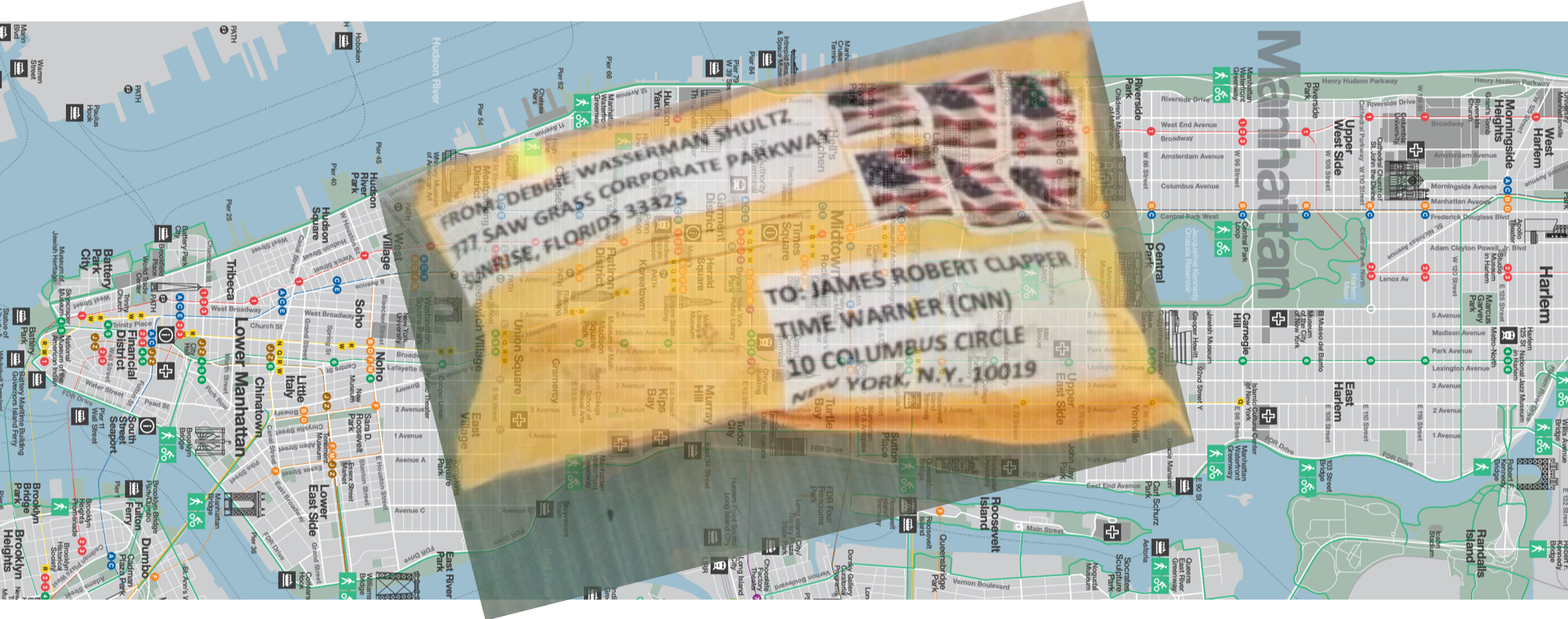 We are divided. We are angry. Regardless of what side of the political chasm you stand on, we each scream at ears that cannot hear. Each side can site their own origin for our condition, but increasingly, our cold civil war is getting hot.
 Thoughts at Large