

Our Ink Is Drying

As I write this, I can watch the gel ink dry into the paper behind each new word. Dried into the fibers, permanent. Immortal. Eternal—for as long as the paper exists.

Place this paper in a vault, and the words will live forever. But they will not live. They remain preserved, filed, and recorded. Yet unread, they exist only as part of the vault’s mass. Their weight merely added to the total.

To the living world, the paper does not exist.

The same can be said of us.

We are the ink. As it dries, we move on—the march of time relentless, unpausing, uncaring. Once the ink dries, it is finished. That is our past. Our memories.

And we are also the vault. Every memory exists within us, along with anyone else who experienced it while the ink was still wet. Once we are gone—once those who share our memories are gone—so too is the memory. So too is the ink, the paper, the vault.

And that is life. Our life. Everyone’s life.

There will come a time when even the thought of you is lost. A day when the last person who remembers you will recall your name or your story for the final time. Then you are gone—lost to eternal oblivion.

Clifton Fadiman once said:

“A cheese may disappoint. It may be dull, it may be naive, it may be oversophisticated. Yet it remains cheese, milk’s leap toward immortality.”

Creativity—our art—is our cheese. Write a book, and it may be read forever. Paint, and your strokes may hang long after your heartbeat fades. The internet has become our new Library of Alexandria. Our vault.

In Cosmos, episode eleven, Carl Sagan said—and I’ll never forget it:

“What an astonishing thing a book is. It’s a flat object made from a tree with flexible parts on which are imprinted lots of funny dark squiggles. But one glance at it and you’re inside the mind of another person, maybe somebody dead for thousands of years… Books break the shackles of time. A book is proof that humans are capable of working magic.”

Another favorite of mine, Oscar Wilde, wrote:

“All art is immortal. For emotion for the sake of emotion is the aim of art, and emotion for the sake of action is the aim of life.”

So create. Plant a tree. Paint a picture. Write a story—your story.

Oblivion awaits. But leave something behind that will outlive you—and outlive the memory of those who knew you.

Will you be remembered for it? Maybe. Maybe not. But your creation might.

I wonder if anyone will ever read this.
I wonder if anyone will remember it, if they did.

Our ink is drying.
Expect Delays

On November 3, 1993, New York’s legendary senator Daniel Patrick Moynihan introduced a bill to tax Winchester hollow-tipped “Black Talon” bullets, “specifically designed to rip flesh,” wrote the senator in an Op-Ed to the New York Times on December 12, 1993, at 10,000%.  So sacrosanct is the poorly written Second Amendment that no rational debate can proceed beyond the “shall not be infringed” clause (conveniently omitting the “well-regulated militia” part. Nineteen days after the bill was introduced, Winchester voluntarily announced it would cease the sale of these “cop killer” rounds to the public. What a shame. Winchester’s action rendered the narrowly written bill moot. Perhaps a more broadly written bill, introduced in an era when public discourse and compromise still existed, might have progressed and saved countless lives. What a shame.

Is there a mindset, a phrase, that city planners use with their public works departments where delaying maintenance on a road is considered the safer option? Hear me out. Automobiles are profoundly safer than they were in the 1960s. Seatbelts, airbags, better braking and steering systems, and computers armed with the ability to either stop the car autonomously or, at the very least, alert the driver of an imminent collision. Coupled with that is the rise of the SUV and the baffling dominance of pick-up trucks, most of which haul groceries and passengers instead of tools and dirt. Most are polished to a greater shine than my sedan. And I know most have never seen the off-roads except in testosterone-dripping advertisements with chunky guitar riffs and gruff narrators. I had a Camry at one point, about 20 years ago, and had to trade it in because I could not see around the walls of aluminum and plastic in front of me.

I inquire about the city planners because, once again, like Senator Moynihan’s end run around the Second Amendment to save lives, the size, power, safety, and speed on our roads create a recipe for disaster when paired with the divisive, Dunning-Kruger homeowners who’ve claimed their territory on Mt. Stupid. Driving to work daily, I can picture insurance leaders scratching their heads, wondering why they continue to underwrite auto policies. In addition to the countless lives lost during the COVID-19 pandemic, another casualty of that time, still affecting us today, is the demise of the speed limit on our roads. 65 mph means 80 (at the very least), 45 means 70, and 25 means 40. If you drive at the speed limit, you risk being run over or, at the very least, becoming the target of the NASCAR driver behind you, engaging in road rage characterized by flailing hand gestures, flashing headlights, and monosyllabic profane grunts. Furthermore, bad behavior no longer has any consequences. While my blood pressure rises and I feel the urge to respond in kind, they are already home, feet up, watching SportsCenter for this weekend’s zoom-zoom race pole positions.

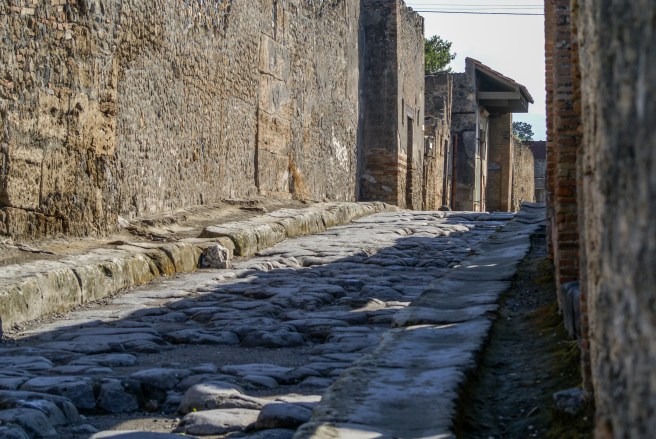
So, if society has ever safer, ever more powerful, ever bigger road behemoths, can we not take a page from the late senator’s book and reduce highways and byways to either dirt paths or the cobblestones of Pompeii? Lives would be saved because traffic would have to slow down. Counter programming through delayed maintenance: Inverse Safety Measures.

And so, while the gun chorus chants, “Guns don’t kill people, people do,” a suitable response to the petulant and self-appointed “special” drivers can be expressed as, “Cars don’t kill people, people do.” While cars are safer, guns are increasingly ubiquitous in Red/Blue angry America. And that truly is a recipe for death.