I want to take a moment and thank someone. Someone who, after all she’d been through, passed one more lesson on to someone needing a class.
Tamara (Lukowicz) O’Hara had every reason to be me. Every reason to be angry, pessimistic, defensive, and assuming, a person who only saw what was wrong with the world and never what was good. A victim. The war I saw my late wife Lisa wage against cancer scarred me eternally as sure as it took her life. I have guilt that will never be assuaged. It can never be mitigated despite logic and reason, regardless of the assurances from my children that my guilt is misplaced. I have bottled rage with no pressure relief valve. There is no one to complain to or in charge with whom to debate my points.
And I found myself bitter. Angry with the unfairness, inconsolable in my rage.
As a child, Tamara had childhood cancer. She battled it and beat it. She was Lisa’s cousin. I only met Tamara as a young adult after I began dating Lisa in the late 1980s. It was either a Thanksgiving at Lisa’s parent’s house or a Christmas Eve party at Lisa’s mom’s cousin’s apartment. I found her bubbly, engaging, and happy when I first met her. She greeted everyone, me included, with a smile and a story. Her parents and her sister were all there. The whole family was approachable and energetic. I took to them all fast. At the time, I think she was the only person I’d ever met who had survived cancer. Not that I ever asked. At that time, cancer was as foreign to me as hieroglyphics and certainly not a polite topic of dinner conversation.
Every time I saw Tamara, she was the same. I never once heard her complain about anything. Not the dinner, the people, the conversation, work, life, nothing. Ever. Over time, as I matured into marriage and had twins, her perpetual bubbliness I relegated to goofiness! She was goofy! Happy beyond all reason, charismatic seemingly without cause. And that’s when I first missed the opportunity to learn from her. She wasn’t goofy. She was alive in every way.
As we age, relationships fade, faltering, not through animosity, but as our lives are dominated by the mundane. Work consumes our days as we seek to purchase the bread our families eat at night. The kids’ kindergarten work morphs into helping them build a trebuchet for high school. And soon, or so it seems, after decades of this march, we see extended family members at weddings and funerals. We see ourselves taking another step up in the generational parade.
A corollary consequence of this separation is the paralysis of others in time. A different cousin of Lisa’s had a daughter who recently graduated from Columbia. I missed it! Without the periodic injection of news (touching base with that faction of the family), she was forever a student there. It is the mirror image of how we miss the small changes in those in our household. Those that have not seen them (or us) for a while notice the slow changes we miss.
And so it was with Tamara. She was somewhere out there, bubbly and happy. Except that was not how she was. She married in 2015, and I saw her in 2021 at Lisa’s mom’s funeral. She became ill again last November and endured procedures and pain I hope never to experience. She died Thursday at 53 years of age. Far too young for her shining light to be extinguished, leaving those who knew her to continue in a darker world.
I will see her family at the funeral. I will see again the familiar anguish, incomprehensible sense of loss, and appreciation that her struggle and pain are over. Her widower has lost a soulmate. Her parents have lost a child. Her sister has lost a part of herself. Cancer has again stolen one of the best of us. I have lost a belated teacher. A teacher I failed to learn from in life, but one whose message I hope to employ in the future.
My sister-in-law is celebrating a milestone birthday this year. To celebrate, she said she wanted to do something huge. “A trip,” she said. My wife and I asked where.
She’s a planner, like me. If I travel somewhere new, I have Excel spreadsheets of sites (complete with links, times, and reviews) and handmade travel brochures for my family. If I’m going somewhere new, especially a bucket-list location, I’m wringing as much out of the experience as possible. One never knows if one will ever return to this place, and there are so many other places I want to visit before my time on this mortal coil is up. It’s the same reason I don’t reread books.
“Let’s each make a list of places, and then we’ll compare notes,” she said. I feverishly retrieved the mental list of places I’d like to see and started jotting down the names of places. It didn’t take long for us to realize we all had similar places listed. England, Italy, and Ireland. “Maybe a cruise,” she said. So, with that framework, we set about finding cruise lines and itineraries that would meet our goal. Ultimately, we landed on a cruise from Rome to Pisa and Florence, then Sicily, Malta, Naples, Santorini, Mykonos, Olympia, and Athens. Unfortunately, once we started adding plane fare and tours, the price escalated well beyond our initial budget, and that didn’t include eating some of the world’s best food or shopping. We canceled the trip.
Dejected, my wife secretly began cobbling together an alternative plan. Rather than a cruise, why don’t we pick one country and go there? She built an entire trip through Italy before showing it to me. I was ecstatic! Count me in! And so, Birthday Celebration Trip version 2.0 was created. Four days in Rome, four days in Florence, and two days in Venice. The trip of a lifetime all starts on Saturday, June 24th. Bucket-list checkmarks are all over the map! We booked everything. That was early February.
Having recently moved, my sister-in-law needed to update her passport. We joked that she better get it back before the trip or else! We talked about the trip incessantly. My spreadsheet blossomed (I had a tab just for the Vatican Museums). Tours were selected based on length, location, and sites, and shoehorned into our burgeoning schedule. A good family friend was kind enough to list his favorite restaurants based on his travels to Italy.
As we entered May, we began to joke that the passport people must have been jealous, and that’s why we hadn’t received it yet. Although, as the month progressed, the jokes were soon tinged with anticipation and growing anxiety.
By the time June rolled around, anxiety had given way to panic and dread. Calls to the passport agency were met with the customer service levels you expect from the cable company. “We can’t give you any update.” “We’re swamped; call back later.” “Your call is very important to us, but blah, blah, blah….” The 90-minute wait times (if you’re lucky enough not to be told they’re too busy to accept your call) ruined a bit of my enjoyment of Mozart’s “Romanze” serenade from Eine kleine Nachtmusik! And my sister-in-law had paid for expedited passport processing! As we got within 14 days of travel, we were told we could call again and get into the expedited-expedited pile! Woohoo! Progress! We also contacted our US Senator to see if his office had any staff with connections in the passport department. Sure enough, they very kindly worked with us to tell us that since we were within 14 days of travel, we were moved to the expedited-expedited pile. We were also reassured that within five days of travel, we could call the passport agency to schedule a meeting to issue an emergency passport.
Panic, anger, depression, and anxiety ratcheted up every day as the mailman again delivered everything but a passport. We also learned that if we waited to reschedule or cancel the trip after Tuesday, June 20th, we would incur an astronomical penalty, significantly more than the cost of my first car!
So, Tuesday was the day, do or die. We’d call for the appointment! Then the knife in the heart. We called and were told there were no appointments in the nearest Passport office (Boston) and no appointments available ANYWHERE IN THE UNITED STATES. Game over. We had to cancel or reschedule the trip.
They say man plans, and God laughs. Today is Friday, June 23rd, 2023. We were scheduled to leave tomorrow afternoon on a flight to Rome. Instead, the closest we’ll get is DiGiorno pizza and a beer to cry into.
My kids grew up in the golden age of reading. They started reading chapter books just when the Harry Potter books took over the world. I grew up in the golden age of baseball. And by that, I mean the 1970’s. I grew up in Rhode Island that weigh station stop between Boston and New York. Many older baseball fans, stung by the Boston Braves leaving town, counted themselves as New York Yankee fans. Most of the kids I grew up with were Boston Red Sox fans. I was a Cincinnati Reds fan. Why? It’s a convoluted story of my father liking them as a kid because he followed Corky Valentine, a short-time pitcher for the Reds in the mid-1950s. Anyway, I grew up during the Big Red Machine of the mid-1970s.
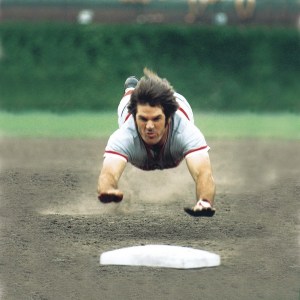
I had most of the team in baseball cards. I meticulously considered my All-Star Game ballot long before dangling chads migrated to politics. And Pete Rose was my hero. He was me. He was not gifted athletically or physically. He was not a pitcher. He was aggressive “between the white lines.” And he was on one of the most dominant teams in baseball history. Tony Perez at first base, Joe Morgan at second base. Dave Concepcion at shortstop, Rose at third base, George Foster in left field, Cesar Cedeno in center field, Ken Griffey in right field, and Johnny Bench behind the plate. Believe me when I tell you, I wrote that from memory, as fresh today as it was when I was ten.
As the Fates planned, “my” Reds met my friends’ Red Sox in the 1975 World Series. Before each game, I would lay my baseball cards in their defensive positions on the rug. And while Game 6 almost caused me to drop out of school or seriously consider either homeschooling or the Peace Corps (rather than face my friends), the Reds won Game 7 and the World Series. Rose batted .370 and was named the World Series Most Valuable Player.
The thing about Rose as a player was that he was granted limited physical ability but an insatiable need to win, essentially at any cost. He was Charlie Hustle. Was he a showboat? Maybe, but he backed it up. I wanted to be a better player than I was. But I did love the game. My brother was a much better player than me, and I base that on the fact that he was a pitcher and played in college. I could barely break a window with my “fastball.” My brother once aimed at a kid’s head in Little League because he taunted him. Wrong? Maybe, but the kid didn’t do it again. Being competitive was equated with toughness. We were constantly reminded that we were not tough because we were not city-born. It was (and still is) a driving force to be overcome.
My father coached me and then my brother for many years. I can’t tell you the number of former players on those teams impressed by my father’s post-victory speech. He may have been disappointed in me (usually) or the team’s performance, but he always summarized his talk with, “The most important thing was we won, and they didn’t.” It never failed to bring goosebumps to the team. He was competitive, and so were we. Unfortunately, as my skills waned and were eclipsed by others, his pushing and my anger caused too many rifts. They ended in me withdrawing from baseball and fracturing our relationship for too long. I missed my brother’s college career because of it, and it is a regret I will live with always.
Pete Rose also made mistakes, permanently fracturing his relationship with Major League Baseball. Whether he, in the wake of the steroid era and Draft Kings advertising on MLB.com, deserves to be in the Hall of Fame cannot be settled here in 1,000 words (he does belong). He’s still a baseball fanatic and can tell you he batted .261 against Nolan Ryan for his career, but that one summer day in 1978, he went 4-4 with two doubles on an unseasonably cool July day in Cincinnati. He could tell you it was 71 degrees at game time. Ryan wasn’t supposed to pitch but came back on three days’ rest because… and he could do that with every pitcher and every game over every year of his long career.
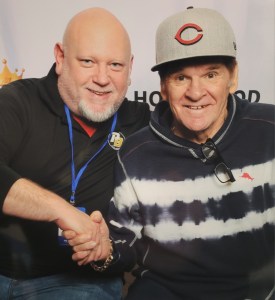
Last weekend, my brother had the opportunity to meet Pete Rose at a baseball card show in Boston. In many ways, it culminated a baseball pilgrimage for the Fucile’s.
My dad is gone, and Rose is frail at 82, but he was my baseball hero, the tough hometown boy from Cincinnati. The Reds always were my dad’s favorite team and still are for my brother and me. My hero could fly.
Password management, strong and secure protection. Computer laptop keyboard and weak password on memo sticks, office desk background
WASHINGTON, D.C.- Bob Winston’s day began like any other day. He woke early, at 4:30 am, shaved, showered, and dressed before heading downstairs for his usual breakfast of coffee, a banana, and a yogurt. His commute to work was uneventful, and as he sat at his desk, he had no inclination that today he would save the world.
“I sat at my desk, turned on my computer, completed the company-mandated password challenge, then entered my username and password to log in to the network,” a humble Bob said when asked about yesterday morning. “After that, I simply entered a different password into the computer to access the group folder. Then it was simply reentering my usernames and passwords six more times to bring up the day’s files. To be honest, and don’t tell my boss, I did a little online shopping and read the news! That was just me entering my usernames and passwords on the four websites I was shopping, trying to find a gift for my wife. I like to catch up on the news by entering my usernames and passwords on the three news sites I read.”
Bob does not say that when signing into his Amazon account, he accidentally mistyped “Amazon,” which brought him to a covert dark web portal operated by the Russian FSB responsible for maintaining and, if necessary, activating the Russian nuclear arsenal. “I had no idea!” said Bob, laughing at his innocent mistake. “At first, it looked like the normal Amazon front page. I try to be an attentive husband, and my wife had mentioned in passing that she was interested in reading Atomic Habits for work. I entered Atomic Habits in the Amazon search field and was brought to a subfolder that had nothing to do with the book! I figured Amazon had a glitch on their site and decided to try again later. Claire, my wife, had also mentioned that she had spoken with Mildred, our neighbor, who said her husband Martin was planning on playing in an Under 35 softball league this summer. Being a bit older than Martin, I wondered if there were any Over 35 leagues, as I loved playing baseball. I thought I typed in “U35 leagues”, but I must have accidentally hit the 2 and 3 together and typed “U235″ instead. Well! Let me tell you, that brought me to an exciting site! My screen filled with schematics of missiles in bunkers and aboard submarines. What the heck is this, I thought!”
At the same time in Virginia, Virginia Sims began her morning at the NSA. “Yeah, just another manic Monday, I thought,” said Ms. Sims. I spent the first three hours of my morning, just like every other morning, signing into the various networks, folders, and files. I’m no different than anyone else. Just an endless series of usernames and passwords! Every day, three or four sites require me to update my password because they are outdated.”
“Sometimes it’s hard to develop a new variation on a password. There are just so many to remember!” laughs Ms. Sims. When she signed on to the last network, Ms. Sims’s screen was filled with a red background and the words “Russian Nuclear Arsenal Operational!”
“Well, you can imagine, my heart jumped into my throat! I had been listening to an audiobook on the way to work and hadn’t caught up on the news, so I was entirely in the dark about whatever geopolitical drama was unfolding!
I called my boss, but he needed to remember the password to his network. He reset it on Friday, but he forgot to write it down! He struggled to remember it, and more than once forgot to enter that he was not a robot which kicked him back to the beginning. Once he did remember it, he told me he was booted twice again when he didn’t correctly select all the photos containing stoplights or, what was it, crosswalks?”
“Anyway, he finally got signed in and saw the message I had sent him. He called me immediately and said he was unaware of any crisis but would contact the CIA and Pentagon to confirm we hadn’t missed anything.”
As Ms. Sims waited to hear back from her boss, Bob Winston struggled to get back to what he thought was a search for a softball league.
“The screen with the missiles and submarines looked real enough, but my son sometimes plays video games on my computer at home. I figured maybe the sign-on information he used for his Xbox had migrated to my work computer because the credit card was tied to me. Anyway, I’m curious, so I clicked on one of the missiles.”
“Instantly, the missile turned red, and I was brought to a different screen showing a list of coordinates. I’m not a cartographer, so I didn’t know what the latitude and longitude numbers meant! All I saw was SS-27 Mod 2 (Yars) and many numbers. It looked fun, so I clicked the big red button at the bottom of the screen to see what would happen! The screen started blinking green and then returned to the previous screen. Well, that was anticlimactic, I thought! No inflight cut-scene, no BOOM! Nothing! What struck me was that after all the usernames and passwords I had used all morning, you would think I would need some authorization to launch a missile in what I thought was a game! Poor game design, I figured!”
At NORAD and worldwide, screens started screaming. People began panicking over the seemingly unprovoked first-strike launch of a multiple-warhead nuclear missile from the Vladivostok peninsula in eastern Russia.
At the Pentagon, line officers began calling their superiors. Within minutes, it is reported, though unconfirmed, the President was relocated to a secure bunker in an undisclosed location conferring with the Joint Chiefs on both an intercept mission and a counter strike with nuclear munitions located in eastern Europe. And, as has been reported, the bunker was slowed in being brought online due to password issues with the secure internal network. Chairman of the Joint Chiefs, Gen. Mark Miley, with a nervous chuckle, recounts the fifteen minutes it took his staff to sign on to the network because a Lt. Commander misspelled “Analytics” three times in a row, forcing him to reset his password using an email link, an authenticator, proving he was not a robot, and identifying all the photos containing peanuts.
In Virginia, Virginia Sims received confirmation from her boss that a nuclear launch had been verified by NORAD and geostationary satellites orbiting in low earth orbit over North Korea. Her mind flashed to a similar situation she had read about in school.
On September 26, 1983, at the height of the Cold War, engineer Stanislav Petrov of the Soviet Air Defense Forces waited rather than responded when confronted by notification of an intercontinental ballistic missile launch from the United States and four subsequent launches. While awaiting corroborating evidence (which never came) rather than escalating the situation to his superiors, Lt. Col Petrov prevented initiating the world-ending mutually assured destruction doctrine. What turned out to be a false reading of sunlight on high-altitude clouds was mistaken by the new Soviet early warning system as a nuclear attack. Lt. Col Petrov saved the planet that day.
Ms. Sims, with Lt. Col Petrov in the back of her mind, began, essentially, reverse engineering the situation to back beginning. After signing into the NSA internet monitoring system using a handheld token of rotating numbers, verifying she was not a robot, and identifying all the photos of chickens, Ms. Sims quickly traced the IP address to Bob Winston’s insurance company computer in Burke, Virginia.
However, in a twist usually saved for cheesy Hollywood movies, the situation ended as quickly as it began.
“Yeah, I heard the coffee machine in the break room and knew either my boss or my colleague Barbara had arrived for work. It was time for me to get out of the game. At least, I thought it was a game! I clicked the back button on my computer, bringing me back to the screen showing the missile. A popup screen appeared, and I clicked Terminate, which I honestly thought was an overly dramatic way to say End Game. Then a second popup appeared with a space for a password. I have no idea, I thought. I heard my boss’s footsteps approaching me and just entered “password” into the computer. My browser closed just before my boss said good morning. Whew!”
High above the Pacific Ocean, the SS-27 Mod 2 ICBM carrying multiple nuclear warheads detonated in a harmless fireball, splashing pieces into the ocean, witnessed only by sea life and a lone longline trawler.
“It could have been much worse,” said Ms. Sims in a monumental understatement. “Thankfully, Bob entered the right password -“password”!”
“All art conspires toward the condition of music.” Walter Pater
I agree with Mr. Pater, one of Oscar Wilde’s influences and a proponent of Aestheticism (Art for art’s sake, i.e., neither social nor political).
Artists must create. It is in their blood and must be birthed onto the canvas. I use the word “birthed” purposely. I have seen the great effort artists willingly undertake to create art from nothing. As the blank page stares back at the writer, so does the white canvas mock the artist. The effort required to transform nothingness into art is akin to birth.
I once needed help with where to rank photography in the order of the arts. Artists must labor (pun intended) over their work to bring their vision onto the canvas, but the photographer “simply” captures the world before them. Now, I do not dismiss the intimate understanding the photographer has over their instrument nor the “eye” they must exercise when capturing the scene before them. However, historically at least, once the shutter is activated, most of the artistic influence of the photographer is exhausted. True, in days of old, efforts could be taken by the photographer with the development process (more additive here, more time there) to bump up the contrast or wash out a double exposure. And today, image editing software can transform any photo into a masterpiece with masking, editing, filters, and many other tools. But is that just window-dressing of an existing property? When I was younger, I would have agreed. However, I now believe photography blends perfectly well into the prism of art without hesitation or equivocation.
Allow me to diverge into another art form, music. Here, Mr. Pater is spot on. I have always said musical genres speak to the individual emotions of humans. Whatever mood I am in, there is music that matches it. A sad song can spark creativity in me. Black Sabbath can assuage my anger. Jazz can even out my temperament. Classical can elevate my senses. Smart, clever lyrics can drive me to my keyboard. A David Gilmour solo can transcend words altogether. Unlike other art forms, music elicits emotion from the audience via the ears rather than the eyes. Certain composers can tell a story with their music without the employment of any other sense.
I once attended a performance of Mozart’s Piano Concerto No. 22 in E-flat major, where a fully-fledged story presented itself in my mind. As it began, the piano sounded very playful, almost childlike, not in its complexity but in how it meandered in and out of the string instruments behind it. At some point, I imagined the piano as a child and the stringed instruments as the parents and extended family. The strings would play a piece first, and the piano would respond, often playful but still in keeping with the string direction. It was always strings first and then piano. Sometimes the piano would go off into a new direction without accompaniment as if a child was wandering around in the safety of the family’s embrace.
The second piece introduced the wind instruments (who’d been there all along but had yet to stand out). Because of the increased complexity of the music, I envisioned the piano as a teen beginning to interact with the wind instruments, which I saw as friends/schoolmates/lovers/colleagues. The piano would sometimes lead, and the wind instruments would follow. And then the strings would return with the refrain, telling the piano to come back into the fold and remember its responsibilities.
The third piece saw the ascension of the piano to a full-grown man (I say man because Emanuel Ax was the pianist, it could have been a fully-grown woman). The piano-led, and the strings followed. The piano assumed the refrain to which the strings (and sometimes the winds) would follow, but always with a sense of individuality and playfulness in the piano. It was as if the piano was now the patriarch/matriarch of the family and responsible for it, but it had never given up its individualistic flair. Perhaps I heard what I wanted to hear to make the story fit, but after the first piece, I anxiously awaited the next piece to see if my storyline fit- and it did every time.
By the end, I was in tears, weeping for the story Mozart had told me that day, written 234 years before. I had listened to the concerto over the previous few months, anticipating the performance. Still, there was something about seeing the piano up front, the strings extending as wings behind it, and the wind instruments centered in the back that made the story explode before my eyes. If this all sounds incredibly corny and uncultured, or if I’m missing the true intent of the concerto, I apologize. But as I sat there applauding, tears running down my face, I knew I had seen the storytelling power of music.
Painters can do the same thing with their medium. Stand before a Bierstadt landscape, and I swear you can hear far-off thunder or birds chirping. Stand before a Monet, and I promise you’ll see the wind interact with the haystacks. Stand before a Michelangelo, and I swear you’ll see muscles tense before your eyes.
Ultimately, the difference between painters, sculptors, composers, and photographers is one of perspective. Painters and sculptors offer you their vision. Impressionists do not provide you with a photorealistic version of the scene before them. Instead, they offer you their interpretation of that scene. You, the viewer, can choose what to see in the offering. Stand up close, and you’ll see the artist’s effort, brush strokes, and palette knife sweeps. Stand back, and you see sunlight where a smudge was, passion where disparate colors touched up close. Same with the sculptor. Go to a museum and listen as a docent regales a group with seemingly pretentious interpretations of the work before them. But do listen! Because while you may disagree with things being said or not “get” specific points, they offer you a vision into the artist, a glimpse into their intent.
The difference between viewing a painter’s or sculptor’s interpretation of the world before them and the photographer’s is a shift in perspective. As a viewer of paintings and sculptures, we are a passive audience of another’s life. As a viewer of photography, perhaps because it is easier for our 3D brains to insert us into a realistic 2D scene, we are the center of the world, active rather than passive. We see a photo of the shore and envision ourselves in that place. We see a picture of the mountains and ourselves on the plains before them. We may recollect a memory from a photograph of a familiar subject that fills us with the accompanying emotions. Alternatively, we may inject ourselves into an unknown scene, envisioning ourselves in that space and projecting matching feelings.
Mr. Pater is correct in that all art aspires to the purity of music in that music exists beyond our eyes. But in the end, whether it is photography, painting, music, sculpture, poetry, or prose, they all live on the spectrum of art. Ultimately, the spectrum of art is another analogy for the full scope of human emotion.
When I was young, my sister and I were charged with going to the Newport Creamery each night to get my father a pint of Maple Walnut and Walnut Fudge mixed. The bottom half of the pint was Maple Walnut ice cream, and the top half was Walnut Fudge ice cream. We did this most nights. It’s a memory my feeble brain still recalls. My sister is a year younger than me. We lived on the west side of West Main Road in Middletown, Rhode Island. The Newport Creamery was about half a mile away on the east side of West Main Road. Getting there required us to cross West Main Road at dusk or early evening when we were 10 or 12. And we thought nothing of it.
Seeing that road now, both with the volume of traffic and speed at which cars travel, it’s a wonder we saw our teens. And that’s one of the problems with viewing yesterday’s events through today’s lens. When we were younger, speed limits meant something. And while Aquidneck Island was always a tourist spot and Navy town, traffic back then was a fraction of what it is today.
The Newport Creamery holds a special place in my heart. Many an evening, after a Little League, Babe Ruth, American Legion, or High School baseball game, or just on a warm summer evening, “The Creamery” was a welcoming place to celebrate a win or lament a loss. I thought they had the best chocolate chip (and coffee) ice cream. And their Junior Hamburger was my favorite. Two, with a side of fries, please! And then a Turtle Sundae my way (chocolate chip ice cream, hot fudge sauce, caramel sauce, marshmallow topping, whipped cream, and a cherry).
They also have a milkshake made with iced milk instead of ice cream called an Awful Awful. Despite its off-putting name, it is so called because it is “Awful Big and Awful Good.” The challenge on the menu said if you could drink three, you’d get the fourth free. How could a teenage boy not accept that challenge? And at least once, I got my fourth free Awful Awful. Always vanilla flavored (for me), the marginal return on enjoyment waned dramatically on the second and third, only to rally for the free one. And then I’d walk home feeling the liquid slosh around inside me like my stomach was at high tide during a named storm.
The Creamery also sells half gallons of their ice cream in plastic buckets. Every home in Rhode Island has a few buckets holding various items (buttons or ribbons in the craft area, multiple nails and screws in the garage, marbles and toys in the kid’s room). And if I had access to the photographs in every home, I could find a photo of every child with the bucket on their head. I know I have them of my kids.
The Newport Creamery has had financial troubles in the past decade or so, and while I don’t know what the future holds for any of us, despite heavier and faster traffic than when I was a kid, I hope The Creamery exists for a long time into the future. There are many Awful Awfuls to drink and plastic buckets for kids to wear. And while my sister will argue that Frosty Freez is the iconic summer ice cream stand on “the island,” especially given that she worked there many a summer (and I concede to making a pilgrimage there a few times each summer), The Creamery holds many more memories for me.
No one has a perfect childhood or flawless life. But there are idyllic memories of youth and raising children, and The Creamery holds both for me.
My wife is dating. Not sure how I feel about that. And before this becomes the screenplay for an A&E/History Channel/Oxygen made-for-tv movie, let me explain.
Dating at any time is hard. Finding someone who checks all your boxes is tough. Six numbers and the Powerball are easier. My sister-in-law is learning this again after almost two decades. Wracked with confidence issues and subjected to scammers and men only looking for one thing, she’s enlisted the help of my wife to keep her keel even and search positive as she traverses the pitfalls of online dating.
I can tell you, based on the photos they’ve shown me on one of the dating sites she’s subscribed to, that:
Men post the absolute worst pictures of themselves.
It appears that men think a photo of themselves holding a fish is an aphrodisiac.
Men only want one thing and are willing to skip the 800 steps before that one thing to get it.
They think a photo of them in a costume (elf, coconut bra, etc.) will get them dates, not just a permanent position on aisle 127 at Walmart.
Men post the worst photos of themselves. Did I mention that?
Men only want one thing. Did I mention that?
A hit to your self-confidence can make you believe the hurtful things others have told you about yourself. Worse, it can make you accept less than you deserve, potentially setting yourself up for future heartache when you finally realize you deserve better. Maintaining your self-worth while enduring the endless line of “not in your wildest dreams” losers on these sites is critical and borders on the impossible. You truly need an advocate, someone in your corner to counter your wavering self-esteem, and a sounding board to give you unbiased opinions on the horribly photographed individuals on your screen as you swipe from one “Man with Fish” photo to the next. Seriously, what’s with the fish? Here’s an idea! How about a photo with you in front of a bookshelf or you holding a picture of you and your sixth-grade spelling bee participation certificate?
Look. I get it. There are all types out there. I’m sure there are women looking for men who hold fish or men on a Harley, or men who can’t spell. Some women can’t spell, ride Harleys, and like fish. However, when my sister-in-law is looking for love, she’s looking for a companion with whom she can spend the rest of her life. She’s looking for someone to travel with, watch movies with, discuss books with, describe her day at work with, and grow old together. Someone who will love her as much as she loves them, someone who respects her. It’s not easy to find that person. Does anyone want a Powerball ticket?
And so, my wife is dating. She’s texting on her sister’s behalf on dating sites, keeping the conversation respectful and probing for that kernel of honesty, that proverbial needle in the haystack. She shares with me what they write, and so many of them flame out within 24 hours when they cross the line (skipping those 800 steps) or reveal themselves as scammers looking for money or someone needing a dictionary.
Here’s some advice for the men out there from a guy who knows how to fish, ride a motorcycle, and spell. Lose the fish, guys. Put on a clean shirt and ask someone to take your picture (or learn how to use the 3-second delay on your cell phone camera). If you want a relationship, don’t ask them whether they “landscape” in the first text. That’s not a relationship. Texting is hard enough because it is devoid of emotional intent. Proofread what you type and try to project how your writing will be interpreted. Take the extra few seconds to ensure you spelled everything correctly. Seriously, it’s not that hard! You’re making all men look bad when you skip the steps and can’t spell “steps.”
Incredible women are looking for their Mr. Right. Self-esteem is always on the line when dating, on both sides. You leave yourself vulnerable and subject to hurt every time you engage with someone on dating sites. Put your best foot forward. Take a good picture. Spell correctly. She’s out there. I know one. And then my wife can stop online dating. Thanks.
“Even in our sleep, pain which cannot forget falls drop by drop upon the heart until, in our own despair, against our will, comes wisdom through the awful grace of God.”
With these words, quoted from Aeschylus, Robert Kennedy consoled African American campaign workers (and millions worldwide) in Indianapolis on this night 55 years ago after having announced to the crowd that Martin Luther King, Jr. had been assassinated earlier that evening in Memphis.
If you get a chance today, watch the speech he gave. It is shocking in its beauty and honesty. It was reported that the Secret Service told Kennedy they could not guarantee his safety if the crowd became violent. He gave the speech anyway.
He said, “Let us dedicate ourselves to what the ancient Greeks wrote so many years ago, to tame the savageness of man and make gentle the life of this world.”
Martin Luther King, Jr. was 39 years old on that day. Imagine a different universe where he lived. What would the United States look like today? Would we have faced the horrific stain of slavery head-on and ensured equality among all our citizens? Would we finally be living in a nation where his (now grown) are judged not by the color of their skin but by the content of their character? Maybe. Probably not. Intransigence and ennui ossify both the disengaged and unaffected. It is worth noting, Robert Kennedy was dead two months later, himself the victim of America’s gun violence.
At 58 years old, after a decade of railing against gun violence, that uniquely American disease, I am still haunted by the following sentiments when tending to my own heart and not the soul of our troubled nation:
Robert Kennedy:
“Few will have the greatness to bend history itself, but each of us can work to change a small portion of events. It is from numberless diverse acts of courage and belief that human history is shaped. Each time a man stands up for an ideal, or acts to improve the lot of others, or strikes out against injustice, he sends forth a tiny ripple of hope, and crossing each other from a million different centers of energy and daring those ripples build a current which can sweep down the mightiest walls of oppression and resistance.”
“The purpose of life is to contribute in some way to making things better.”
“Few men are willing to brave the disapproval of their peers, the censure of their colleagues, the wrath of their society. Moral courage is a rarer commodity than bravery in battle or great intelligence. Yet it is the one essential, vital quality for those who seek to change a world that yields most painfully to change.”
Martin Luther King, Jr.:
“Our lives begin to end the day we become silent about things that matter.” “In the end, we will remember not the words of our enemies, but the silence of our friends.”
“If you can’t fly then run, if you can’t run then walk, if you can’t walk then crawl, but whatever you do you have to keep moving forward.”
“There comes a time when one must take a position that is neither safe, nor politic, nor popular, but he must take it because conscience tells him it is right.”
“Nothing in the world is more dangerous than sincere ignorance and conscientious stupidity.”
“The ultimate measure of a man is not where he stands in moments of comfort and convenience, but where he stands at times of challenge and controversy.”
Christopher Hitchens:
“Never be a spectator of unfairness or stupidity. The grave will supply plenty of time for silence.”
“What I used to say to people, when I was much more engagé myself, is that you can’t be apolitical. It will come and get you. It’s not that you shouldn’t be neutral. It’s that you won’t be able to stay neutral.”
“For years, I declined to fill in the form for my Senate press credential that asked me to state my ‘race,’ unless I was permitted to put ‘human.’ The form had to be completed under penalty of perjury, so I could not in conscience put ‘white,’ which is not even a color let alone a ‘race,’ and I sternly declined to put ‘Caucasian,’ which is an exploded term from a discredited ethnology. Surely the essential and unarguable core of King’s campaign was the insistence that pigmentation was a false measure: a false measure of mankind (yes, mankind) and an inheritance from a time of great ignorance and stupidity and cruelty, when one drop of blood could make you ‘black.”
Today, a former president was arrested and indicted on criminal charges in Manhattan. Donald Trump is the antithesis of Robert Kennedy or Martin Luther King, Jr. because while they carried the torch of justice to move society ever closer to a bright future, he chose to pour gasoline on smoldering embers and moved us backward toward our dark past.
At a time when our country is as divided as ever, short of outright conflict, I hope there are more of us whose “purpose of life is to contribute in some way to making things better” than those who want to see it burn.
I am 58 years old. I grew up between the memory-searing days of November 22, 1963, and September 11, 2001; days everyone remembers where they were when they heard the news. My childhood was relatively calm. Vietnam was a million miles away, and I was too young to understand the protests here at home. Watergate was my first entry into politics, and that’s because my father was always informed and made sure I understood the importance of the events. Trauma in my youth was limited to my Cincinnati Reds losing Game Six of the 1975 World Series and me having to go to school the next day to face my Red Sox-loving friends.
And then, on September 11, 2001, a new (to Americans here at home) word entered our vocabulary: Terrorism. That day, we realized we were not immune to the horrors of geopolitical terrorism. The “two oceans” buffer we enjoyed no longer protected us. Now the horror of war came to us in our homes and places of work. We all know someone affected by that day. And we have never been the same.
And while we wanted revenge or justice as a united front, we were left deflated because, unlike times past, those that brought us that pain did not represent a government, a nation, a colored blotch on a map between other colored blotches. They were individuals following one deranged man and hiding in mountainous caves somewhere. And so, we bombed mountains and carried out military missions with so-called surgical precision to maintain public support with anesthetized news.
Before 9/11, men in the United States did not wear beards in the current numbers. Fashion? Maybe. Or maybe it was because our military grew beards in the Middle East to assimilate with the local population and brought that look back home. Interesting that US men now look like those we sought to destroy.
And so, a generation of children, my children, grew up in a world where terrorism from foreigners was a threat. We took our coats, belts, and shoes off at airports, carried only 3 oz bottles of liquid on planes, and saw everyone who looked different from us as a potential sleeper cell. We thought the greatest threat to America was from without. We should have been paying closer attention.
Two years before 9/11, an incident in Colorado laid the groundwork for the real threat to America. On April 20, 1999, two students from Columbine High School shot and killed 12 students and one teacher and injured 21 more with the guns they brought to school that day. In addition to the trauma it caused a community and the shock it sent through America, it was only the first of many mass shootings that saw the rise of “thoughts and prayers” and little else in Washington.
The massacre of 20 children and six adults at Sandy Hook Elementary School in Newtown, Connecticut, was a turning point for many, including me. Filled with rage that we didn’t have to live in fear of sending our children to school wondering if they would come home, groups formed, political pressure was generated, and little was done. Time and again, politicians fell back on the Second Amendment as if it had descended from the heavens, God’s will that gun-lover “freedom” supersedes your neighbor’s life. Politicians (mostly Republicans) have this perverted notion that the founding fathers not only walked on water and did no wrong but also possessed the gift of foresight, knowing and understanding the tremendous technological advancements firearms would take. It seems there is no finish line in man’s quest to find better, more efficient ways of killing other men. Once relegated to the battlefield, the NRA paid politicians to ensure citizens had access to guns in numbers and lethality never conceived by the average 58-year-old, never mind those in the 1780s.
The intransigence and callousness of these politicians play out the same way after every mass shooting, whether in a school, nightclub, movie theater, outdoor concert, church, grocery store, or workplace. First, there are notices that they are monitoring the situation. Then “thoughts and prayers” from them and their spouse. Then admonitions not to politicize the case when the facts haven’t been published yet. Then talk of not wanting to punish the law-abiding, gun-owning citizenry. Then deflections akin to “criminals don’t follow laws.” Then time passes, people forget, and nothing changes. Until the next breaking news story of the latest mass shooting, and then the carousel starts all over again. And the narrative is changing. Some law enforcement organizations and news organizations no longer refer to them as “mass shootings” or “active shooter” situations. They are now referred to as “active aggressor” situations. We have removed the weapon from the story. Mental health is the culprit, not the innocent weapon designed to turn human flesh into jelly.
Please understand. There have been changes made. The groups formed after Sandy Hook have done fantastic work on the state level in many states nationwide. But on the federal level, it’s the same old story. Mass shootings, because they generate an initial spike in calls for gun control, instill fear in the gun-hugging public. They run out and buy more guns for fear (how irrational is this?) that the federal government will stop their ability to own enough guns to arm a small country. Gun sales surge under Democrat presidents because of this irrationality.
While some nibbling has been done around the edges of the problem, meaningful things will only be done at the federal level when we are willing to revisit the Second Amendment. Justice Scalia (writing for the Supreme Court majority) said a well-regulated militia meant the individual. Somehow a state’s National Guard became Cletus out back with his 40 guns, preparing to take on his tyrannical government. America now has more guns than people. My dream, and that is all it is because I am powerless to enact change, is that America will one day wake up from this self-induced nightmare and repeal the Second Amendment, followed by a gun buyback program followed by lengthy prison sentences for those still owning these incredibly effective methods of death.
We have raised a generation of children who endure “active aggressor” drills at school and are willingly offered up as sacrifices at the altar of “freedom.” We have failed a generation and will continue to do so until the United States is willing to look in the mirror and see the terrorist with a gun staring back.
Isolation became as much a pandemic as the COVID-19 virus that caused it. And the social paradigm shift left in its long wake continues to affect millions of people. Social pastimes such as going to the movies, going out to dinner, visiting friends and relatives, comedy clubs, concerts, art shows, vacations to amusement parks and bucket-list cities all foundered. And like the millions of virus victims, many of these venues and pastimes did not survive.
We were left to entertain ourselves at home. And some of us did this better than others. The American Journal of Emergency Medicine said domestic violence cases increased by 25% and 33% globally, with an increase in the United States by over 8%. In my house, crafts replaced excursions. It began when my daughter, Samantha, came to my house wearing a stylish three-ply mask she fashioned from a curtain. In what might have been a humorous episode of a sitcom (you fill in the blank), she proceeded to sew another mask at the dining room table while watching me try to do the same with her guidance. Ultimately, my finished product was less fashionable and (probably) less effective. Still, I wore it to the grocery store until better masks were readily available. I still have it.
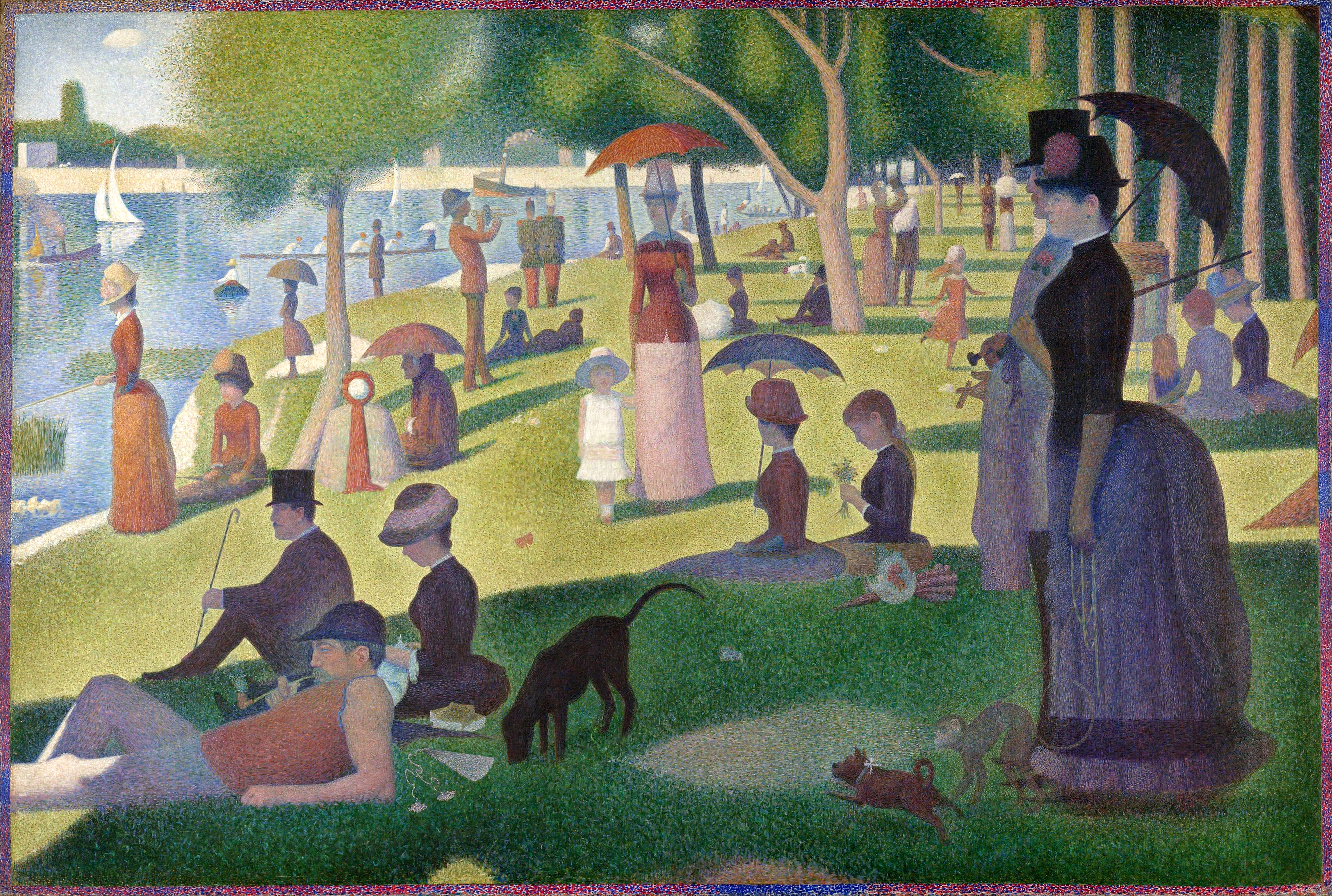
And then there were the crafts. Let me back up. Pointillism is a method of painting developed by Georges Seurat and others in 1886. It is an offshoot of the impressionists (Monet, Manet, Cassatt, Degas, Pissarro, Renoir, and Cezanne). In pointillism, artists use dots of paint to form images. It was the precursor to pixels on televisions, monitors, and cell phones. Seurat’s most famous painting is A Sunday Afternoon on the Island of La Grande Jatte.
Incidentally, my son Cameron and daughter Samantha saw the 2017 revival of the Sondheim penned Sunday in the Park with George musical on Broadway; itself a fascinating statement on art, artists, people, humanity, and human interaction as the painting comes alive before the audience. Little did we know how human interaction would be a recipe for a lethal worldwide pandemic just three short years later. Ironically, Johnson & Johnson, supplier of one of the COVID-19 vaccines, was created in the same 1886 that Georges Surat created pointillism. Pfizer was formed in 1849. Thanks, Google.
Art proved to be the salve for my family and me. And as a corollary to my last post, art proved once again to forestall being lost. This time, while writing continued to provide me a venue to consolidate my disparate thoughts, “dipping dots” consumed our time and provided hours of entertainment (and a few sore necks!). Of course, they are not called “dipping dots.” Those are the frozen pebbles of ice cream found at hockey games and stadiums. I refer to the tiny, colorful plastic dots (or squares) on a sticky canvas.
My wife (and sometimes my two stepdaughters (although typically, they would start a project and we would finish it)) saw these projects devour hundreds of hours of quarantine and isolation during the pandemic. I also know every word to every pop song played on the radio over the last 50 years as we listened to these songs on a loop while working our dipping dots. These craft projects (I differentiate here between creating (art) and producing (crafts) so as not to offend artists who create original works) were terrific distractions from the horror of the pandemic and the schism of politics.
Both mindless and intoxicating, these projects consumed us. We couldn’t wait to finish working for the day so we could “dip dots.” Maybe it was a consequence of the work we each do. My wife works for an insurance company and spends most of her days in meetings. I live in Microsoft Excel spreadsheets, deep in the weeds of cells and formulas. Although we both work from home (I have worked exclusively from home since moving back to Rhode Island in 2016 while she was new to the concept, as were millions of others affected by the coronavirus), there was no tangible evidence of our daily efforts. She ends the call; I close the file. There is nothing to see, nothing to hold up as real progress or something that will exist beyond the next call or following report. Dipping Dots projects checked that box. It exists today, tomorrow, and always as a physical manifestation of effort.
Again, to create is to exist and to endure. Tiny plastic dots, pixels, or pointillism gave me a productive outlet during a worldwide pandemic and many enjoyable hours with my family. These are but a few of the many projects we completed during the lockdown. They were good times in an awful time, centering and fun while the world spun off its axis.











 Thoughts at Large