
Undecided No More

Image from The New Yorker

My son, a freshman in college, and I were on the phone last night discussing our impressions of the latest town hall debate between President Barack Obama and former governor Mitt Romney.  Given the particularly rancorous tone the debate had, a mirrored reflection of the actual campaign, I commented that I found it hard to believe that there were enough undecided voters in the country to fill the audience, let alone that many in Nassau County; but there they were.

Rabid, robotic sycophants in each party leave no room for the truly undecided voter to express their uncertainty with a candidate lest they be subjected to immediate internment in the opposing camp, suddenly responsible for each plank in a platform in which they are ill-prepared and unwilling to defend.  Are these undecided voters genuinely inquisitive, searching for positions on a myriad of issues or are they the dull, unread and oblivious?  For the sake of the future of the United States, I hope it is the former while concerned it is the later.

The polarization of politics, the fracturing of consensus and absence of debate, the removal of concession as a tool toward progress has paralyzed politics.  A shattered media, where any myopic obsession with one particular issue is rewarded with its own cable channel and a thousand militant websites, encourages the electorate to choose a candidate for their position on a single issue and while ignoring the candidate’s position on every other issue as “somebody else’s problem.” You’re concerned about the economy? The environment be damned.  You’re concerned about healthcare? Jobs be damned. And so on…

Neither candidate has successfully escaped this reality.  In a perfect world, Mitt Romney would be able to express the desire for small business (“the economic engine of the country”) to thrive and grow.  He would be able to encourage the celebration of the individual based on their genius and initiative (not their celebrity quotient), rewarded with the fruits of a capitalistic marketplace or starved by the same; where wealth is seen, not as the unconscionable greed plundered by the mindless “looters” of Ayn Rand’s Atlas Shrugged, but celebrated as the moral destination of individual gain.  In this perfect world there would be more Hank Rearden’s and Dagny Taggart’s and fewer Wesley Mouch’s and Jim Taggarts.  Unfortunately, this industrial utopia ignores the choices people make.  Atlas Shrugged spends an exhaustive number of pages explaining that the choice a mother makes to give the last piece of bread to her child is not a sacrifice and not given out of pity, but the rational choice of a rational mind.  In the real world, choices like this are made by individuals on a daily basis with no expectation of societal support in return.  Honor is held internally by these individuals, as they navigate life’s course, carved by the choices they have made and determined to persevere.  There are no children in Atlas Shrugged and no characters ravaged by illness, excepting, of course, that a conscious refusal to think for one’s self is terminal. In reality, there are those whom Fortune has betrayed, felled by disease or events beyond their control for whom that proverbial “governmental safety net” should be axiomatic.

Conversely, President Obama has not been able to effectively convey a perfect world where government involvement in the minds and pocketbooks of citizens is not for the benefit of the lazy takers and looters, but where an “audacity of hope” lifts all boats; where society’s infrastructure is measured in the tons of steel and yards of cement in our roads and bridges and not in the number of governmental agencies handing out food stamps and welfare checks to the unworthy.  He has not been able to sell his opponents on a middle class worthy of the platitudes bestowed upon it by Democrats as the hardworking backbone of America, and not the resource-sponging Pablum vilified by Republicans.  To assume that every citizen is doing their best and ignoring society’s leeches does nothing but invite deserved criticism.    No amount of rhetoric can make up for the picture of the able-bodied young man who has fathered countless children without concern for their future, waiting in line for a government check rather than searching for work, laughing in full belief that the government “owes” him.  Nor has the president escaped the portrait, painted in dazzlingly surreal colors by the “Confiscation Day” fear-mongering NRA, of  him as a soft, yellow, liberal hoplophobe, as opposed to a father and leader legitimately questioning why regular citizens need to own AR-15’s with 100 round drums.

Each side sees only the idealized version of themselves in the mirror and ignores the Dorian Gray painting in the corner while only seeing the Dorian Gray painting of their opponent.

My son suggested that the town hall format, while colloquial and folksy did little to further either candidate’s command of the undecided.  He, himself an accomplished high school debater, suggested that there be two debates scheduled for future presidential campaigns.  Each candidate selects the most partisan member of the media they can find, crafts pointed questions and directs them at their opponent, knowing that their opponent will have the same opportunity in the next round.  In fact, why not remove the commentator altogether?  This would eliminate the bias claims leveled at every commentator by partisan hacks and conspiracy theorists.  Simply have one debate where the Republican candidate asks questions directly to the Democratic candidate and a second debate where the Democratic candidate asks questions directly to the Republican candidate.  These debates should be limited to six hours in length and broadcast on every cable and radio station.  Proof of viewership (of both debates) should be required of every voter on election night, thus ensuring that an informed electorate is a prepared electorate, undecided no more.

Killer Words

“Bully.”  What does that word make you think of?  Someone in particular, a story in the news, your past, yourself?  What about “Intimidation?”  What does that make you think of? “Assault?” “Coersion?” “Extortion?” What about phrases like “mob-mentality” or “balance of power” or “cyberbullying?”

Words have meanings and these meanings are the combined perceptions, prejudices and mores we assign to them, either consciously or inadvertently.  “Bullying” tends to take on the framework of childhood, to be equivocated, downplayed, “kids just being kids.” We typically think of our own lives, the times we were teased, taunted, called-out and called names.  “Toughen-up,” we were told, “Stand up to the bully and he will never bother you again.”  Unfortunately, these equivocations, this preconceived framework of childhood embarrassment betray us and we ignore the effect it has on the individual.  Bullying, in either its verbal, social or physical manifestation would be called harassment, stalking, coercion, extortion, blackmail or assault were it to happen to an adult.  Why, then, do we ignore one and summon the police for the other?  Again, it is the framework we build around the words.

If we relegate bullying to childhood (and young adulthood), we must also acknowledge that this is the time in an individual’s life when they are most vulnerable to the machinations of mobs.  Self-conscious in their physical appearance and their emotional well-being exposed, they magnify every kernel of attention, often distorting it to meet their current frame of mind.  We call it “peer pressure,” a nice, succinct phrase we too eagerly dismiss.  We’ve all been there, we all survived.  Kids!  What can you do?

Unfortunately, we don’t all survive.  Many of us are scared, either physically or mentally due to the effects of this early life assault.  We carry the bitterness of being a victim into adulthood; our self-esteem forever damaged.  We doubt ourselves, limiting our potential and stunting our development, both social, emotional and financial.

Some of us do not survive at all.  According to the Centers for Disease Control, suicide is the third leading cause of death among Americans aged 15-24.  Preliminary 2010 data shows that this amounted to 4,559 kids killing themselves.  3,784 boys whose parents will be destroyed forever and 775 girls whose parents will blame themselves forever, condemned to a lifetime of lost opportunities with acid in their stomach, muscles twisted into perpetual pain and a hole in their heart that will never know comfort.  A lifetime of events left as shattered dreams instead of captured memories.  And why?  Because another individual or group did not “like” their son or daughter?  They did not wear the right clothes, listen to the right music, play the right sport, do the right drugs or drink the right alcohol?  Did they dare to think for themselves, and in doing so become ostracized to the point of complete emotional isolation, the perfect incubator for irrational teenage thoughts to propagate?  The majority of these deaths occur with the explosion of a gun and a bullet tearing into the skull of the child their parent would willingly throw themselves in front of a train to protect.

There is an ongoing debate as to whether cyber bullying should carry the same penalties as bullying, as if the environment in which it is inflicted has any bearing on its effect.  Again, it is the equivocation of words.  The damage is the same, so too should be the penalty.  Worse, the internet never sleeps and feeds upon itself.  One posting has the potential to metastasize into thousands, creating an exponential damage multiplier on its victim.  “Libel.”  “Slander.”  “Extortion.”  “Stalking.”  “Inciting violence.”  “Mob mentality.”  “Coercion.”  “Blackmail.”  “Assault.”  These terms should replace the innocuous “bullying” (or cyber bullying).  Let’s not get trapped in a naming convention when we should be acknowledging the symptoms and acting appropriately.

Amanda Todd killed herself last Wednesday.  She was 15 years old.  Her YouTube video, posted five weeks before she took her life, showed a series of hand written cards outlining her plight and finishing with these words:

I have nobody.

I need someone.

My name is Amanda Todd.

Tell me again how bullying is just a rite of passage, a childhood gauntlet through which we all pass, always made the stronger for surviving?  Tell Amanda’s parents.

Enough

Malala Yousufzai was shot in the head Tuesday by the Taliban in Pakistan while riding her school bus home for defending the rights of girls to go to school.  She is 14 years old. In a CNN interview she said, “I have the right of education. I have the right to play.  I have the right to sing. I have the right to talk.  I have the right to go to market. I have the right to speak up.” The Taliban “leadership” met several months ago and agreed to have her killed for speaking out.  If she recovers, they have vowed to murder her. To murder her for claiming the right to an education; the right to play!  UN Secretary-General Ban Ki-moon summed it up nicely when he said, “The terrorists showed what frightens them most: a girl with a book.”

Malala Yousufzai, age 14

And lest you think this affront to girls is limited to the backwater, mentally-stunted, religious drones of the Taliban, or in the sickening stories of 8-year-old girls being married off to men in Afghanistan, think again.

Amanda Todd killed herself yesterday.  She was 15 years old.  People claim that she was the victim of bullying, but that is far too easy.  The young Canadian girl was destroyed by a society that has no issue eating its own.  Please read her story here: http://www.cnn.com/2012/10/12/world/americas/canada-teen-bullying/index.html?hpt=hp_c1.  I dare you not to cry.

Amanda Todd, age 15

Yesterday was the first International Day of the Girl Child as proclaimed by the United Nations.  Celebrations were held and speeches were made, yet we ignore the fact that girls like Malala and Amanda pay the price for a society hell-bent on continuing to acquiesce to the “morality” of the most depraved among us at the cost of our children and our future.  We continue to embrace their practices as “cultural differences” instead of recognizing them as the barbaric edicts of the wrong and the antithesis of the cultured.  Amanda is gone and Malala clings to life with a bull’s-eye on her recovery.  I love my daughter, my wife, my mother and my sister.  I am a man, but a man in the family of mankind, neither its ruler nor entitled, just a man.   To subject girls to anything less than what I aspire to is just wrong and the face of evil on earth.

Ramblings and Rants

Just some ramblings and rants today!

The FY2011 budget for the Corporation for Public Broadcasting (CPB) is $430 million.  The CPB funds both the Public Broadcasting System (PBS) and National Public Radio (NPR).  The Department of Defense budget for FY2011 is $678 billion.  I did some quick math and found that killing the CPB budget would run the Defense Department for 5 minutes and 33 seconds.  Conversely, cutting the Defense Budget for one year would ensure Big Bird stays on the air for another 1,577 years, or until the year 3589. Now, I don’t know that given the embarrassment of channels available on cable TV, we need to fund a public station, but I do know that I have connected with many of their offerings over the years, including

  • This Old House
  • Victory Garden
  • Sesame Street
  • The Electric Company
  • ZOOM
  • Mister Roger’s Neighborhood
  • NOVA
  • The New Yankee Workshop
  • PBS Newshour
  • Live from Lincoln Center
  • Masterpiece
  • Frontline
  • Julia Child
  • Scientific American Frontiers
  • Ken Burns documentaries
  • Downton Abbey

Did you know that only 15.5% of the PBS budget is funded by the CPB.  The rest is made up of federal grants and contracts (3.3%), state and local taxes (21.8%) and donations from “viewers like you” (59.4%).  The United States spends as much as the next 14 highest spending countries on its military, according to the Stockholm International Peace Research Institute.  Don’t believe me?  Here’s the chart:


It seems that we won the Cold War and our reward was to outspend the rest of the world for a military that can be outfoxed with a 737 and an IED.  Al Qaeda would be so much easier to defeat if they had a flag and a specific colored patch on my globe to target.  Unfortunately, they don’t and yet we have “reluctantly” proclaimed ourselves “the world’s policeman,” mainly because the UN is terminally impotent.  We don’t declare war anymore and politicians trip over themselves to declare peace, but a peace devoid of meaning.  We preach democracy and capitalism and ignore the fact that ours is being defeated by the very marketplace mechanism we tout as China buys up our debt.  Our citizens deny personal responsibility in favor of societal blame, seek government handouts while condemning a bloated system and idolize celebrities while condemning a foe stuck in the Dark Ages.  What happened to the Enlightenment, the Age of Reason?  The Greatest Generation shouldn’t be treasured because they defeated Hitler.  They shouldn’t be treasured because they brought us into the technological wonder that is modern day living.  They should be treasured because they got up every day, went to the office, or climbed up and down a ladder painting someone’s house, or focused on being a good parent, or because they paid their taxes and asked for nothing in return but safe roads and bridges.  They should be treasured because they embraced the opportunity to grind out a living.  Today we observe, critique and obfuscate.  We avoid tough decisions and manufacture drama.  Neither Mitt Romney nor Barack Obama claims to have an answer to this problem.  Why should we look to Washington to solve this problem?  Maybe, just maybe, we need to become responsible for ourselves instead of trying to fix the rest of the world’s problems.  Maybe, just maybe, we should bust our ass a little more and kiss it a little less.Put another way, the US spends five times the amount annually on its military as China, 10 times as much as Russia, 43 times as much as Israel and 113 times as much as Pakistan.  And yet, we plan to build 10 new aircraft carriers to replace our existing fleet, at a cost of $10 billion a piece.  Last year, Congress authorized $181 million to build another 70 M1A2 Abrams tanks, despite the fact that the Army doesn’t want them.  They already have 2,000 of these sitting in the California desert collecting dust because they don’t need these either!

It seems that we won the Cold War and our reward was to outspend the rest of the world for a military that can be outfoxed with a 737 and an IED.  Al Qaeda would be so much easier to defeat if they had a flag and a specific colored patch on my globe to target.  Unfortunately, they don’t and yet we have “reluctantly” proclaimed ourselves “the world’s policeman,” mainly because the UN is terminally impotent.  We don’t declare war anymore and politicians trip over themselves to declare peace, but a peace devoid of meaning.  We preach democracy and capitalism and ignore the fact that ours is being defeated by the very marketplace mechanism we tout as China buys up our debt.  Our citizens deny personal responsibility in favor of societal blame, seek government handouts while condemning a bloated system and idolize celebrities while condemning a foe stuck in the Dark Ages.  What happened to the Enlightenment, the Age of Reason?  The Greatest Generation shouldn’t be treasured because they defeated Hitler.  They shouldn’t be treasured because they brought us into the technological wonder that is modern day living.  They should be treasured because they got up every day, went to the office, or climbed up and down a ladder painting someone’s house, or focused on being a good parent, or because they paid their taxes and asked for nothing in return but safe roads and bridges.  They should be treasured because they embraced the opportunity to grind out a living.  Today we observe, critique and obfuscate.  We avoid tough decisions and manufacture drama.  Neither Mitt Romney nor Barack Obama claims to have an answer to this problem.  Why should we look to Washington to solve this problem?  Maybe, just maybe, we need to become responsible for ourselves instead of trying to fix the rest of the world’s problems.  Maybe, just maybe, we should bust our ass a little more and kiss it a little less.

I’m Still Someplace

I had to steal this from Letters of Note, Correspondence deserving of a wider audience, located at http://www.lettersofnote.com.  As they describe themselves, “Letters of Note is an attempt to gather and sort fascinating letters, postcards, telegrams, faxes, and memos.  Scans/photos where possible. Fakes will be sneered at.  Updated as often as possible; usually each weekday.”  It is a great site.  I signed up for their daily email.  You can too at:

http://feedburner.google.com/fb/a/mailverify?uri=LettersOfNote&loc=en_US.

So, here, today is their offering, blatantly stolen, but graciously sourced:

In his wonderful book, Chuck Reducks, the late-Chuck Jones — a true legend in the world of animation who, amongst countless other achievements, created characters such as Wile E. Coyote and Road Runner, and also directed what is widely considered to be one of the best cartoons ever made: What’s Opera, Doc? — credits his beloved “Uncle Lynn” with teaching him “everything [he] would need to know about animated cartoon writing” during his early years, going on to paint him as a hugely positive influence in his life in general and an “ideal uncle” whom he “worshipped.”

Uncle Lynn also knew how to write a beautiful letter. One day, soon after the sad death of Teddy, the Jones’s dear family dog, Uncle Lynn sent the following to young Chuck and his siblings.

Dear Peggy and Dorothy and Chuck and Dick,

I had a telephone call last night. “Is this Uncle Lynn?” someone asked.

“Why yes,” I said. “My name is Lynn Martin. Are you some unregistered nephew?”

“This is Teddy.” He sounded a little impatient with me. “Teddy Jones, Teddy Jones the resident dog of 115 Wadsworth Avenue, Ocean Park, California. I’m calling long distance.”

“Excuse me,” I said. “I really don’t mean to offend you, but I’ve never heard you talk before—just bark, or whine, or yell at the moon.”

“Look who’s talking,” Teddy sniffed, a really impatient sniff if ever I’ve heard one. “Look, Peggy and Dorothy and Chuck and Dick seem to be having a very rough time of it because they think I’m dead.” Hesitate. “Well, I suppose in a way I am.”

I will admit that hearing a dog admit that he was dead was a new experience for me, and not a totally expected one. “If you’re dead,” I asked, not being sure of just how you talk to a dead dog, “how come you’re calling me?” There was another irritated pause. Clearly he was getting very impatient with me.

“Because,” he said, in as carefully a controlled voice as I’ve ever heard from a dog. “Because when you are alive, even if the kids don’t know exactly where you are, they know you’re someplace. So I just want them to know I may be sort of dead, but I’m still someplace.”

“Maybe I should tell them you’re in Dog Heaven, Teddy, Maybe to make ’em feel—”

“Oh, don’t be silly.” Teddy cleared his throat. “Look, where are you?”

“Oh, no, you don’t. We’re trying to find out where you are,” I barked.

“Hey, I didn’t know you could bark.” He sounded impressed with my command of the language.

“Wait just a minute,” I said. “You had to know where I am, or you couldn’t have called me on the telephone, right?”

“Boy, you know so little,” said Teddy. “I simply said I called you long distance. Who said anything about a telephone? They asked me if I knew where you were, and I said you were someplace else, besides 115 Wadsworth Avenue. So they dialled someplace else and here I am and here you are.”

“Can I call you back?” I asked dazedly. “Maybe that’ll give me a clue.”

“Be reasonable,” said Teddy. “How can you call me back when neither you nor I know where I am?”

“Oh, come on, give me a clue,” I begged desperately. “For instance, are there other dogs around there? I’ve got to tell the kids something.”

“Hold it,” said Teddy, apparently looking around. “I did see a pug/schnauzer with wings a minute ago. The wings could lift the schnauzer part of him off the ground, but the pug part just sort of dragged through the grass bumping into fireplugs.”

“Fireplugs?”

“Orchards of them, hundreds of ’em. Yellow, red, white, striped. Unfortunately, I don’t seem to have to pee anymore. I strain a lot, but all I get is air. Perfumed air,” he added proudly.

“Sounds like Dog Heaven to me,” I said. “Are there trees full of lamb chops and stuff like that?”

“You know,” Teddy sighed. “For a fair to upper-middle-class uncle, you do have some weird ideas. But the reason I called you was Peggy, Dorothy, Chuck, and Dick trust you and will believe anything you say, which in my opinion is carrying the word ‘gullible’ about as far as it will stretch. Anyway, gullible or not, they trust you, so I want you to tell them that I’m still their faithful, noble, old dog, and—except for the noble part—that I’m in a place where they can’t see me but I can see them, and I’ll always be around keeping an eye, an ear, and a nose on them. Tell them that just because they can’t see me doesn’t mean I’m not there. Point out to them that during the day you can’t see the latitudes and you can’t really see a star, but they’re both still there. So get a little poetic and ask them to think of me as ‘good-dog,’ the good old Teddy, the Dog Star from the horse latitudes, and not to worry, I’ll bark the britches off anybody or anything that bothers them. Just because I bit the dust doesn’t mean I can’t bite the devils.”

That’s what he said. I never did find out exactly where he was, but I did find out where he wasn’t—not ever very far from Peggy, Dorothy, Chuck and old Dick Jones.

Sincerely,

Lynn Martin, Uncle at Large


An Alien Impression

It’s hard to step back, to see things in a different way, to extract one’s self from the myopic view of daily life.  But imagine if you can, a visitor from another world peeking in on our pale blue dot for the first time.  What would it see?  What would its first impressions of us be?

It would see Earth’s dominant creature huddled on a land composing only one third of our planet’s surface.  Two thirds of our planet, covered in water, the life nurturing element we seek on all other space rocks, avoided here at home.  We want to live near it, but cannot live in it.  It would see our frail, little bodies carried around in individual metal conveyances.  Cars, everywhere cars!  2010 saw the earth surpass the 1 billion automobile mark for the first time.  Nikolaus Otto created a stationary four-cycle internal combustion engine in 1876.  Karl Benz, at the urging of his wife Bertha, registered patent (DRP 37435) on January 29, 1886 for a three wheel, four-cycle motor car.  Gottlieb Daimler and Wilhelm Maybach used a mobile version of Otto’s engine on a stagecoach in 1886.  Everything since, every innovation, advancement and safety feature, is built on this transformational, but dated, internal combustion engine.  Choking on self-inflicted pollution and limited in access by the venous network of roads across our planet, our visitor might wonder at our lack of imagination.  Our visitor would see the tricked-out pickup truck next to us scream down the highway at 80 miles an hour, cutting across four lanes of highway, oblivious to the welfare of his fellow travelers.  From above, this looks callous and entitled, and yet almost stationary!  Even our air travel looks lethargic.  Metal tubes with protruding wings shepherded by specially trained operators, herding people like cattle across states, countries, oceans and continents, flying at a mere 350 mph (or 0.000052% the speed of light) and limited in their decent to specialized patches of cement bedazzled with various colored lights, from which more tendrils of road emerge.

And speaking of light, it would see that we still use the incandescent light bulb!  Thomas Edison’s first commercially practical light bulb was created in 1879.  We still use this as our primary source of artificial light, in spite of the fact that 95% of the energy created is wasted as heat, while only 5% is converted to visible light.  If our visitor could travel the world at night and take a panoramic picture, this is what it would see:

It would also notice that we cannot speak to one another!  At last count, there were at least 6,700 active languages in the world.  According to Ethnologue, here are the top twenty (in terms of the number of speakers):

Language

Speakers

Chinese

1,213,000,000

Spanish

329,000,000

English

328,000,000

Arabic

221,000,000

Hindi

182,000,000

Bengali

181,000,000

Portuguese

178,000,000

Russian

144,000,000

Japanese

122,000,000

German

90,300,000

Javanese

84,600,000

Lahnda

78,300,000

Telugu

69,800,000

Vietnamese

68,600,000

Marathi

68,100,000

French

67,800,000

Korean

66,300,000

Tamil

65,700,000

Italian

61,700,000

Urdu

60,600,000

You may notice that this accounts for only 3,679,800,000 of the 6,973,738,433 inhabitants of our planet, or 52.8% of the earth’s population.  You might also be interested to know that the United Nations, the “international organization founded in 1945 after the Second World War by 51 countries (but now composing 191 countries) committed to maintaining international peace and security, developing friendly relations among nations and promoting social progress, better living standards and human rights,” has only six official languages: Arabic, Chinese (Mandarin), English, French, Russian and Spanish (representing only 33% of the world’s population).

Another look by our visitor would see that we have invented incredible methods of murdering one another.  We kill each other at an amazing rate and over reasons quite unfathomable to our guest.  And it is always 20/20 hindsight for these “inventors of death.”  Robert Oppenheimer, “Father of the Atomic Bomb” quoted the Bhagavad Gita saying,

Now, I am become Death, the destroyer of worlds.

Albert Einstein said,

I made one great mistake in my life—when I signed the letter to President Roosevelt recommending that atom bombs be made; but there was some justification—the danger that the Germans would make them.

Mikhail Kalashnikov, creator of the AK-47 said,

I would prefer to have invented a machine that people could use and that would help farmers with their work — for example a lawn mower.

Even Alfred Nobel, the man whose name is synonymous with peace, but who also invented dynamite, considered his invention for the mining industry to ultimately be a peacemaker.

My dynamite will sooner lead to peace than a thousand world conventions.  As soon as men will find that in one instant whole armies can be utterly destroyed, they surely will abide by golden peace.

Should our visitor land on our soil (without being shot out of the sky), breathe our specific atmosphere (without inhaling instantaneous toxic death) and speak to us (in flawless English the caricatured words of science fiction movies from the 1950’s, “Take me to your leader”) who amongst us can speak for all of us?  Who can stand and represent us to the galaxy?  The answer, I think, is not the President of the United States, the Secretary General of the United Nations or the Pope, it is our children.  Unburdened by the fractious effects of race, religion or sex, they retain their wonder, their imagination and, most importantly, hope.  Science and mathematics may be the galactic language, but every child, with the flame of hope burning brightly within, is our best envoy.

So the next time you’re stuck in traffic at night and pass a billboard written in a foreign language for “Bulk Ammo and Silencers”, think of our imaginary visitor and wonder, can’t we do better?

Dullard Nation

Five people were killed yesterday in a workplace shooting in Minneapolis.  A father accidentally shot and killed his 15 year old son last night in Connecticut.  These were six of the 87 people killed by a gun yesterday.  Eighty-seven, every day, equals over 31,500 killed every year in the United States.  Since 1968, the year Martin Luther King, Jr. and Robert Kennedy were assassinated, over one million Americans have been killed by a gun.

We need to acknowledge that the first ten amendments to the Constitution included in the Bill of Rights are not the same thing as the Ten Commandments.  Stop treating the 2nd Amendment as if it were part of the Decalogue handed down to Moses in Deuteronomy (the sixth edict of which states, “Thou shall not murder”).

The Constitution lives and breathes in two ways.  First, it is open to the interpretation of the Supreme Court and second, it is amendable through a purposely rigorous process. Embrace that it is amendable, and change this anachronistic law or get used to ever more stories like those above.  I hate to be a “glass half empty” guy, but I’m afraid there are too many right-wing, “Day of Confiscation” governmental fear-mongering, opportunistically and selectively religious dullards out there.  The next story is coming, and the one after that.  Neither the ink nor the tears will dry and the blood will continue to flow.

A Bug’s Life

I saw a bug yesterday, a beetle actually.  It was in the parking garage attached to my building at work.  It was black and shiny, almost iridescent, about an inch long.  It lay on its back, legs flailing helplessly, trying to right itself.  I flashed my badge at the sensor on the door and walked by, my morning coffee in one hand, my lunch bag and computer bag in the other.  It was 7:15 AM.  At 5:30 PM, pleased with the day’s accomplishments and eager to get home, dreading the hour commute, but looking forward to seeing my wife and dog, I left the building and walked to the garage.  There, in the same spot I had seen it earlier in the day; lay the beetle, now motionless.  It was dead.  Why had I not helped it?  Why did I feel guilty?  It was only a bug.  I had stepped on, swatted at or killed hundreds of bugs in my lifetime. Why did I feel guilty?   As I walked into work this morning, I looked for the beetle, half hoping not to see it.  Why does it still bother me?

Moon Shots

ImageIn the third season of The West Wing, at the end of the episode titled “100,000 Airplanes,” Deputy White House Communications Director Sam Seaborne deletes from his computer the following passage from a final draft of President Bartlet’s upcoming State of the Union speech:

“Over the past half-century, we’ve split the atom, we’ve spliced the gene, and we’ve roamed Tranquility Base. We’ve reached for the stars, and never have we been closer to having them in our grasp. New science, new technology is making the difference between life and death, and so we need a national commitment equal to this unparalleled moment of possibility. And so, I announce to you tonight, that I will bring the full resources of the federal government and the full reach of my office to this fundamental goal: we will cure cancer by the end of this decade.”

Politics prevented the fictional president from making this statement.  I would submit that politics has prevented every actual president from making this proclamation as well.  However, it is the private sector (coupled with federal initiatives) that rises to meet this monumental challenge.  Through the tireless efforts of countless researchers over the past few decades, major advances have occurred in the fight against cancer.  This past Sunday (September 23, 2012) Nature published an article identifying four definitive types of breast cancer following a comprehensive genetic study.  This study is part of The Cancer Genome Atlas (TCGA).  Funded as a pilot program in 2006 with a $50 million investment from both the National Cancer Institute (NCI) and National Human Genome Research Institute (NHGRI), the TCGA pilot project concluded that a compendium of DNA “errors” could be categorized for specific cancer types. The National Institutes of Health has committed $175 million from the American Recovery and Reinvestment Act (ARRA) to continue the program.

Four days earlier, on Wednesday, September 19th, the University of Texas M.D. Anderson Cancer Center launched its Moon Shots program designed to “accelerate the pace of converting scientific discoveries into clinical advances that reduce cancer deaths.”  The cost of the Moon Shots Program will be an estimated $3 billion in the first 10 years. It will be funded through M.D. Anderson institutional earnings, philanthropic donations, research grants and earnings gained from new discoveries.

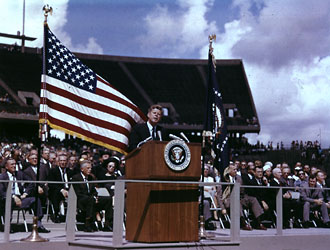
Cancer knows no boundaries, takes no prisoners and ensures its own destruction by ultimately killing its host.  War against such an enemy can likewise know no mercy.  ImagePresident Kennedy, in his famous speech at Rice University on September 12, 1962 wherein he committed the United States to reach the moon by the end of the decade said, “William Bradford, speaking in 1630 of the founding of the Plymouth Bay Colony, said that all great and honorable actions are accompanied with great difficulties, and both must be enterprised and overcome with answerable courage.”  Let neither great difficulties, nor politics dissuade us from reaching this “moon.”

The Confluence of Idealism and Pragmatism

Progress occurs when idealism and pragmatism merge.  However, whether due to the explosion of the internet, or globalization in general, rather than having a better understanding and acceptance of our fellow earthlings, we have splintered society to the point where we only associate with like-minded individuals or groups.  Discussion, debate and compromise have given way to intransigent positions and hatred of others.   All issues now have rabid followers with hardened stances, whether it is gun control, abortion, unions, welfare or UFO’s.   Carl Sagan wrote,

“The chief deficiency I see in the skeptical movement is its polarization: Us vs. Them — the sense that we have a monopoly on the truth; that those other people who believe in all these stupid doctrines are morons; that if you’re sensible, you’ll listen to us; and if not, to hell with you. This is nonconstructive. It does not get our message across. It condemns us to permanent minority status.”

(By the way, it was Richard Feynman who replied to the notion of UFO’s with this calculated response:

“…from my knowledge of the world that I see around me, I think that it is much more likely that the reports of flying saucers are the results of the known irrational characteristics of terrestrial intelligence than of the unknown rational efforts of extra-terrestrial intelligence.”)

No more fractious issue exists than abortion.  Since the Supreme Court’s decision was handed down on January 22, 1973, Roe v. Wade has been a lightning rod for generations and has resulted in a binary opinion status with their corresponding labels of “Pro Life” or “Pro Choice.”  No discussion, no debate, no compromise.  Passion runs deep on both sides.  Each side batters society with horror stories and images designed to persuade an imaginary, nonexistent, undecided populace.

In response to the image below, my son has attempted to suppress emotion and rely on fact to convey a rational position.

Here, for your consideration, is my guest blogger’s post:

Claims:

1. Abortion is murder

2. Liberals “want to force taxpayers to pay for her to be killed”

3. Liberals value the egg of an eagle more than a human fetus

4. The punishment for murdering an eagle is greater than that of infanticide

Responses:

1.  Abortion is not infanticide. Abortion ends the life of a fetus, but it is not murder. Abortion is not murder in any sense of the word other than the biological. Personhood does not begin at conception. The death of a fetus can in no way be equated to the death of a conscious adult.

Mary Ann Warren, in her article “On the Moral and Legal Status of Abortion” identifies five traits that differentiate personhood from merely the biological definition of being a person. These are consciousness, reasoning, self-motivated activity, the capacity to communicate, and the presence of self-concepts. Neither a human fetus nor an eagle fetus possesses these qualities. Therefore, the fetus is not a person and the eagle fetus is not an eagle. To equate abortion to murder, especially using such a juvenile and slanted phrase as “not only is it legal to kill her” does nothing but cheapen and delegitimize the “pro-life” argument.

2.  Three percent of all Planned Parenthood health services are abortion services. Other services provided by Planned Parenthood:

– Preventing more than 584,000 unintended pregnancies annually

– Providing 770,000 Pap tests and 750,000 breast exams annually

– Providing more than four million tests and treatments for sexually transmitted infections annually

– Providing educational programs for more than 1.1 million young people and adults annually

http://www.plannedparenthood.org

“The Hyde amendment, passed in 1976, excludes abortion from the comprehensive healthcare services provided to low-income people by the federal government through Medicaid.”

ACLU – “Public Funding for Abortion”

“If a woman chooses to carry to term, Medicaid (and other federal insurance programs) offer her assistance for the necessary medical care. But if the same woman needs to end her pregnancy, Medicaid (and other federal insurance programs) will not provide coverage for her abortion, even if continuing the pregnancy will harm her health.”

ACLU – “Public Funding for Abortion”

The Supreme Court case ‘Webster v. Reproductive Health Services’ ruled that states were not required to fund abortions that were not medically necessary.

The duty of the government is not to bow to the bigotry of religious groups or overpowered lobbies. Individual objections are not enough to deem abortion legal or illegal. The simple truth is that abortion is the choice of the woman. No panel of elderly men or amount of Bible quotation can be allowed to strip this right from women. Responsibility and freedom cannot be political footballs, only mentioned when they are convenient.

3.  Liberals support a woman’s choice, not the denial of all human potential. The debate is over potential human life, not the “slaughter of babies”. Every prominent Supreme Court ruling has agreed with this, rejecting the “fetus’ right to life” argument.

4.  Infanticide is prosecuted as homicide. Killing bald eagles is not. The chief difference here, which should be obvious, is that eagles are not people. They do not have Warren’s five qualities of personhood. Yes, bald eagles were taken off of the endangered species list in 2007, but those who kill them do face possible prison time and fines. Any person who kills another person faces a lot more than a fine, and rightly so. Animals do not have more rights than humans. Abortion has nothing to do with the economy. Government funds are disallowed from funding abortions.

The proposed laws changing the punishments for infanticide are based on mental health studies and illnesses. Referencing them in this to prove the conservative position is completely inappropriate here.

Conclusion

The comparison between the egg of an eagle and a fetus is inflammatory. Every position or fact in this picture is exaggerated. It paints liberals as hateful murderers and conservatives as the moralistic, enlightened few. Abortion is legal in the United States of America. I can only hope that this continues to be true. The current trend of conservatives having medieval stances on social issues can do nothing but slow progress in civil rights. Abortion is not infanticide. Abortion is not murder in the comparative sense that this photo implies. In the history of The United States, when has the side of freedom and choice not won in the end? The bigots and the judgmental have an alarming habit of converging on one side where abortion is concerned. The loudest voices among us are not always correct.